What Are You Carrying?

For the week of February 28, 2026 / 11 Adar 5786
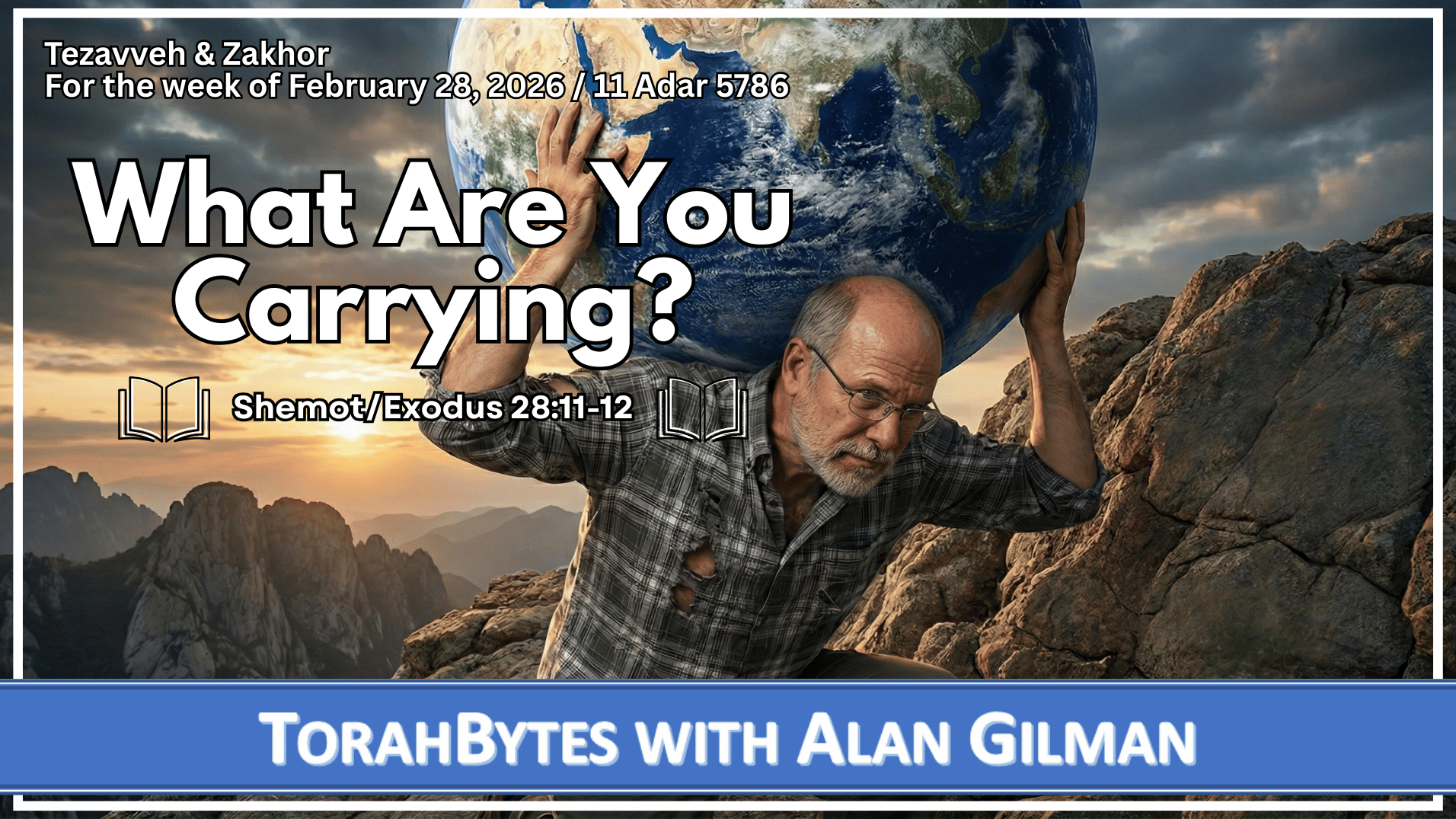
Message information along with an illustration of podcast host trying to carry the world on his shoulders

Tezavveh & Zakhor
Torah: Shemot/Exodus 27:20 – 30:10; D’varim/Deuteronomy 25:17-19
Haftarah: 1 Samuel 15:2-34
Originally posted the week of March 7, 2020 / 11 Adar 5780 (revised)

As a jeweler engraves signets, so shall you engrave the two stones with the names of the sons of Israel. You shall enclose them in settings of gold filigree. And you shall set the two stones on the shoulder pieces of the ephod, as stones of remembrance for the sons of Israel. And Aaron shall bear their names before the Lord on his two shoulders for remembrance. (Sh’mot/Exodus 28:11-12)

This week, we look at one particular aspect of the elaborate garb of the Cohen HaGadol (English: Chief or High Priest). Over his main clothing, he was to wear an ephod, an apron-like overgarment with special spiritual significance. On each of the ephod’s shoulder pieces was a stone with the names of the twelve tribes of Israel. We read: “Aaron” (meaning he and his successors) “shall bear their names before the Lord on his two shoulders for remembrance” (Sh’mot/Exodus 28:12). The Cohen Hagadol, therefore, literally carried the names of the tribes into the presence of God.

It isn’t clear whether the “remembrance for the sons of Israel” refers to the need for the Cohen HaGadol to remember the people of Israel in his priestly service, or if, in his priestly service, he was bringing the people of Israel to the remembrance of God. Either way, he was symbolically carrying the weight of the nation on his shoulders. That this was symbolic makes what he was doing no less real. He obviously wasn’t carrying the people themselves on his shoulders, but the burden of the cares of the nation is a heavy burden—one that would intensely affect most people.

Like the Cohen HaGadol, we carry burdens on our shoulders. Any responsibility, be it family, job, community, and so on, is a burden—a burden that may or may not feel burdensome, but a burden nonetheless.

God had clearly placed the people of Israel on the Cohen HaGadol’s shoulders. What you and I are to carry, however, may not be so clear. At times, we find ourselves overwhelmed by the cares and concerns of others. I suggest we take the time to ask God, whether or not these are our assigned burdens or if we have mistakenly put them on ourselves.

Sometimes we carry burdens God has given us, but we make them heavier than they really are. We might misunderstand the nature of the responsibility, leading us to take misguided courses of action. It is important to let God clarify for us how he wants us to do the things he gives us to do. Don’t be deceived into thinking that going extreme on something is the same as being faithful to God. Doing more than we should can be as destructive as neglect.

Frankly, I don’t know how common this is, but you might find this helpful. At times, I have felt burdened without knowing what I am burdened with. I find myself feeling heavy, thinking that I am personally struggling emotionally, when actually God is placing a concern on my heart for someone else. When you find yourself carrying a weight, but don’t know what it is, as in everything else, ask God what is going on. You might be bearing the burden of another. If so, then ask him what he wants you to do about it.

While very few are called, like the Cohen HaGadol, to carry the burden of an entire nation, what has God placed on your shoulders? Unlike those who find themselves overly burdened or misunderstanding what it is they are carrying, perhaps you have been too busy to notice. Few carry the responsibility level of a Cohen HaGadol, but all people carry something. As bearers of God’s image, created by him to fulfill his plans and purposes on earth, we all have some part to play, some burden to carry, a responsibility to fulfill.

Yeshua said, “Come to me, all who labor and are heavy laden, and I will give you rest. Take my yoke upon you, and learn from me, for I am gentle and lowly in heart, and you will find rest for your souls. For my yoke is easy, and my burden is light” (Matthew 11:28-30). Often, when this is referenced, the lightness of his burden is emphasized so much that we forget there is still a burden to carry. What God calls us to do is not designed to crush us, but we are called to carry it.

Scriptures taken from the English Standard Version

Facebooktwitterredditpinterestlinkedinmail

God Is in the House

For the week of February 21, 2026 / 4 Adar 5786

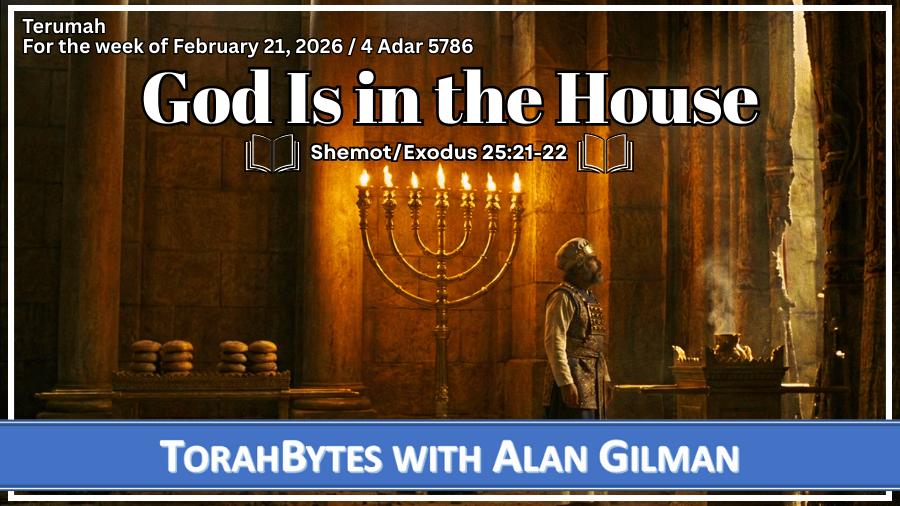
Message info over a depiction of the tearing of veil in the Jewish Temple mentioned in Matthew 27:51

Click image to view video version

Terumah
Torah: Shemot/Exodus 25:1 – 27:19
Haftarah: 1 Melachim/1 Kings 5:26 – 6:13 (English 5:12 – 6:13)
Originally posted the week of February 17, 2018 / 2 Adar 5778 (updated)

And you shall put the mercy seat on the top of the ark, and in the ark you shall put the testimony that I shall give you. There I will meet with you, and from above the mercy seat, from between the two cherubim that are on the ark of the testimony, I will speak with you about all that I will give you in commandment for the people of Israel. (Shemot/Exodus 25:21-22)

It’s fairly common to hear the God of the Old Testament contrasted with the God of the New. Even among those who would never dare to say that these constitute two very different beings, they may as well, given how common it is to mischaracterize what many view as irreconcilable depictions of this one God. There are indeed key contrasts between the Hebrew Scriptures and the New Covenant Writings vis-à-vis the divine. The differences, however, are not in God himself. But, rather, in his relationship to human beings.

To the casual reader, the Hebrew Scriptures seem to depict a God who is distant, while the New Covenant Writings portray him as approachable. That is somewhat true, because on our own, we are not fit to approach him. This is not due to his aloofness, as if he is sitting far away in heaven, nor a disinterest in human affairs. Far from it! As he revealed himself to the people of Israel within the covenant given at Mount Sinai, we see him anxious to live among his precious human creatures.

The entire Sinai covenant system was built upon the centrality of God’s dwelling place. God directed Moses to construct a mobile structure called the “mishkan” (English: tabernacle). It was here that the sacrifices and other worship rites were to be exclusively performed. Mishkan means “dwelling.” It was the precursor of the temple, which in Hebrew is “bayit,” the word for “house.” It is difficult to say whether God’s taking up residence in the mishkan was metaphorical or literal. It is probably both in some ways and not in others. Regardless, the people of Israel were to understand that the Master of the Universe was among them.

Inside the mishkan, in its innermost sanctum, called the “kodesh ha-k’dashim” (English: Holy of Holies), was a special golden chest, called the “aron ha-b’rit” (English: the Ark of the Covenant). On top of the aron ha-b’rit was the “kapporet” (English: “cover,” traditionally referred to as “the mercy seat”). As we read at the beginning, it was here that God would meet and speak with Moses. It would be here that the Cohen HaGadol (English: the Chief Priest) would appear before God once a year on Yom Kippur (English: the Day of Atonement).

That God was in the house was an essential element of ancient Israeli society. God is not a concept, but an actual personal being (the Being of all Beings, we can say). Obedience to his Word, even then, was not simply cold adherence to abstract principles, but the reasonable response to the reality of his presence. Everything that the people did or didn’t do was in response to him being in the house.

One of the dramatic developments within the New Covenant is that God’s presence is no longer confined to the ancient house, be it the mishkan or the temple. This is illustrated by the miraculous tearing of the curtain that separated the Holy of Holies from the rest of the house (see Matthew 27:51, Mark 15:38, Luke 23:45). This occurred immediately following Yeshua’s death to demonstrate that his sacrifice not only provided access to God for people of all nations, but that God’s presence was being unleashed throughout the entire world.

Through the New Covenant, the God of Israel is no longer exclusive to the people of Israel. In a sense, he never was. Not only did the calling of Israel through Abraham always have the nations in mind, but the Hebrew Scriptures are clear that God was neither nationalistic nor regional. It’s due to the human condition that the world wasn’t ready for his presence.

Since Yeshua’s death and resurrection, God’s presence has manifested throughout the earth in a most personal way. While most people seem to be blind to his taking up residence within his creation, he is no less present. God is in the house—the world he has made—yet we too often ignore him. We think we can get away with doing our own thing our own way, as if he will not call each and every one of us to account. He is doing far more, speaking far more, and responding far more than we care to admit.

We are not alone. God is in the house.

All scriptures, English Standard Version (ESV) of the Bible

Facebooktwitterredditpinterestlinkedinmail

Where Is Heaven?

For the week of February 14, 2026 / 27 Shevat 5786

Message info over a mountain hiking scene

Click image to view video version

Mishpatim & Shekalim
Torah: Shemot/Exodus 21:1 – 24:18; 30:11-16
Prophets: 2 Melachim/2 Kings 12:1-17
Originally posted the week of February 25, 2017 / 29 Shevat 5777 (revised)

Then Moses and Aaron, Nadab, and Abihu, and seventy of the elders of Israel went up, and they saw the God of Israel. There was under his feet as it were a pavement of sapphire stone, like the very heaven for clearness. And he did not lay his hand on the chief men of the people of Israel; they beheld God, and ate and drank. (Shemot/Exodus 24:9-11)

One of the most intriguing incidents in the Torah is when Moses, his brother Aaron, two of Aaron’s sons, and seventy elders ate with God. The references to seeing and beholding God seem to contradict God’s later statement to Moses about not seeing his face (see Shemot/Exodus 33:20). But in both occasions, there seems to be a seeing but not seeing happening at the same time. In the latter story, Moses is told that he can’t see God’s “face,” but only his “back” (Shemot/Exodus 33:23). How literally this is to be taken, we don’t know. It is reasonable to assume that seeing God’s face as opposed to his back is a reference to various levels of encountering his presence in the material realm. Human beings, due to our alienation from God, can only tolerate his revealing himself to some extent, a fullness of which would result in death. This explains the reaction of surprise by people such as Jacob, Gideon, Samson’s parents, and Isaiah, who have encountered God in some physical sense and yet survived (e.g., Bereshit/Genesis 32:30; Shoftim/Judges 6:22-23; 13:22, Isaiah 6:5).

A hint that Moses and company in this instance didn’t see God in his fullness is the mention of “his feet” and the appearance of the ground underneath him. If they saw more than that, one would think that there would be additional, more graphic things to describe.

Experiencing the presence of God, or the lack thereof, is a recurring theme in Scripture. The early pages of the Bible describe God mingling with people (see Bereshit/Genesis 3:8). Adam and Eve’s exile from the Garden of Eden for their rebellion against their Creator marks the beginning of our alienation from him. And yet God is not entirely absent. His contact with human beings from that time on is primarily verbal (however that worked) with a few dramatic and more intimate encounters such as the ones I have mentioned.

The directives God gave to Moses for building the Mishkan (English: Tabernacle), the precursor to the Temple, indicate God’s desire to dwell with his people. On one hand, he was understood to be in the people’s midst, but on the other hand, he was hidden from them behind the veil in front of the Mishkan’s inner sanctum, “the Holy of Holies.”

But doesn’t God live in a completely other place called “heaven”? Both the experience of eating with God and God’s presence within the Mishkan tell us something different. Heaven isn’t way out there somewhere. Rather, it’s where God is. Understanding heaven as far away is a way of speaking to describe the separation of God’s realm from the world in which we live. Yet the Bible teaches that the heavenly realm breaks in from time to time. And one day, the heavenly and earthly realms will co-exist harmoniously as God always intended, when the New Jerusalem is established on earth (see Revelation 21). What Moses and company had was a taste of this age to come.

Whenever and however that will be, we can access heaven now. That’s what happens when God’s Spirit takes up residence in us. The Messiah’s sacrifice and his defeat of death through his resurrection create access to heaven beyond anything experienced prior to his coming, Moses and company’s experience included. Heaven, the realm of God, is not something we must wait to experience when we die; it can be our lived experience now, by putting our trust in the Messiah, Yeshua.

All scriptures, English Standard Version (ESV) of the Bible

Facebooktwitterredditpinterestlinkedinmail

Greater

For the week of February 7, 2026 / 20 Shevat 5786

Message information along with TorahBytes host, Alan Gilman, with Mount Sinai in the background

Click image to view video version

Yitro
Torah: Shemot/Exodus 18:1 – 20:23
Haftarah: Isaiah 6:1 – 7:6; 9:5–6
Originally posted the week of January 26, 2019 / 20 Shevat 5779 (revised)

Now I know that the LORD is greater than all gods… (Shemot/Exodus 18:11)

There are different kinds of knowing. In certain contexts, knowing God doesn’t necessarily mean having a personal relationship with him. For the Egyptians to know the God of Israel is to say that they experienced the reality of his character and ability as a result of the incident of the Red Sea. Moses’ father-in-law, Jethro, on the other hand, uses the same word for knowing, yada, differently. He didn’t experience God’s power first-hand as the Egyptians did. Rather, he received this knowledge through Moses’ retelling of the events: “Then Moses told his father-in-law all that the LORD had done to Pharaoh and to the Egyptians for Israel’s sake, all the hardship that had come upon them in the way, and how the LORD had delivered them” (Shemot/Exodus 18:8). Yet simply hearing the stories of what happened had a greater impact on him than the impact of what the Egyptians experienced had had on them. Even though the Egyptians personally experienced the reality of God’s power and observed his favor extended to the Israelites, it made no lasting difference in their lives. Jethro, on the other hand, truly learned something, the realization “that the LORD is greater than all gods.”

We don’t know how far Jethro went with this knowledge. He was a priest of Midian (see Shemot/Exodus 3:1). And yet, following his realization, he brought offerings to God in fellowship with Aaron and the elders of Israel. This is followed by Moses receiving some helpful administrative advice from him. Then he returned home, which is the last we hear of him in the biblical record. Did he forsake the Midianite gods and establish an outpost of Truth outside of the community of Israel? We don’t know. He is regarded as the chief prophet of the Druze religion, but there is no biblical support for this.

Whatever the rest of his life looked like, we do have what he said. Through Moses, he came to know that the God of Israel is greater than all gods. For readers of the Bible, this is the most basic of truths. The God of Israel is God alone. Nothing or no one compares. In fact, other gods are not really gods even though they may be called gods. In some cases, they are figments of people’s imaginations. In other cases, they are demonic or natural forces that are given god-like status. Jethro’s statement appears to reflect the common belief that other so-called gods did exist. Yet, none match the greatness of the God of Israel.

Do you agree with him? In keeping with biblical truth, you may reject the notion of other lesser gods. Still, there are other personal and impersonal forces at work in the world that we encounter every day of our lives. We may or may not think of them as gods or any kind of entity whatsoever, but they do seek to assert power over us. We may call them circumstances and problems, or more positively, opportunities. Endless books have been written to help us overcome negative forces and leverage positive ones to prevent harm and achieve success. Based on how much time, energy, and money we spend engaging with these forces, I sometimes wonder whether we actually believe that God is truly greater.

Depersonalizing the myriad forces in the world doesn’t necessarily reduce their control over our lives. We need to ask: who or what concerns us most in life? Is it money, relationships, our job situation? Maybe it’s ourselves. As I have struggled to truly know God for who he is, I have often lamented over myself as being my greatest problem. That might even be biblical. Don’t we have to put off our old nature, for example? Yes, but when we think that the remnants of ungodliness (or however we may express our issues) have the upper hand, then do we not deny Jethro’s assertion that God is greater?

Whether it be our own selves or any other forces, whenever we assert that they have more power and influence than the good and loving God of the Bible, then we not only ascribe god-like status to them, but we also elevate them above the One whom we claim to worship. And speaking of worship, focusing on these forces in the way we do, whether cowering under their threats or overly investing in them for our benefit, that’s worship.

We don’t know what Jethro did with his realization “that the LORD is greater than all gods.” Perhaps he had a wonderful spiritual experience with Moses and company, and then, after going home, it was business as usual. But what about you and me? If we know that God is greater than every other force in life, is it going to be business as usual? The same old patterns, the same old fears, the same old tactics? Or are we going to make the appropriate adjustments and live life based on the truth that God is greater than all gods?

Scriptures taken from the English Standard Version

Facebooktwitterredditpinterestlinkedinmail