Acknowledging Israel

For the week of April 25, 2026 / 8 Iyar 5786

Message information along with TorahBytes host, Alan Gilman, over a flying Israeli flag

Click image to view video version

Aharei Mot & Kedoshim
Torah: Vayikra/Leviticus 16:1 – 20:27
Haftarah: Amos 9:7-15
Originally posted the week of April 29, 2023 / 8 Iyar 5783 (revised)

I will restore the fortunes of my people Israel, and they shall rebuild the ruined cities and inhabit them; they shall plant vineyards and drink their wine, and they shall make gardens and eat their fruit. I will plant them on their land, and they shall never again be uprooted out of the land that I have given them,” says the LORD your God. (Amos 9:14-15; ESV)

Beginning Tuesday evening this week (April 15, 2026), Yom Ha’atzmaut, Israel Independence Day, begins. This year marks seventy-eight years since the establishment of the modern state of Israel. I may be wrong, but it seems to me that the vast majority of people in the world who claim strong adherence to the Bible see no relation whatsoever between Scripture and the reemergence of Israel as a geopolitical entity. You can probably guess already that I don’t agree.

First, let me say that anything I list as support for a biblical basis for God’s ongoing faithfulness to the Jewish people, including our return to our ancient homeland, does not justify everything Israel has done prior to or during the past seventy-eight years. But can anyone tell me why I even need to say this? Don’t we know that everyone and everything in this world is a mixed bag? Of all people, those of us who value Scripture must be aware that God uses broken vessels. Abraham, Isaac, Jacob, Moses, and David all had issues. But if anything, their issues powerfully demonstrate God’s faithfulness both to them as individuals and to Israel as a nation. And yet, for some reason, the majority of the Church tends to regard Israel’s sins as unpardonable despite innumerable promises to the contrary. This week’s Haftarah (weekly reading portion from the Prophets) is but one of many examples that clearly establish God’s commitment to preserve Israel and fulfill its glorious destiny. Yet this doesn’t stop a majority of Christians from irresponsibly reading “the Church” into these promises. If that’s not bad enough, at the same time they are content to leave the judgment aspects with the Jewish people.

There are at least two factors at work here. The first is anti-Jewish sentiment. As the Church went from an exclusively Jewish movement to an exclusively non-Jewish one, non-Jewish leaders brought their ingrained disdain for Jewish people with them, unchecked. As a result, they happily affirmed scriptural critique of Israel, while deflecting God’s messages of love, concern, assurance, and restoration solely to themselves. The second factor is the misapplication of the concept of ingrafting that Paul expounds in Romans, chapter eleven. The inclusion of the nations in the Gospel is something Paul calls, in Ephesians chapter three, a mystery (see Ephesians 3:1-6). No one expected God’s blessings to be extended to non-Israelites through the Messiah in the way God always intended. But instead of receiving this undeserved grace with humility, they quickly developed a “new kid on the block” attitude, an attitude Paul adamantly warned against in Romans 11 (see Romans 11:18).

The Jewish people have endured great suffering due to the Church’s unwillingness to grasp the scriptural complexity of God’s commitment to Israel. Messiah’s coming emerged out of God’s faithfulness to Israel in order to resolve, once and for all, their alienation from God due to ongoing disobedience. But no one anticipated how this would fulfill God’s promise to Abraham to bless the nations, while also working to restore Israel to himself and to their land.

For some reason, many Christians are fine with a god (note the lowercase “g”), who is willing to receive outsiders but doesn’t have it in him to preserve and restore his own covenant people. I am aware of parables spoken to certain Jewish leaders, warning them of being cast out, while Gentiles will be let in. At an individual level, that’s true. But it is wrong to paint this as Jews vs. Gentiles. Instead, it’s between the arrogant and the humble, whoever or wherever they may be. This is why Paul would write: “For if you were cut from what is by nature a wild olive tree, and grafted, contrary to nature, into a cultivated olive tree, how much more will these, the natural branches, be grafted back into their own olive tree” (Romans 11:24; ESV).

“Their own olive tree.” Does it bother you that God’s inspired Word calls it Israel’s tree? You can redefine Israel all you like by turning the olive tree into “the Church,” but I hope it isn’t too long before you see how ridiculous that is. I don’t mean to offend anyone. It’s just that the biblical promises to my people have been misappropriated by most of the Church for far too long.

Scriptures taken from the English Standard Version

Facebooktwitterredditpinterestlinkedinmail

When Nonsense Will Be No More

For the week of April 18, 2026 / 1 Iyar 5786

Message info along with TorahBytes host, Alan Gilman, and nonsensical cartoon creatures

Click image to view video version

Tazria & Metzora
Torah: Vayikra/Leviticus 12:1 – 15:33; B’midbar/Numbers 28:9-15
Haftarah: Isaiah 66:1-24
Originally posted the week of April 22, 2023 / 1 Iyar 5783 (revised and expanded)

For as the new heavens and the new earth that I make shall remain before me, says the LORD, so shall your offspring and your name remain. (Isaiah 66:22)

This week’s Haftarah (portion from the Hebrew Prophets) is special because the new Jewish month begins this week on Shabbat. It is the second of two references in Isaiah to “the new heavens and the new earth” that God will create (the first occurring in Isaiah 65:17). The renewal of the entirety of creation is central to the overall story of the Bible. From the beginning, God determined he would not allow the cursed state of affairs resulting from our first parents’ disobedience to be permanent. From the first hint of restoration in Bereshit/Genesis 3:15, which foretells the eventual destruction of the serpent and all it represented to God’s promise to Abraham in Bereshit/Genesis 12:3, anticipating world-wide blessing (compare Galatians 3:8) to various other prophecies to Israel and their implications for the nations, Isaiah’s summation in terms of universal renewal should be of no surprise.

Contrary to popular misconception, the expectation of the new heavens and new earth was never to be understood as God’s intent to destroy the material realm. Far from it! God was and is committed to his creation project. What is to be destroyed will be all the evil forces that have worked to undermine the essential goodness of God’s plans and purposes. A day is coming when the universe will be fully and forever set right.

To deny God’s intentions for the material realm distracts from an accurate biblical understanding of the world we live in. Biblically minded people may be surprised, if not offended, to be told that our tendency to degrade the creation by denying the God-given goodness of the material realm has contributed to the growing tendency of much of today’s culture in its embrace of nonsense.

We live in a world of design, God’s design. Despite its cursed state, the creation is based on divinely intended principles. Denying these principles denies reality, nonsense in other words. C.S. Lewis, in his book The Problem of Pain, eloquently explains that the only thing that God can’t do is nonsense. He writes:

His [that is, God’s] Omnipotence means power to do all that is intrinsically possible, not to do the intrinsically impossible. You may attribute miracles to him, but not nonsense. There is no limit to His power. If you choose to say “God can give a creature free-will and at the same time withhold free-will from it,” you have not succeeded in saying anything about God: meaningless combinations of words do not suddenly acquire meaning simply because we prefix to them the two other words “God can.” It remains true that all things are possible with God: the intrinsic impossibilities are not things, but nonentities. It is no more possible for God than for the weakest of His creatures to carry out both of two mutually exclusive alternatives; not because His power meets an obstacle, but because nonsense remains nonsense even when we talk it about God.

The universe we live in has both material and non-material aspects. But nonsense doesn’t exist; nor can it.

Yet, that doesn’t stop human beings from pretending that it does. I attribute this phenomenon to the wonderful God-given gift of imagination. Imagination is a key dynamic involved in creativity. It is imagination that enables us to problem solve, to explore possibilities, and to expound the complexities of life and the universe in extraordinary ways. What imagination on its own cannot do is determine what is good and right. When imagination is allowed to run amok, untethered from the realities of our universe, untold destruction is the result.

Asserting “anything is possible” or “you can be anything you want to be” is helpful when facing legitimate injustice or badly perceived obstacles. All sorts of beneficial innovations have been discovered and effectively implemented due to such optimistic attitudes. Accepting our inability to fly was reasonable until someone allowed their imagination to develop flying machines. But to imagine we can fly without such a device is outside the realm of God-established reality. To believe we could would be nonsense. Attempts to do so would result in destruction.

Nonsense has beset the human family from the time Adam and Eve accepted the serpent’s claim that God was lying to them. Whether we ascribe power to idols or believe being rich will make us happy, or that being popular will give us self-esteem, or pretending we were born in the wrong body, nonsense has always set us in a destructive direction.

The establishment of the new heavens and the new earth will mark the time when nonsense will be shown for what it really is. No longer will reality be ignored as God unveils the full essence of his design forever. Until then, we have the opportunity and responsibility to reflect the creation’s destiny by navigating our broken world through the truth of God’s Word, under the forgiveness of the Messiah and the power of the Ruach HaKodesh (English: the Holy Spirit). Imagine that!

Scriptures taken from the English Standard Version

Facebooktwitterredditpinterestlinkedinmail

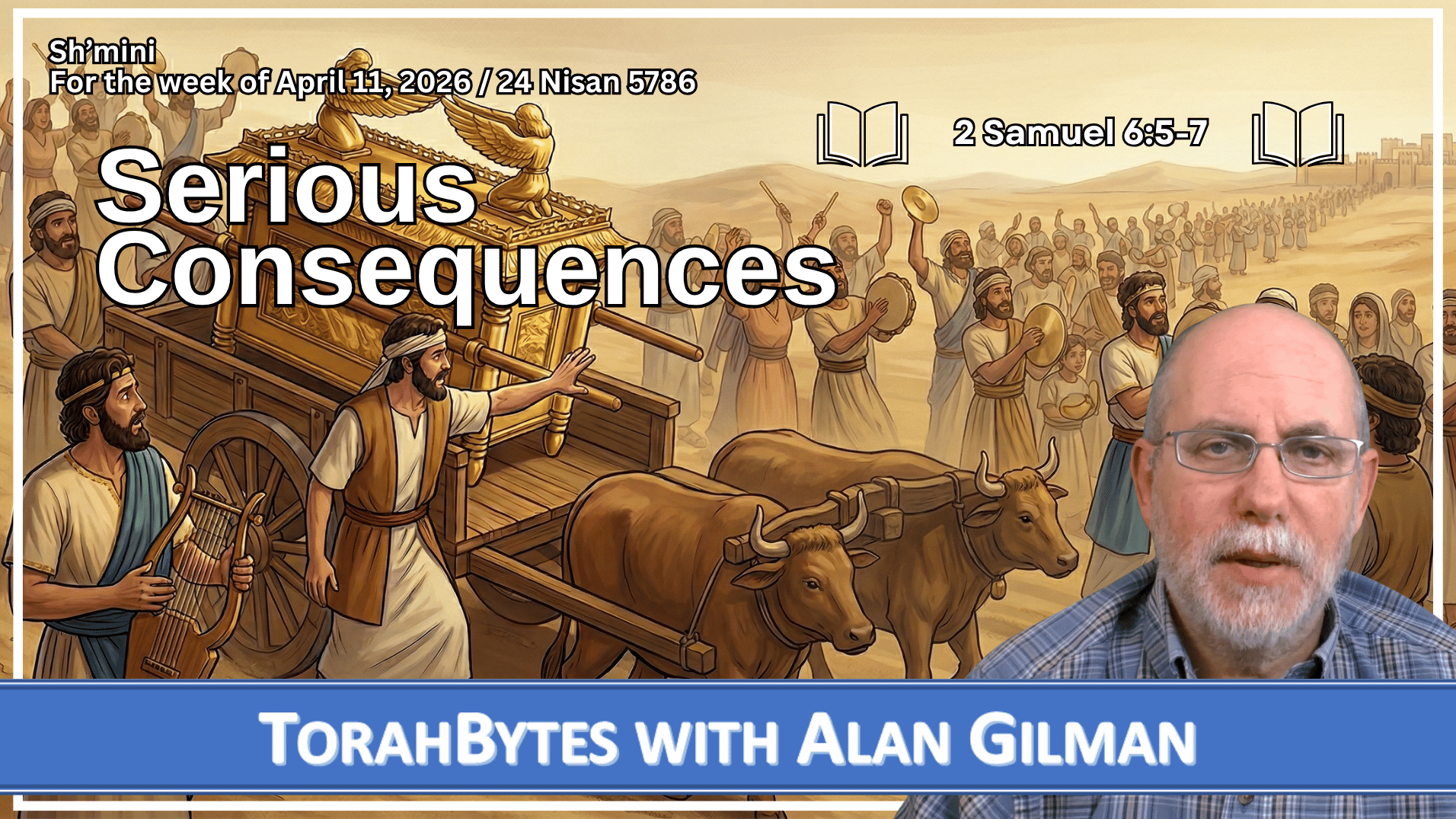
Serious Consequences

For the week of April 11, 2026 / 24 Nisan 5786

Message info and TorahBytes host, Alan Gilman, over the biblical scene of Uzzah about to stabilize the Ark of the Covenant

Click image to view video version

Sh’mini
Torah: Vayikra/Leviticus 9:1 – 11:47
Haftarah: 2 Samuel 6:1 – 7:17
Originally posted the week of April 10, 2021 / 28 Nisan 5781 (revised)

And David and all the house of Israel were celebrating before the LORD, with songs and lyres and harps and tambourines and castanets and cymbals. And when they came to the threshing floor of Nacon, Uzzah put out his hand to the ark of God and took hold of it, for the oxen stumbled. And the anger of the LORD was kindled against Uzzah, and God struck him down there because of his error, and he died there beside the ark of God. (2 Samuel 6:5-7; ESV)

The connection between this week’s parsha (weekly Torah reading portion) and its associated haftarah (excerpt from the Prophets) is very clear. The parsha includes the death of two of Aaron’s sons for their inappropriate offering. The haftarah also includes a death due to a mishandling of one of God’s most specially set-aside objects. It was during David’s first attempt to bring the Ark of the Covenant to Jerusalem. When the cart upon which it was being transported tipped, a man by the name of Uzzah attempted to stabilize it, and God struck him dead as a result.

The Torah incident doesn’t provide us with the specifics as to what Aaron’s sons did wrong. All we know is that it was, in Hebrew, “zur” (“strange” or “unauthorized”); in other words, outside of that which was prescribed. The context suggests they may have been drunk. We don’t know if that in itself was what was deemed unacceptable and deserving of death, or if drinking led them to make a bad decision.

In the case of the haftarah, however, the reason for the extreme result is much clearer. David had directed his people to transport the Ark in an unauthorized way. Instead of following the Torah protocol of carrying it on poles by Levites, they transported it on an ox cart. We see the acknowledgment of this error sometime later when they resumed the plan; this time in keeping with Torah. The reason for the change of transport method is more explicit in the parallel passage found in 1 Divrei Ha-Yamim/1 Chronicles 15:1–2.

These are two examples of Bible stories that fall into my “don’t like it” category. I am not alone. Aaron, who lost his two sons, was understandably grieved, while David was upset and wouldn’t continue the journey with the Ark until sometime later. Yet, as I struggle with these and other unpleasant incidents in Scripture, I realize that life is full of things that I don’t like.

I have heard statements such as “I could never believe in a god who”—referencing stories like these. It seems to me that such sentiments are loaded with all sorts of additional assumptions. There is likely little to no understanding of the reasons behind such extreme consequences. Plus, little to no acknowledgment or understanding of God’s complex nature, purposes, and plans that could provide the necessary context for such serious consequences.

Whatever one’s relationship is to the God of the Bible, life is full of serious consequences. I am aware that much of such harshness is inexplicable. But, at the same time, how much trouble have we gotten ourselves into because we haven’t taken life as seriously as we ought? At times, this ignorance is at an individual level, as was the case with Aaron’s sons. It appears they should have known better themselves. In Uzzah’s case, he suffered due to the leadership’s irresponsible handling of the situation.

We could learn to accept the way the world God made works, or choose to reject the God who created such an environment for human beings. More and more people insist that we need a type of freedom that ignores the consequences of our actions. Our government may protect and/or mandate all sorts of preferences and/or lifestyles. But that will never change the way things actually work. Not doing things God’s way has serious consequences.

Scriptures taken from the English Standard Version

Facebooktwitterredditpinterestlinkedinmail