For the week of December 20, 2025 / 30 Kislev 5786
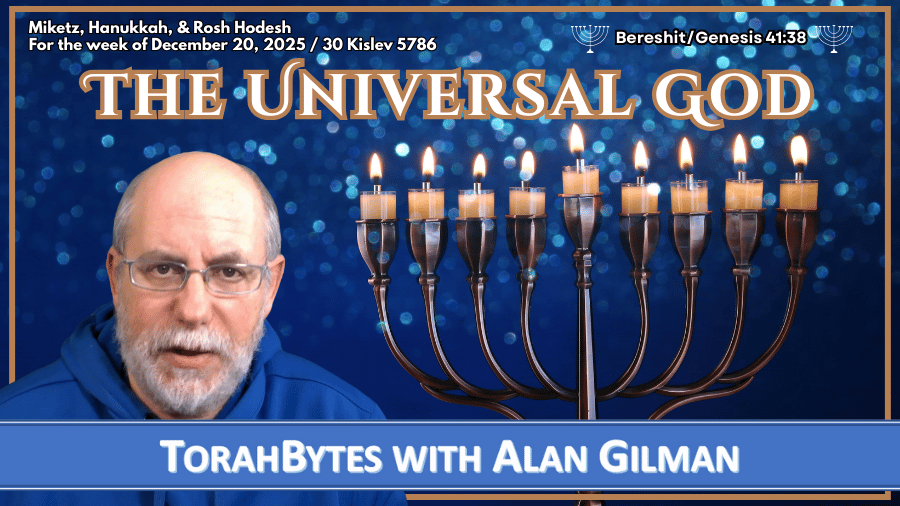
Click image to view video version
Miketz, Hanukkah, & Rosh Hodesh
Torah: Bereshit/Genesis 41:1 – 44:17; B’midbar/Numbers 28:9–15, 7:42–53
Haftarah: Zechariah: 2:14 – 4:7 (English: 2:10 – 4:7)
And Pharaoh said to his servants, “Can we find a man like this, in whom is the Spirit of God?” (Bereshit/Genesis 41:38)
The dominant Hanukkah theme is light (Hanukkah this year occurs from Sunday evening, December 14, through December 22). It might surprise you to learn that the light theme doesn’t originate from the legend of the miraculous provision of oil, which likely didn’t happen, but from the altar rededication celebration that was patterned after the eight-day feast of Sukkot (English: Booths), which probably hadn’t happened that year due to the desecration of the Temple by the pagan oppressors. By that time, kindling great lights in Jerusalem had become part of the Sukkot observance. Referencing Hanukkah as the “Festival of Lights” is first recorded by the Jewish historian Josephus in the first century CE.
Despite the lack of evidence for the oil miracle, it’s fitting that light is still a central theme of Hanukkah. Dark assimilating forces were having their way in Israel at that time. Throughout history, despite our supposed disdain for tyrannical despots, people have welcomed various forms of empire-building. We prefer to go along with the latest popular thing, rather than fully embrace our unique ethnic and individual diversity in the way God designed us.
In contrast to the prevailing mood of their day, the Maccabees bravely shone the light of God, leading the people of Israel back to their unique, God-given destiny to stand out as lights in a dark world.
According to this week’s parsha (weekly Torah reading), Joseph, too, was such a light. After enduring years of darkness due to his brothers’ jealous betrayal, he became an illuminating force not only in Egypt but also throughout the region, including to his own extended family, who had been destined to be the light of the world. His willingness to be used by God in interpreting Pharaoh’s dreams and his graciousness in arranging for the migration of his clan to Egypt were enormous blessings.
The brilliance of God’s light through Joseph was so great that Pharaoh, who didn’t know the God of Israel, recognized it. But what was it that he recognized? He indeed encountered the true light of the true God. He said to his servants, “Can we find a man like this, in whom is the Spirit of God?” (Bereshit/Genesis 41:38). Yet, as an Egyptian king, his allegiance was to other gods, false gods. When most of us read “God” here, I am guessing that we assume he is referring to the Bible God, the only God, the creator God, Joseph’s God, the God of Israel. But as an Egyptian king, he wouldn’t have had such an understanding. The Hebrew word translated as “God” here is elohim, which is actually a generic term used for both the one and only God and other gods as well. To Pharaoh, divine power was at work in Joseph, expressing itself in a most effective way.
Even though Pharaoh was not thinking of God the way the Scriptures assert, almost all English translations represent elohim here as “God,” with a capital “G,” which is the conventional way English expresses “the true God.” The only exception I can find so far is in the New American Standard family of translations that use “divine spirit” (all in lower case), which is much closer to Pharaoh’s intent.
While Pharaoh’s theology was ill-informed, he wasn’t entirely wrong. Even though he didn’t know the true God, Joseph’s God, he recognized the illuminating power of genuine prophetic insight. While Pharaoh didn’t fully understand the true source of light at work through Joseph, the divine power he recognized was that of the only true God. This might explain why so many English translations use “God” with a capital “G.”
However, his reference to elohim was not the true elohim. Pharaoh’s valid recognition of the reality of God in this case doesn’t in any way authenticate his spirituality. Since the one true God, the God of Israel, is also the universal God, any encounter with his reality is legitimate, even though a failure to associate his power with his person would skew an accurate perception of his identity. This is all to say that the use of the capital “G” is misleading. Pharoah did recognize the true divine power of the one and only God, but didn’t understand him as such.
Pharaoh’s inability to recognize the God of Israel would one day lead Israel into the darkness of bondage in Egypt until the light of God’s deliverance through Moses would dawn. As we celebrate Hanukkah this year, let us not only remember the miraculous victory of the Maccabees but also the call to illuminate the darkness around us with the brilliance of the truth of God’s Word.
All scriptures, English Standard Version (ESV) of the Bible




Thank you for shedding light on this rich, multi-layered subject matter.