For the week of February 21, 2026 / 4 Adar 5786
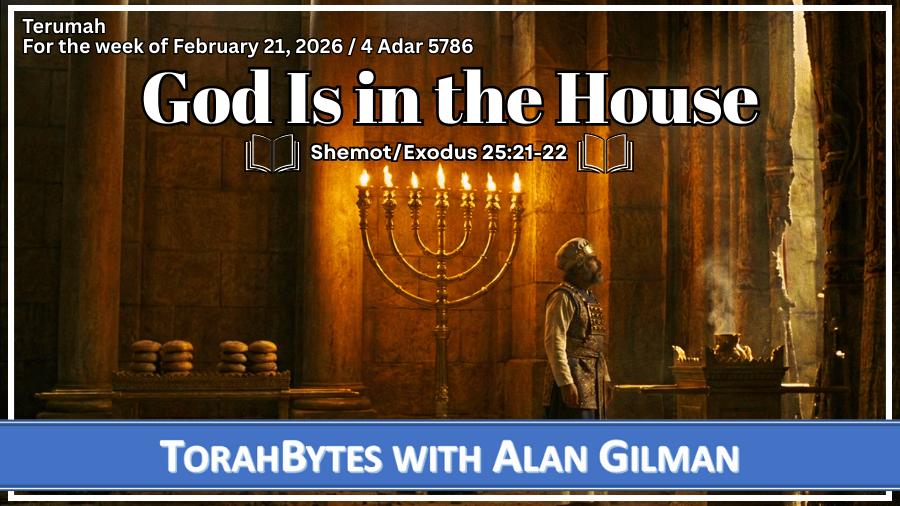
Click image to view video version
Terumah
Torah: Shemot/Exodus 25:1 – 27:19
Haftarah: 1 Melachim/1 Kings 5:26 – 6:13 (English 5:12 – 6:13)
Originally posted the week of February 17, 2018 / 2 Adar 5778 (updated)
And you shall put the mercy seat on the top of the ark, and in the ark you shall put the testimony that I shall give you. There I will meet with you, and from above the mercy seat, from between the two cherubim that are on the ark of the testimony, I will speak with you about all that I will give you in commandment for the people of Israel. (Shemot/Exodus 25:21-22)
It’s fairly common to hear the God of the Old Testament contrasted with the God of the New. Even among those who would never dare to say that these constitute two very different beings, they may as well, given how common it is to mischaracterize what many view as irreconcilable depictions of this one God. There are indeed key contrasts between the Hebrew Scriptures and the New Covenant Writings vis-à-vis the divine. The differences, however, are not in God himself. But, rather, in his relationship to human beings.
To the casual reader, the Hebrew Scriptures seem to depict a God who is distant, while the New Covenant Writings portray him as approachable. That is somewhat true, because on our own, we are not fit to approach him. This is not due to his aloofness, as if he is sitting far away in heaven, nor a disinterest in human affairs. Far from it! As he revealed himself to the people of Israel within the covenant given at Mount Sinai, we see him anxious to live among his precious human creatures.
The entire Sinai covenant system was built upon the centrality of God’s dwelling place. God directed Moses to construct a mobile structure called the “mishkan” (English: tabernacle). It was here that the sacrifices and other worship rites were to be exclusively performed. Mishkan means “dwelling.” It was the precursor of the temple, which in Hebrew is “bayit,” the word for “house.” It is difficult to say whether God’s taking up residence in the mishkan was metaphorical or literal. It is probably both in some ways and not in others. Regardless, the people of Israel were to understand that the Master of the Universe was among them.
Inside the mishkan, in its innermost sanctum, called the “kodesh ha-k’dashim” (English: Holy of Holies), was a special golden chest, called the “aron ha-b’rit” (English: the Ark of the Covenant). On top of the aron ha-b’rit was the “kapporet” (English: “cover,” traditionally referred to as “the mercy seat”). As we read at the beginning, it was here that God would meet and speak with Moses. It would be here that the Cohen HaGadol (English: the Chief Priest) would appear before God once a year on Yom Kippur (English: the Day of Atonement).
That God was in the house was an essential element of ancient Israeli society. God is not a concept, but an actual personal being (the Being of all Beings, we can say). Obedience to his Word, even then, was not simply cold adherence to abstract principles, but the reasonable response to the reality of his presence. Everything that the people did or didn’t do was in response to him being in the house.
One of the dramatic developments within the New Covenant is that God’s presence is no longer confined to the ancient house, be it the mishkan or the temple. This is illustrated by the miraculous tearing of the curtain that separated the Holy of Holies from the rest of the house (see Matthew 27:51, Mark 15:38, Luke 23:45). This occurred immediately following Yeshua’s death to demonstrate that his sacrifice not only provided access to God for people of all nations, but that God’s presence was being unleashed throughout the entire world.
Through the New Covenant, the God of Israel is no longer exclusive to the people of Israel. In a sense, he never was. Not only did the calling of Israel through Abraham always have the nations in mind, but the Hebrew Scriptures are clear that God was neither nationalistic nor regional. It’s due to the human condition that the world wasn’t ready for his presence.
Since Yeshua’s death and resurrection, God’s presence has manifested throughout the earth in a most personal way. While most people seem to be blind to his taking up residence within his creation, he is no less present. God is in the house—the world he has made—yet we too often ignore him. We think we can get away with doing our own thing our own way, as if he will not call each and every one of us to account. He is doing far more, speaking far more, and responding far more than we care to admit.
We are not alone. God is in the house.
All scriptures, English Standard Version (ESV) of the Bible