For the week of January 24, 2026 / 6 Shevat 5786
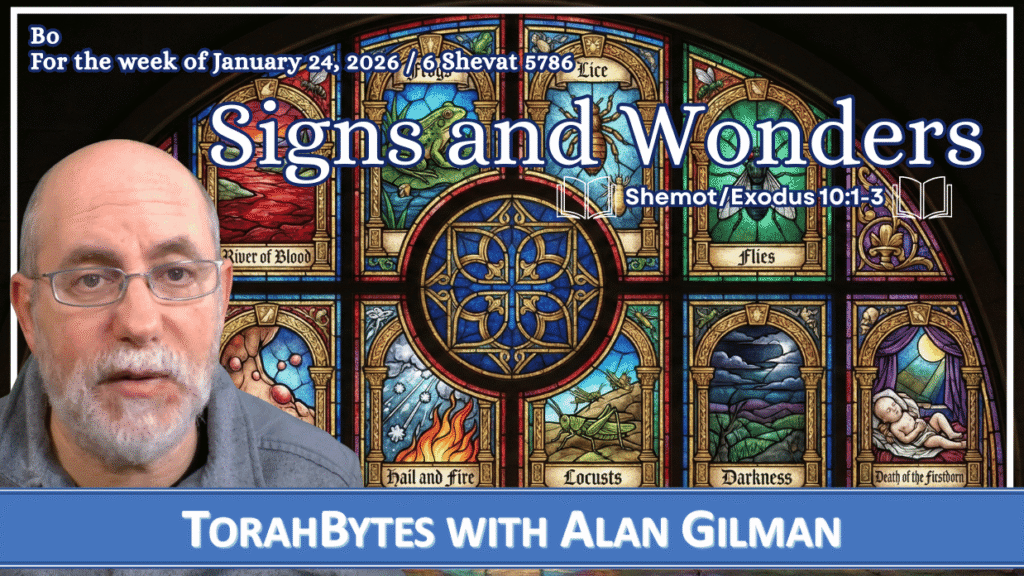
Click image to view video version
Bo
Torah: Shemot/Exodus 10:1 – 13:16
Haftarah: Jeremiah 46:13-28
Originally posted the week of January 24, 2015 / 4 Shevat 5775 (revised)
Then the LOED said to Moses, “Go in to Pharaoh, for I have hardened his heart and the heart of his servants, that I may show these signs of mine among them, and that you may tell in the hearing of your son and of your grandson how I have dealt harshly with the Egyptians and what signs I have done among them, that you may know that I am the LORD.” (Shemot/Exodus 10:1-3)
Last week and this week, the parashot (Torah reading portions) contain an extensive display of God’s power, commonly known as the ten plagues. You might be surprised to learn that the word “plague” (or more literally “strike”) is hardly used to describe these events. Throughout the Bible, the more common description is “signs” and “wonders” (see Shemot/Exodus 7:3, D’varim/Deuteronomy 6:2, Nehemiah 9:10, T’hillim/Psalm 135:9, and Jeremiah 32:20).
Generally speaking, signs are designed to communicate something. A traffic sign informs drivers and pedestrians of crucial information to control their behavior. Responding properly to a sign brings great benefit to those for whom it is intended. Failure to respect signs causes great trouble to ourselves and others.
Wonders are extraordinary events, commonly called miracles. But the way we normally understand miracles may not reflect the biblical concept of wonders. If miracles are a way to describe God’s work in the world, rather than when he is not, then we are not thinking biblically. According to the Bible, God not only created the universe, but he also sustains it. God is at work in and through every aspect of life. There’s a well-known miracle story about George Müller, who established orphanages in Great Britain in the nineteenth century. It is said that one day, there was no food for the approximately 300 orphans in his care. So Müller gathered everyone at mealtime as usual and thanked God for his provision anyway. Not long afterwards, a baker and a milkman, each for unusual reasons, came by with offers of bread and milk respectively. If by calling this a miracle, you mean that God wasn’t involved when food was provided in normal, usual ways, then you are distorting the reality of God’s ongoing role of provider.
But if God is always the provider, whatever the means of provision he uses, then would it not be better to call every act of provision a miracle? This misses the point regarding signs and wonders. Even though God is involved in either case, there is a difference between the ordinary and the extraordinary. Recognizing God at work in life in general is essential, but not everything is a sign and a wonder. I have attended more births than most non-medical people, having been present for all ten of our children. My wife and I tend to refer to these events as miracles, as we have been so struck by the wonder of it all. But despite how precious each baby is, births are ordinary, not extraordinary, events – as is the growth of a flower, the roar of ocean waves, or the twinkling of a star.
This is not to diminish the awe we should have towards the ordinary. We should be in ongoing awe of the glory of creation. Every aspect of physics, chemistry, biology, and the ways they work together is worthy of our praising God. It’s that if we think of everything that God does as a miracle, then we will miss the significance of his actual and intended signs and wonders.
Following the Exodus, the people of Israel faced many conflicts with other nations. Of the battles they won, it was because God was with them. Most of the time, Israel used ordinary means of battle. But on a few occasions, God used extraordinary methods that wouldn’t normally produce the results they did, such as the fall of Jericho under Joshua, the defeat of the Midianites under Gideon, or the routing of the Philistines under Jonathan, son of King Saul. It’s the same with the provision of food. Usually, God uses the ordinary means of farming to feed people. On occasion, he uses extraordinary means through signs and wonders.
Many people get excited about miracles as if they are proof of God’s existence. But that is not the purpose of signs and wonders. According to Scripture, creation is the evidence for God (see Tehillim/Psalm 19:2 [English: 19:1]; Romans 1:20). Signs and wonders, on the other hand, have their own particular purpose. As signs, they bring a message. The ten plagues, for example, reveal God’s supremacy over the Egyptian false gods, his distinction between his people and others, and his affirmation of Moses’ leadership. As wonders, they help make these signs significant. Ordinary events by their nature are not going to communicate anything special. Extraordinary events get attention. And when they are accompanied by God’s Word, as was the case through Moses, they powerfully and effectively reveal God’s truth.
Scriptures taken from the English Standard Version