Say the Words

For the week of November 13, 2021 / 9 Kislev 5782

Two men, sitting on some stairs, talking

Vayetzei
Torah: Bereshit/Genesis 28:10-32:3 (English 28:10 – 32:2)
Haftarah: Hosea 12:13-14:10 (English 12:12 – 14:9)

Download Audio [Right click link to download]

Take with you words and return to the LORD; say to him, “Take away all iniquity” (Micah 14:3; English: 14:2)

There’s something that has always bothered me about the day I came to know Yeshua as the Messiah (check out my faith story here). Over forty-five years later, I am still impressed by the compelling godly presentation given to me by this person whom I just met that afternoon. God used an hour and a half intense conversation to completely transform my life. Still, there was something about what I was asked to do I have wondered about since then. This is the first time I am seriously working through it.

After providing a convincing case for the validity of the Bible, especially the Hebrew Scriptures, sharing the prophecies about the Messiah, and explaining the need for forgiveness as provided by Yeshua’s death, I was invited to say a prayer. The prayer was to include my admitting I had sinned against God, acknowledging that Yeshua (we called him “Jesus” back then) died for my sins and that he had risen from the dead. Then I was to ask Yeshua to take over my life (or something like that). Based on everything I was told that day, I felt I had everything to gain and nothing to lose. So, I prayed the prayer. I remember how I had a sense that something special had happened, though I was not fully prepared for the wonderful transformation I was going to experience over the next few days and weeks.

However, despite the great positive change I experienced that day, you may be surprised to learn that I have wondered how legitimate it is to ask someone to pray a prayer that he or she has next to no real grasp of. While I accepted the possibility of my being a sinner as it was explained to me (breaking a commandment of God is a sin; people who sin are sinners), did I actually believe that when I said this prayer? I knew next to nothing about Yeshua before that day, yet I was praying to ask him into my life. Did I mean it? How could I? It was all completely new to me.

Despite whatever level of understanding I had in the moment, the words given to me to say were true. They were true about me; they were true about God. There’s something about the power of words apart from our full understanding of them.

Up until now, I have assumed that for our words to be legitimate, they have to be authentic. To be authentic, I have to honestly mean them, which necessarily includes fully understanding them. But is that really the case? From when our children were very young, we taught them to apologize to each other. The offending party needed to say, “Please forgive me for” – and then name the offense. Then the offended party was to say, “I forgive you.” I am well aware that neither party had a full grasp of the interchange, including the probability that they were just mouthing the words. But apart from learning the importance of apologizing, forgiving, and being forgiven, the words of regret and forgiveness effectively served to preserve relationship. Another example is in the promises we make. We often have little grasp of the implications of those promises, but they carry weight regardless. Further, kind words, such as compliments, have a strong positive effect on people, regardless of how sincere they may be.

You might think, “But God sees through our insincerity. What good is parroting what someone else tells us to say especially when God knows all?” I would agree in the case of complete hypocrisy. But how much sincerity and understanding is necessary before God responds to our words? Apparently, not much. This brings to mind the oft-mentioned parable of the prodigal son (see Luke 15:11-32). What did it take to provoke his father’s generous response? After not caring about his father at all and exploiting his resources, the son’s return was more about himself and his own suffering than a true change of heart. And yet, as soon as the father saw his wayward son approaching, he ran to him and enthusiastically restored him to the household with great celebration.

So, as we read in this week’s Haftarah (reading portion from the Hebrew prophets), it doesn’t take much to return to the Lord. Restoration to God just starts with a simple prayer. He will take over from there.

Scriptures taken from the English Standard Version

Facebooktwitterredditpinterestlinkedinmail

Divine Inquiries

For the week of November 6, 2021 / 2 Kislev 5782

Young woman praying expectantly
Toledot
Torah: Bereshit/Genesis 25:19-28:9
Haftarah: Malachi 1:1-2:7
Originally posted the week of November 10, 2018 / 2 Kislev 5779

Download Audio [Right click link to download]

The children struggled together within her, and she said, “If it is thus, why is this happening to me?” So she went to inquire of the LORD. (Bereshit/Genesis 25:22)

Something wasn’t right. Rebekah was in physical turmoil. After being married for twenty years without conceiving, she finally got pregnant. As the Torah tells it this was an answer to her husband’s prayers. Miracle pregnancies were becoming a tradition in this family as her mother-in-law had Isaac when she was ninety. Still, most mothers-to-be would get anxious when the rumbly-tumblies in their tummies are harsher than normal, not to mention that, for Rebekah, getting pregnant was no easy feat. Whether it was the discomfort alone or that she was afraid she was miscarrying, it was sufficient to send her to inquire of the Master of the Universe.

The Hebrew word translated “inquire” is “darash,” and it paints a picture of her going to God with the expectation of getting an answer. I wonder if that’s how most people think of prayer. You judge if I am wrongly judging, but my guess is that the vast majority of prayers prayed involve zero expectation. Most prayers are prayed out of obligation: obligation to religious duty, obligation to parents, obligation to peers, even obligation to self. A smaller percentage arises from sincere desire from people who for one reason or other truly want to pray. They may really want to take the time to talk to God. But do we expect him to respond? Some prayers, of course, aren’t requests, including expressions of worship or thanks. But many prayers are. And yet, how often do we throw up our requests to heaven, more or less satisfied with our utterances, and move on with life?

Access to information today has never been easier. Instant search results are so common that it’s difficult to remember what it was like before broadband Internet and Google. Now almost anything we need to know is at our fingertips or in response to our voice. I once successfully used Google to help me find my car in a very large parking lot when I was out of town. Whether it’s how to get a stain out of a particular material or finding the facts about a strange skin rash, we search the Net with the can-do attitude of “It’s got to be here somewhere!” And yet when we “inquire of the Lord,” we don’t expect much.

Not to be glib, but Rebekah related to God a lot more like today’s Internet. She went to him expecting answers. While the Bible in no way implies that there’s a push-button dynamic to prayer, it expects us to expect answers from God. Here’s what the Messiah taught. Familiar words to many, but listen to what he is saying:

Ask, and it will be given to you; seek, and you will find; knock, and it will be opened to you. For everyone who asks receives, and the one who seeks finds, and to the one who knocks it will be opened. Or which one of you, if his son asks him for bread, will give him a stone? Or if he asks for a fish, will give him a serpent? If you then, who are evil, know how to give good gifts to your children, how much more will your Father who is in heaven give good things to those who ask him! (Matthew 7:7-11).

Don’t get distracted by the important sub-topic of unanswered prayer. However you grapple with that, any conclusion that contradicts the Messiah’s teaching here is wrong. Which is why later on we read: “If any of you lacks wisdom, let him ask God, who gives generously to all without reproach, and it will be given him” (James 1:5). James accepted Yeshua’s teaching on prayer. James knew the story of Rebekah. The Master of the Universe delights to answer our inquiries.

Now for the big question: How much of our lack of hearing from God is due to lack of expectancy? What are we not hearing because we are not being earnest enough? Why should he respond to half-hearted disinterest? This is not to say that we can manipulate our Father in Heaven into answering prayer. What I am saying is let’s at least start by accepting that he “gives generously to all without reproach.” Praying believing that he answers will certainly result in far more answers than praying believing that he won’t.

Scriptures taken from the English Standard VersionFacebooktwitterredditpinterestlinkedinmail

God’s Particularity

For the week of October 30, 2021 / 24 Heshvan 5782

Hand reaching down to hold a unique pawn among others

Chayei Sarah
Torah: Bereshit/Genesis 23:1 – 25:18
Haftarah: 1 Melachim /1 Kings 1:1-31

Download Audio [Right click link to download]

Abraham gave all he had to Isaac. (Bereshit/Genesis 25:5)

Abraham lived about thirty-eight more years after Sarah died. During that time, he married a woman named Keturah and had several more children through her. This shows that Abraham and Sarah’s inability to have children was due to something to do with Sarah. This was already evident by Abraham’s first son Ishmael whom he had through Hagar, Sarah’s servant, at Sarah’s behest.

That Abraham didn’t have a fertility issue seems to contradict Paul’s statement in the New Covenant Writings, where he writes, “He [Abraham] did not weaken in faith when he considered his own body, which was as good as dead (since he was about a hundred years old), or when he considered the barrenness of Sarah’s womb” (Romans 4:19). This is saying, however, that Abraham reasonably understood himself and Sarah as beyond the age of having children. That the issue all along appears to have been with Sarah is besides the point. As a couple who couldn’t have children, Abraham trusted in God to overcome their infertility in order to fulfill his promise to them.

Abraham accepted God’s particularity regarding his plans and purposes. We see this demonstrated through the dispersion of his inheritance. Abraham and Keturah had six sons. It appears that he also had other children through various concubines (I don’t know if I will ever get used to the idea of concubines in the ancient biblical world). While he provided for all his sons while he was alive, his inheritance went to Isaac alone (see Bereshit/Genesis 25:1-6).

Perhaps you might think this is unfair, but Abraham was following God’s lead. After the birth of Ishmael, God determined that the one to carry on the promise was to be the child born to barren Sarah as we read in Bereshit/Genesis 17:18-19: And Abraham said to God, “Oh that Ishmael might live before you!” God said, “No, but Sarah your wife shall bear you a son, and you shall call his name Isaac. I will establish my covenant with him as an everlasting covenant for his offspring after him.

The inheritance given to Isaac was not mainly about money or livestock, etc. It was the legacy of the promise of blessing unto the nations (see Bereshit/Genesis 12:3). In God’s providence, he deemed that he would develop through Isaac alone a particular people through whom he would reveal himself to the world and by whom the Messiah and Savior would come.

God’s particularity is a core part of God’s creation design. He made a world where things work in a particular way. To ignore the set principles of the universe is to invite unnecessary trouble. Discovering those principles is not a simple matter. But when the Creator God reveals his truth or gives a direction, we are well-advised to follow his lead.

The particularity of Isaac may seem unfair, but God knows what he is doing. What set Abraham apart is that he was willing to do life God’s way. Careful adherence to God’s direction is the only way to lasting blessing. Abraham’s life models God-inspired effective living for us all.

We might think it is unfair that things work the way they do rather than the way we want them to. Some insist that anything but giving people identical opportunities along with guaranteed outcomes is unfair. Perhaps it is unfair. While we must do what we can to enact justice, protecting the vulnerable and providing for the needy, God made a world of diversity. Humans possess a great variety of strengths, weaknesses, and abilities. Surely some inequality is due to injustice and sin, yet to attempt to create absolute equality at every level undermines the great variety that God instilled into his creation.

A key aspect of that variety is God’s particularity in the development of his rescue operation in and through the people of Israel and as fulfilled in the Messiah. It is humbling to accept that some things are just the way they are. Abraham was wise to accept that. We would be too.

All scriptures, English Standard Version (ESV) of the Bible

Facebooktwitterredditpinterestlinkedinmail

Revelatory Reactions

For the week of October 23, 2021 / 17 Heshvan 5782

A woman and a man laughing

Vayera
Torah: Bereshit/Genesis 18:1 – 22:24
Haftarah: 2 Melachim / 2 Kings 4:1-37
Originally posted the week of November 19, 2016 / 18 Heshvan 5777

Download Audio [Right click link to download]

But Sarah denied it, saying, “I did not laugh,” for she was afraid. He said, “No, but you did laugh.” (Bereshit/Genesis 18:15)

The eighteenth chapter of the first book of the Bible is extraordinary in many ways. Primarily that it records a visit to the home of Abraham and Sarah by God Almighty himself accompanied by two angels. Talk about “guess who’s coming for dinner?”! This blows away the popular misconception within Judaic circles that the idea that God manifesting himself in human form is idolatrous. Forbidding the manufacturing of images is one thing, that God takes on human form from time to time, and supremely in the person of the Messiah, is another. Apples and oranges.

God’s agenda for this visit appears to be twofold. First, it is to confirm his promise concerning the birth of Isaac through Sarah. Abraham already received this promise in the previous chapter at the same time as the establishment of the covenant of circumcision. The confirmation of the promise regarding Isaac recorded here may have been more for Sarah’s benefit than Abraham, which we will come back to in a second. The other purpose for this special visit is found in the following chapter, in which God reveals to Abraham the coming judgement of the cities of Sodom and Gomorrah, where his nephew Lot was residing.

There is an interesting compare and contrast in the reactions of Abraham and Sarah to the two promise announcements, since both of them laughed, which became the basis of Isaac’s name. This is the sort of thing that keeps scholars employed as they discuss how these are likely two different story traditions that were both included in the final version of the book. We don’t know exactly how these accounts were passed on over time, but it’s not unreasonable to accept them at face value. That both parents laughed makes sense. That such a couple would have their first baby is pretty funny no matter how you look at it. It also makes sense that their laughter arose from completely different perspectives as they are two very different individuals.

Abraham’s laughter appears to be one of astonishment. He gives no indication that such a thing wasn’t possible for God to do; only that it was completely unusual. Sarah’s laughter, on the other hand, was one of incredulity, unbelief in other words. We derive this from a combination of her statement about her elderly condition, the Lord’s response to her laughter, and her denial of it. Reading this, I don’t get the impression that the Lord has a serious issue with her reaction, but rather with her denial.

God’s promise of the unexpected and the unusual, if not impossible, elicited different responses from two different people. Laughter is an emotion that doesn’t normally emerge after a long period of contemplation; it occurs in the moment. As a reaction, it reveals something about the nature of the person at that precise time. In Sarah’s case, it was unbelief. That she would deny it is understandable, especially when talking to God. But who is she kidding? Did she really think she could fool God?

And yet don’t we do the same? Don’t we try to cover up when we are embarrassed and ashamed about something? Sometimes the shame of what we have done is so great, not only would we deny it to God’s face, we may even try to fool ourselves into thinking we didn’t do what we did.

Look at God’s response to her after she said she didn’t laugh: “No, but you did laugh” (v. 15). End of scene. Did anything happen between God and Sarah on this issue after that? We don’t know. Did Sarah accept the truth of her behavior? We don’t know that either. In the way the story is presented, the reader knows the truth of the situation, and God has the final word. That’s a picture of the way life is for all of us. There is an objective truth about who we are and why we react the way we do. God, more than anyone, knows what’s going on. He will have the final word about us and our lives. We can either accept the truth and deal with it or we can keep on denying it.

All scriptures, English Standard Version (ESV) of the BibleFacebooktwitterredditpinterestlinkedinmail

Follow Me

For the week of October 16, 2021 / 10 Heshvan 5782

School of fish with one fish swimming in an opposite direction

Lech-Lecha
Torah: Bereshit/Genesis 12:1 – 17:27
Haftarah: Isaiah 40:27 – 41:16

Download Audio [Right click link to download]

Now the LORD said to Abram, “Go from your country and your kindred and your father’s house to the land that I will show you. And I will make of you a great nation, and I will bless you and make your name great, so that you will be a blessing. I will bless those who bless you, and him who dishonors you I will curse, and in you all the families of the earth shall be blessed.” (Bereshit/Genesis 12:1-3)

I don’t know if you have heard of the show, “The Chosen,” the first-ever multi-season dramatic depiction of the Gospels, currently with season three in development. At some point I want to do a full review of it on my weekly video podcast “Thinking Biblically,” but for now let me say that I have found it very insightful, especially in reminding me how very real Yeshua, his followers, and the time they lived in were. Also, it has shown me how much I have read into the Bible without realizing it, including elements such as emphasis and tone. The Chosen depicts the characters and the cultural context in surprising ways, challenging me to give more thought to these elements than I usually have. Their interpretations aren’t necessarily correct but are certainly worthy of consideration. Here’s an example.

Up until watching the Chosen, I always understood Yeshua’s call as “Follow me,” (e.g. Matthew 9:9) with the emphasis on the “me.” That preaches well. As Messiah and Son of God he calls us to focus on him. After all, he is Messiah, Lord, and Savior, “the way, the truth and the life” (John 14:6), the only one who can restore our relationship to God. But in the Chosen, the Yeshua character doesn’t say it like that. Instead, it’s “Follow me,With the emphasis on “follow.” (I have provided a link below to the Chosen clip of Yeshua’s call of Matthew the tax collector, where you can hear it yourself.)

Of course, we don’t know for sure how it sounded. It was probably Aramaic anyway, though it could have been Hebrew (the scholarly jury is still out on that one). The point is, however, the “follow” in “follow me” is at least as important as the one we are called to follow.

Last week, we looked at what I called “Noah’s secret,” which is walking with the Lord. I mentioned that doing so is a mark of every good Bible character. Whether or not a person heard the actual words, “Follow me” as did many of Yeshua’s disciples, true godliness is expressed by living according to a course set by God, a course that is most often very different from that of the prevailing culture.

Few characters exemplify this as much as Abram, whose name became Abraham, as described in this week’s parsha (Torah reading portion). I never tire of thinking about what it must have meant for this elderly man to journey in those days from his homeland to live as a nomad in hostile foreign territory. His following a God unrecognized by those around him is the biblical model of faith.

The call to follow is a call to direct our lives in God’s direction alone. He doesn’t lasso us and drag us on a leash (sorry for the mixed metaphor). He is intent on finding those who are willing to keep in step with him, whatever the cost. To follow is to give ourselves to him as he leads us into the great unknown, a life out of step with the crowd, to go against the grain, to swim upstream, and as I mentioned last week, to march to the beat of a different drum.

To follow is not to enter into an alternate spiritual state disconnected from reality. Far from it! It is to journey through life according to reality, the reality of a creation God designed and is restoring. To follow is to live like Abraham, who, by turning his back on what others thought was normal, helped to set the course of God’s rescue plan whereby all the nations of the world would be blessed.

You can be part of that plan. But are you waiting for God to swoop you up on a magic carpet and carry you along on some spiritual high? Or will you get up, turn from whatever it might be that is holding you back, and follow the Messiah right now?

An example of “Follow me” from The Chosen:

All scriptures, English Standard Version (ESV) of the Bible

Facebooktwitterredditpinterestlinkedinmail

Noah’s Secret

For the week of October 9, 2021 / 3 Heshvan 5782

Title information against colorful background

Noach
Torah: Bereshit/Genesis 6:9 – 11:32
Haftarah: Isaiah 54:1 – 55:5

Download Audio [Right click link to download]

And God said to Noah, “I have determined to make an end of all flesh, for the earth is filled with violence through them. Behold, I will destroy them with the earth. Make yourself an ark of gopher wood. Make rooms in the ark, and cover it inside and out with pitch. (Bereshit/Genesis 6:13-14)

We live in troubled times. Whether you believe that we are doomed due to climate change or climate change politics, it’s pretty unsettling. COVID, of course, has taken this to another level. Whether we view it as the plague of all plagues or an excuse for the establishment of totalitarian control, pandemic or no pandemic, we are certainly in a global predicament.

Whatever the exact nature of the current situation, whether we are on the brink of disaster or this whole thing will blow over (I would be very happily surprised if that is the case), this week’s parsha (weekly Torah reading) is instructive. Its lessons are a sort of one-size-fits-all solution to just about any kind of challenge we might face in life. While it’s simple in its all-encompassing nature, implementing it is easier said than done. Yet, it’s something that is within reach of everyone.

This week’s reading includes the story of Noah and how God enabled him to overcome the second greatest disaster in world history. The greatest disaster of all time hasn’t happened yet. As we wait for that to happen, we continue to endure many lessor disasters. So let’s learn Noah’s secret.

It’s not a secret, actually. We are told in Bereshit/Genesis, chapter six and verse nine, “Noah walked with God.” That’s it. That’s all we need to know, sort of. You need the rest of the Bible to fully understand what walking with God is all about. But that’s what he did. That’s what made the difference between him and everyone else. That’s why only his family survived the flood. And that’s what we need to survive the challenges of our day.

To walk with God is a metaphor, a figure of speech, that creates a mental picture of traveling with God as we would with any other person. Walking with someone is necessarily relational. It requires a basic agreement between the two parties. If the parties are peers, the directional orientation may be that of mutual consent. If one is regarded as the senior in any way, then that person sets the course and the other follows, which would be the case with Noah and God. God set the course; Noah followed.

Noah’s day was one in which the prevailing culture was on the brink of destruction due to lifestyles completely contrary to the Creator’s design. Noah was different in that he kept in step with God. As a result, God entrusted him with a long-term plan that saved not only his own family, but also God’s overall creation project. To walk with God is not only beneficial for self, it finds fruition in being a blessing to others.

This is also the essence of God’s call of Abraham (see Bereshit/Genesis 12:1-3). The directive to him to go to the land which would become the land of Israel was a call to walk with God. It’s no wonder, that when the Messiah finally appears on the scene, he says, “Follow me.” To walk with God is set to one’s course in the direction in which God is going. Whatever might be happening around us, God sets the course; God determines the destination.

How walking with God finds expression in each person’s life will be different. For Noah, it meant spending a large portion of his life building an enormous rescue craft that must have appeared ridiculous to everyone else. But since Noah walked with God, he wasn’t deterred by people’s opinions and emotions. Abraham lived as an elderly foreigner in a hostile environment with little to show for his efforts while he was alive yet laid the groundwork for God’s master plan. We could look at almost every other key Bible character and remark on how they marched to the beat of a different drum – different metaphor, but you get the point.

So then, when you and I respond positively to the Messiah’s call to follow him, we find ourselves on the same journey as all these before us who walked with God. To others, we may look strange, out of place – crazy perhaps – but on a road full of life and blessing. We don’t have to be overwhelmed by these troubled times if we walk with God.

All scriptures, English Standard Version (ESV) of the Bible

Facebooktwitterredditpinterestlinkedinmail

Blessing from Nothing

For the week of October 2, 2021 / 26 Tishri 5782

Open hands receiving brilliant light

Bereshit
Torah: Bereshit/Genesis 1:1-6:8
Haftarah: Isaiah 42:5 – 43:11

Download Audio [Right click link to download]

And God blessed them. And God said to them, “Be fruitful and multiply and fill the earth and subdue it, and have dominion over the fish of the sea and over the birds of the heavens and over every living thing that moves on the earth.” (Bereshit/Genesis 1:28)

Some time ago I read through the New English Translation, also called the NET Bible. One of its key features is its extensive notes. One of those notes led me to consider an intriguing concept. It’s one of those things that is difficult to prove, but at some level, is self-evident. It’s from Bereshit/Genesis 1:22, where the word “blessed” is first found in the Bible. It’s in reference to the sea creatures and birds. The second time is in the verse I quoted at the start when God blessed human beings.

The NET Bible note makes a connection between the Hebrew words for create and bless based on the similarity of their sounds. The Hebrew for create is bara; the Hebrew for bless is barach (if you have never listened to the TorahBytes audio version, now might be a good time). As far as I know this similarity is purely coincidental. I doubt the early readers of the creation story would have thought to make a connection between creating and blessing, but there is one.

Torah is clear that God is the author of life. He is the originator, designer, and developer of all there is in the universe. He brought everything into existence by the exertion of his will through the power of his word. He himself is not created but eternal. The universe is not made up of his substance as if he used up part of himself and transformed it into something. Rather, he created everything out of nothing.

The NET Bible’s suggestion of a close association between bara and barach caused me to be aware of a creative dynamic that is present in blessing. When God blesses something or someone, he fills it with life. It possesses health, strength, and all it needs to grow and to reproduce. It is the opposite of cursing, whereby life is removed, and death ensues.

The connection between create and bless should be obvious. One initiates life, the other enables it to come to fruition, realizing its potential. That God is both the one who creates and blesses underscores that he is more than the originator of life, but it’s ongoing sustainer. Creation is dependent upon him both for its origins and its continuation. But this is not the intriguing idea that came to me that day.

What dawned on me was that the association of bara and barach is just as God created out of nothing, so he also blesses out of nothing. In the same way that God did not depend on pre-existing stuff to create the universe, so he doesn’t depend on pre-existing stuff to bless us.

Why is this important? Maybe it’s just me, but when I am in a difficult situation and I look to God to help me, I tend to base my expectations upon possible solutions that appear to exist. I think in terms of what’s possible. Sure, I give God some credit for being God, but I tend to think he is really good at fixing things that exist, but not necessarily providing solutions that require him to make something out of nothing. He did that at creation; he doesn’t do that now—or does he?

God’s blessing is not derived from his ability to manipulate that which already is. His blessing is based on himself, his infinite creative self. His resources, therefore, are unlimited. There’s nothing he can’t do. I can’t say I know how this works. But instead of my focusing on possibilities, I need to expect the impossible. Blessing is dependent upon God and not on the world around me.

Recognizing this connection between bara and barach is essential to effectively face today’s challenges. Ever changing rules and regulations are restricting our lives. Everything seems more difficult than it was a year and a half ago. Many people are confused, depressed, and angry. Many are waiting for it all to be over. But that’s not necessary when we know the One who blesses out of nothing. Once we accept that his possibilities are limitless, we can be open to anything he wants to do in and through us.

All scriptures, English Standard Version (ESV) of the Bible

Facebooktwitterredditpinterestlinkedinmail

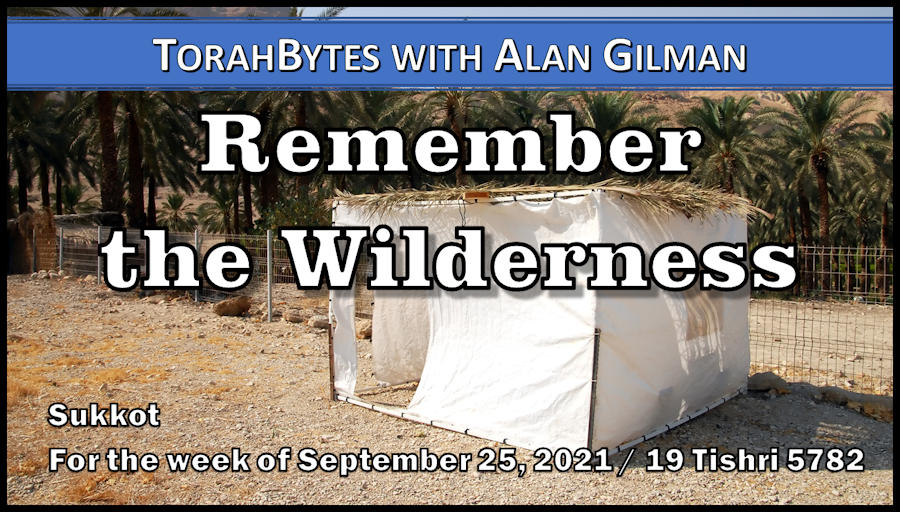
Remember the Wilderness

For the week of September 25, 2021 / 19 Tishri 5782

A plain sukkah (booth)

Sukkot
Torah: Shemot/Exodus 33:12 – 34:26; B’midbar/Numbers 29:23-31
Haftarah: Ezekiel 38:18 – 39:16

Download Audio [Right click link to download]

You shall dwell in booths for seven days. All native Israelites shall dwell in booths, that your generations may know that I made the people of Israel dwell in booths when I brought them out of the land of Egypt: I am the LORD your God.” (Vayikra/Leviticus 23:42-43)

The festival of Sukkot (English: Tabernacles or Booths) began this week the evening of September 20, 2021. Sukkot is the culmination of a special three-week period beginning with the Festival of the Blowing of the Shofar, commonly known as Rosh Hashanah (English: the New Year), followed ten days later by Yom Kippur (English: the Day of Atonement). The first two weeks focus on reflection and repentance in preparation for this week-long celebration of gratitude to God.

Central to the Torah’s Sukkot observances is the building of a sukkah, a temporary, somewhat fragile, though often beautiful, structure, intended as a temporary dwelling for the duration of the festival. The purpose of the experience of living in the sukkah was to remind the people of Israel that we lived in temporary shelters during the forty years of our wilderness travels prior to acquiring the Promised Land.

The wilderness period was a unique, but necessary, stage in the development of the people of Israel. Having spent generations as slaves in Egypt, they needed to be prepared for life in their own land. One day, they would have their own homes and farms and their own governmental and religious structures. They would develop international relations, including a time of renown and influence in the region. Israel was to be a bright light in an otherwise dark world.

However, a people don’t transition from being a nation of slaves to a shining example overnight. The people of Israel were called to be the people of God. In order to realize this, they needed to learn how human beings were to function in right relationship with the Creator. While their training wouldn’t cease upon entering the Promised Land, the forty years prior to doing so were foundational.

During the forty years, the people were completely dependent upon God. During that time the environment they were in provided no stability, protection, or regular provision. They were completely at the mercy of the elements and possessed nothing tangible on which they could rely to fend off enemy attacks. All this time, God saw them through by providing food, water, and protection from both the elements and enemies.

But this particular expression of divine help was not to be God’s will for Israel forever. It is not as if they were expected to live as if they were still in the wilderness, waiting for bread from heaven and other signs and wonders. Far from it! They were to settle the Promised Land and establish permanent agricultural settlements as well as fortified cities. Eventually they were to develop dependable political and military systems. They were to take responsibility for their lives and build a prosperous country.

Yet, despite the eventual normalcy of being a nation in their own land, there was something learned in the wilderness that was never to be forgotten, a life dynamic that was to be as much at work in the Promised Land as it was in the wilderness; a principle that is still as much at work today as it was then. That principle is human beings are completely dependent upon God.

By living in temporary shelters for a week once a year during Sukkot, the people of Israel were caused to experience in a small but tangible way a sense of vulnerability to the elements that is so easily forgotten when living in a permanent home. Seeing the stars, feeling the heat of the day or perhaps a few drops of rain were designed to bring to remembrance when their forebears’ very survival was in jeopardy each and every day unless God personally and powerfully came through.

The reality is that human beings are always dependent upon God. More permanent systems of protection and provision may give the impression that our security is derived from the things themselves. It is easy to forget that unless God works through such systems, they will not deliver as expected. Therefore, God deemed it necessary to remind Israel and the rest of the world through his Word, how this actually works.

We don’t necessarily need Sukkot to be reminded of this. Every now and then life’s circumstances throw us into highly vulnerable situations. If we have learned the lesson of the wilderness, we won’t crumble along with our failing structures. This is the challenge of our current day. Many think that our technical knowhow and political machinations will rescue us from disease and death. Until we learn that all the good we have ever experienced has come from the hand of God, we will continue to look in other directions when hard times come.

All scriptures, English Standard Version (ESV) of the Bible

Facebooktwitterredditpinterestlinkedinmail

Our Father

For the week of September 18, 2021 / 12 Tishri 5782

Hands holding Planet Earth

Ha’azinu
Torah: D’varim/Deuteronomy 32:1-52
Haftarah: 2 Samuel 22:1-51

Download Audio [Right click link to download]

Do you thus repay the LORD, you foolish and senseless people? Is not he your father, who created you, who made you and established you? (D’varim/Deuteronomy 32:6)

It is fairly common among scholars to downplay the presence of key New Testament concepts in the Hebrew Scriptures. These include, for example, forgiveness, life after death, and the complex unity of God, traditionally termed “the Trinity.” While it is correct to note that there is a difference with regard to the prevalence of such concepts within these two sections of the Bible, it would be wrong to claim that a relatively low number of occurrences in Hebrew Scriptures necessarily imply they lack importance.

One such concept is God as father. In the New Covenant Writings (as I prefer to call the New Testament) it is the chief identifier of God. Yeshua almost exclusively spoke of God this way. He also instructed us through his first followers, to address God as “Our Father.” One might regard this shift in emphasis as an intentional contrast to earlier scripture in the sense that under the Old Covenant, God was seen as distant and detached, but Yeshua introduced a more intimate and familiar version of God. Both Christian and Jewish thought often wants to find contrasts like this in order to disassociate Christianity from Judaism. But in order to do so, one needs to ignore what is really going on in the Bible.

It is true that God as father is a rarity in the Hebrew Scriptures, but it’s there a few times, including its first occurrence found in this week’s parsha (weekly Torah reading). In addition, there are also other references to God’s having father-like characteristics.

Moses’ use of “father” for God as part of his final words to Israel is most instructive. After all he and the people had been through the past forty years, as he confronts the people regarding their inevitable unfaithfulness, he urges them to respond appropriately to God on the basis of his being their father. Directly calling God “father” sheds light on what God said to Moses forty years earlier regarding his confrontation of Pharaoh: “Then you shall say to Pharaoh, ‘Thus says the Lord, Israel is my firstborn son, and I say to you, “Let my son go that he may serve me.” If you refuse to let him go, behold, I will kill your firstborn son’” (Shemot/Exodus 4:22-23). To mess with God’s people was to mess with his family. In the days and years ahead for Israel, does it matter how often the term “father” is used in their holy writings? Isn’t one reference enough to be struck by the overwhelming nature of such a relationship?

The people of Israel were delivered from tyranny to serve a new master and Lord. Yet, this master was no tyrant. Instead, God, as father, was dedicated to care, provide, and guide his children. Tragically, it would remain difficult for Israel to accept God’s fatherly heart towards them. Due to the broken nature of humanity, the hearts of the people were constantly pulled away from God and his ways. Yet, our Heavenly Father would not give up. Instead, he determined to transform our nature into one in keeping with his (see Jeremiah 31 and Ezekiel 36).

God’s role of father of Israel reveals to us God’s heart for all people. As our creator, whose familial relationship to humanity was broken due to our first parents’ misguided and selfish actions, he longs for restoration. His heart is to regain the relational intimacy between a loving father and his wayward children. Made in his image we all bear his resemblance, while our actions reflect the nature of rebels. God’s broken fatherly heart, however, could not accept our alienation from his love. And so, in the name of family, his Son, Yeshua the Messiah, completely gave himself up to restore God’s children to him. God’s determination as Israel’s father is that which cleared the way for people of all nations to have the opportunity to be equally part of God’s family.

We need to come to grips with the implications of God’s identity as our Father. Sadly, this is obscured by the confusion over the fatherly role in our society today. Too many people have suffered from absent or abusive fathers. It is said that we often envision God as a reflection of our earthly fathers. But it doesn’t have to work this way. Whatever our experience has been with our natural fathers, we can look at the loving, powerful, close, communicative care of our Heavenly Father as revealed in Scripture. He is our true Father.

All scriptures, English Standard Version (ESV) of the Bible

Facebooktwitterredditpinterestlinkedinmail

Technological Idolatry

For the week of September 11, 2021 / 5 Tishri 5782

Man in sitting in a meditative position with his laptop

Vayeilech
Torah: D’varim/Deuteronomy 31:1-30
Haftarah: Hosea 14:2-10 (English 14:1-9); Micah 7:18-20; Joel 2:15-17

Download Audio [Right click link to download]

Assyria shall not save us; we will not ride on horses; and we will say no more, “Our God,” to the work of our hands. (Hosea 14:4; English 14:3)

God made human beings in his image to represent him on earth. Our primary task was to care for the creation by subduing and cultivating it (Bereshit/Genesis 1:26-28). We were to take control of Planet Earth under God’s supervision and direction. It wasn’t too long, however, before God’s order of things became skewed. Through our first parents we became subservient to the creation, due to the cunning of the serpent, who undermined God’s initial directives. The result was that instead of serving God by ruling over the creation, human beings became subject to the creation. Ever since then the creation has controlled us on its terms rather than our controlling it on God’s terms.

Being made in the image of God for the sake of creation care endowed humans with great creative skill. Contrary to popular misunderstanding, very early mankind practiced agriculture and animal husbandry. Eventually we see the development of tools and musical instruments. Two of the earliest Bible stories are examples of extraordinary technology: Noah’s ark and the Tower of Babel. The first, a boat-like structure the length of a football field designed to preserve the continuation of God’s plan for Planet Earth. The second was intended to be a great statement of human achievement. While both these projects are equally impressive, they greatly differ in their moral and spiritual quality. The ark was initiated and blessed by God to fulfill his purposes. The tower was a humanly initiated self-serving affair.

The tower project was so misguided that God determined it needed to be stopped. His assessment of the situation was this back-handed compliment: “Behold, they are one people, and they have all one language, and this is only the beginning of what they will do. And nothing that they propose to do will now be impossible for them” (Bereshit/Genesis 11:6). God here acknowledges the technological savvy of human beings. This ability along with their unity due to a common language would have disastrous results.

The disruption of the Babel project didn’t put an end to humanity’s technological prowess. It slowed it down. But don’t get me wrong. It’s not our capacity to conceptualize, innovate, and implement creative tools that is destructive in itself. As I already mentioned, God used advanced (for its day) navel technology to save us. It’s our having become subservient to the creation that has twisted human motivation in such a way that, through the ages, the finest technology has been easily abused.

The abuse of technology is rooted, not in the technology itself, which is an expression of God-endowed creativity; but in the human hearts’ shift from reliance upon God, our maker and king, to the technology itself. Instead of our innovations serving the purposes to which God made us, we become enamored with the works of our own hands. We develop conveniences to alleviate suffering and discomfort, and then we can’t live without them. We design solutions to some of our greatest problems, and then we put our trust, our faith, in them instead of God.

The prophet Hosea envisioned a day when the people of Israel would finally accept the fundamental weakness of technology. He references horses, but the point is the same. Nothing wrong with riding a horse, but our lives don’t depend on the manifold ways we have subdued the creation for our benefit. “No more,” Hosea says, will we say, “‘Our God,’ to the work of our hands.” Technology need not be an idol, but that’s exactly what it is when we put our hope in it.

The ever-increasing ability of technology to monitor, care for, transform, and sustain our lives, the more god-like it becomes. The more god-like it becomes, the more it demands our allegiance, our trust, our love.

Apart from a major disruption to the earth’s magnetic field, which is not far-fetched, technological advances will continue. The question is will it serve us or will we serve it?

All scriptures, English Standard Version (ESV) of the Bible

Facebooktwitterredditpinterestlinkedinmail