For the week of July 4, 2026 / 19 Tammuz 5786
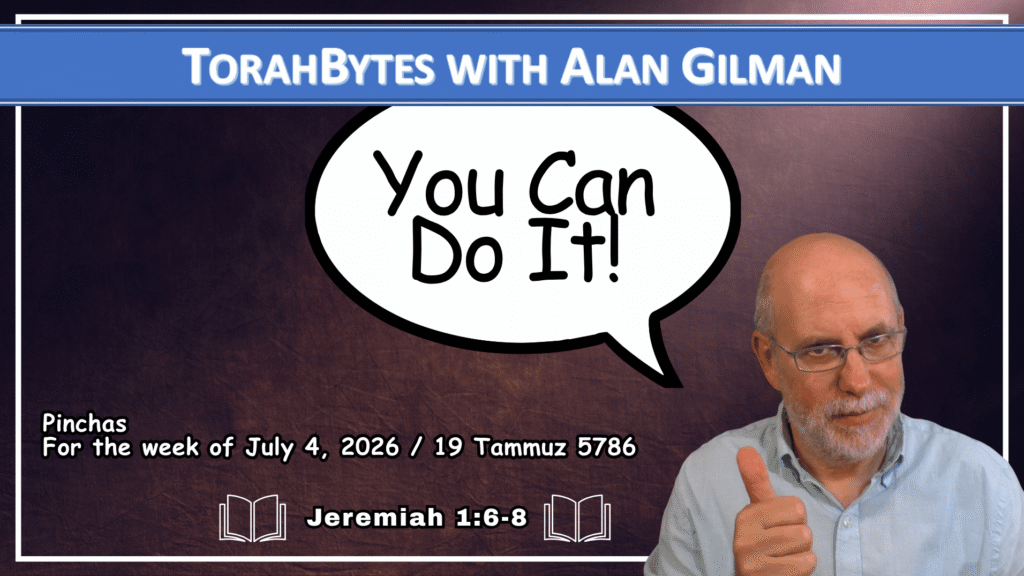
Click image to view video version
Pinchas
Torah: B’midbar/Numbers 25:10 – 30:1 (English 25:10 – 29:40)
Haftarah: Jeremiah 1:1 – 2:3
Originally posted the week of July 26, 2008 / 23 Tammuz 5768 (updated)
Then I said, “Ah, Lord GOD! Behold, I do not know how to speak, for I am only a youth.” But the LORD said to me, “Do not say, ‘I am only a youth’; for to all to whom I send you, you shall go, and whatever I command you, you shall speak. Do not be afraid of them, for I am with you to deliver you, declares the LORD.” (Jeremiah 1:6-8)
A saying I have often heard is “You can do anything you want, as long as you set your mind to it.” However, this only works when it does; otherwise, it doesn’t. It seems to me the purpose of this saying is usually to motivate someone to do something they really want to do but fear they can’t. Fear is certainly an obstacle to accomplishing something, and difficult tasks require that we do our best to see them through to the end. But it is ridiculous to think that setting one’s mind on something is in itself a guarantee of success.
The prophet Jeremiah faced the difficult task of being God’s spokesman at a crucial time in the nation’s history. When God called him to this task, we don’t know if he understood the implications of his vocation, but what we do know is that he didn’t feel up to the job.
God’s response to him was not in the form of the kind of motivational speeches common in our day. God didn’t tell Jeremiah that if he would set his mind on being a prophet, he would be a prophet. Nor did God challenge him to visualize success and strive for greatness.
What God did do was first, he told him not to put himself down. Jeremiah felt that his youth somehow undermined his ability to accomplish the task at hand. This may sound like a “don’t be negative” pep talk, but it is deeper than that. It wasn’t as if a positive frame of mind would automatically enable him to do what God was calling him to do. It was simply that when God calls us to do something it doesn’t matter how old we are. Young people can be prophets too, if God so calls them.
Second, God said that Jeremiah would go where God would tell him to go and he would speak to those whom God would command him to speak. That may sound like, “You are going to do it, because you’re going to do it.” But that’s not really what God said to him. God said that Jeremiah would go where God sends him and speak what God commands. God determined that he would take charge of Jeremiah’s life, directing him and inspiring him. There is nothing we can’t do when God takes charge like that.
Third, God told him not to be afraid. But this wasn’t God just telling him to calm down as if he had no reason to be afraid. What God was telling him to do was truly intimidating. The reason Jeremiah was not to be afraid, was because God promised to personally take care of him.
God was not challenging Jeremiah to find power within himself to overcome the obstacles to his personal dream. Rather, because God called Jeremiah to be a prophet, God would also enable him to do it.
Whenever God calls us to do something, he enables us to do it. That doesn’t mean that everything God calls us to do will be easy as we see from the rest of Jeremiah’s life. Still, no matter how difficult a God-given task may be, we can do it.
Scriptures taken from the English Standard Version