For the week of June 6, 2026 / 21 Sivan 5786
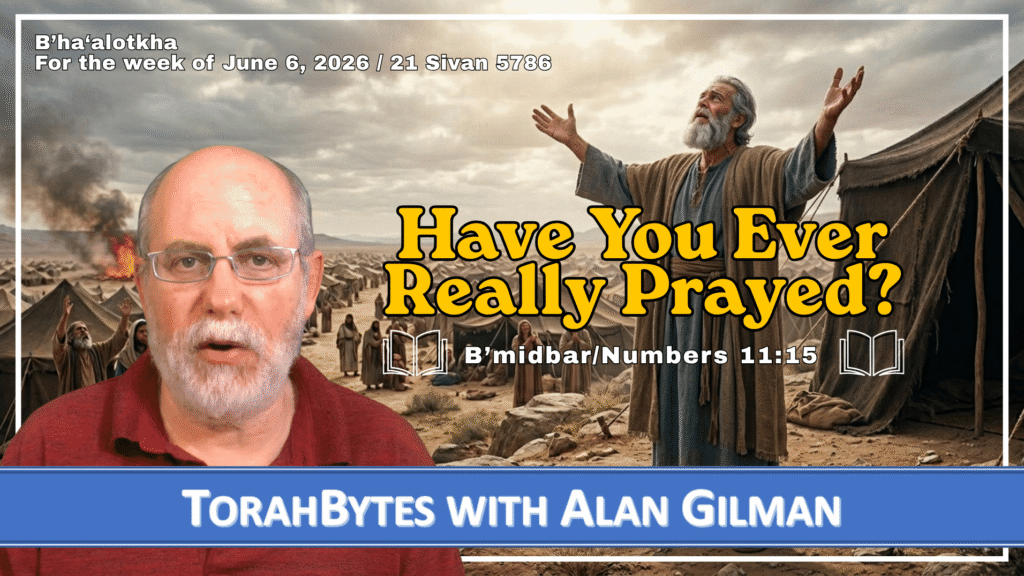
Click image to view video version
B’ha‘alotkha
Torah: B’midbar/Numbers 8:1 – 12:16
Haftarah: Zechariah 2:14 – 4:7 (English 2:10 – 4:7)
Originally posted the week of June 22, 2019 / 19 Sivan 5779 (Updated)
If you will treat me like this, kill me at once, if I find favor in your sight, that I may not see my wretchedness. (B’midbar/Numbers 11:15)
Some time ago, I was chatting with a waitress at a restaurant about some weaknesses in the overall service there. It was exactly what I had read in an online review and thought she should know. She wholeheartedly agreed with me, but felt she could do little about it since she was new at her job. So, I suggested she pray. She looked at me funny for a moment. So I repeated myself, having no idea what she thought of the subject. I told her that praying was simply talking to God and that not only does he have infinite resources at his disposal, he is also generous. She made it clear to me that I gave her something to think about.
As believers in Yeshua, we know this (though I imagine some may want to discuss the theology of prayer and whether it is appropriate to describe prayer as I did to this stranger). Be that as it may, what I shared with her included an essential dynamic. I offered no formulas, and I didn’t tell her exactly what to say. I also gave no guarantee as to what God’s answer might be. All I did was encourage her to start the conversation. The conversation would be on a particular topic, in this case, helping her resolve a need she could not resolve on her own. Since right at the beginning I defined prayer as talking to God, the conversation had to start with her personally and purposely talking to him. There’s so much more we can say about prayer, of course, but without this dynamic, I don’t know if much of what we call prayer is actually prayer at all.
Moses knew how to pray. That he did is vividly illustrated in the brief verse I quoted from this week’s parsha (Torah reading portion). Moses found himself being a waiter extreme. The whole nation of Israel whined like children for food. He had seen God do so much, yet the pressure of the people’s demands had completely overwhelmed him. He was done, and he told God so in no uncertain terms. Talk about a prayer from the heart! Moses held nothing back and told God exactly what he thought and how he felt. Thankfully, however, answered prayer isn’t always about getting all the items on our list. It’s about God meaningfully engaging us in response to our requests and desires.
I don’t know about you, but the best way I can describe some of my prayers is muddled. Even though I set aside some time each day to pray, am I really praying? To be honest, it’s not too unusual for me to do some sort of combination of wondering, thinking, wishing, and muttering. I’ll catch myself daydreaming about who knows what before I realize what I am doing. At that point, I try to focus and really pray, which sometimes I do. When I do, it’s as if I shift from muddled to clear. I know who I am talking to and what I am trying to say.
This is why I remind myself what I encourage others to do: pray out loud. While I cannot discount all silent prayer, there is very little Scriptural basis for it. Even if there were, attempting to project thoughts to God from our heads is very difficult, if not impossible. How do we differentiate thinking from praying when attempting silent communication? Praying out loud reminds us that we are truly speaking to another being who is not us.
Many years ago, when I was in Bible college. I had a roommate from Africa. He would wake up before me and have a time with the Lord at his desk. I would hear him whispering in prayer. I thought he really believes he is talking to someone! That encouraged me to do the same.
Realizing we are truly talking to God makes all the difference. And that’s just the beginning. Unless we intentionally do so, then whatever else we may be doing, we are not praying. Why not start right now?
Scriptures taken from the English Standard Version




Hi Alan: Just a couple of reflections on silent prayer:
At one time many years ago when I was still quite young, our church had a practise of beginning every worship service with silent prayer, although this practise a has not been in place for many years. I believe the intent was for the worshippers to prepare their hearts and minds in a proper state for worship.
On another note, I used to have to fly once in a while for business or have to take a fellow employee with me by car (or even pick up a hitch hiker) and would often pray silently for the Lord to open up an opportunity to have a ‘spiritual’ conversation with the person seated next to me. I found that this often put me in a more sensitive position for me to follow the leading of the Holy Spirit in the conversation.
Thanks for this. I appreciate the response, especially since I am guessing you are (unintentionally) speaking for many others. First, I in no way want to suggest that God doesn’t hear our thoughts or respond to them. Nor am I dissing a practice of preparing one’s heart (better: one’s self) in quietness before a service or anything else for that matter. However, if one were to do a biblical study on the subject of “prayer,” then it would be most difficult to conclude that *normative*biblically based prayer is anything but spoken communication. To my knowledge, there are only two possible examples of “silent prayer” in the Scriptures. One is “Hannah was speaking in her heart; only her lips moved, and her voice was not heard. Therefore Eli took her to be a drunken woman” (1 Samuel 1:13). While this references “speaking in her heart,” note that her lips were still moving. Also, given the full description of what Eli was witnessing, it is possible that her body language was quite demonstrative. The second example is Nehemiah: “Then the king said to me, ‘What are you requesting?’ So I prayed to the God of heaven. And I said to the king, ‘If it pleases the king, and if your servant has found favor in your sight, that you send me to Judah, to the city of my fathers’ graves, that I may rebuild it’” (Nehemiah 2:4–5). I have heard people say that Nehemiah offered up a silent prayer before answering the king. However, it doesn’t explicitly say that. He may have spoken actual words very quietly, like my roommate did each morning.
Please don’t get me wrong. I am not necessarily discounting directing our thoughts to God. However, it is essential to note that there does not seem to be a biblical precedent for silent prayer as it is generally practiced today. Here is my concern. It seems to me that “silent prayer” is normative for many believers. I am concerned that this spiritual practice undermines the “out-there-ness” of God. Yes, he indeed dwells within the believer by his Spirit, but the kind of internal, personal spirituality that is so common for so many today doesn’t reflect the biblical perspective of a God who is outside of us, upon whom we need to rely. Also, perhaps others are better than I am, but when prayer is more of a thought exercise than an outward verbal expression, I don’t know how people can distinguish between their personal thoughts and their attempt to communicate with God in their heads. Note that I cannot speak on behalf of people who are physically or mentally verbally challenged. As I stated, I affirm that God hears our thoughts, but praying via thinking, not talking, isn’t the biblical norm. And by the way, there is no precedent for praying with eyes closed either.