For the week of August 1, 2026 / 18 Av 5786
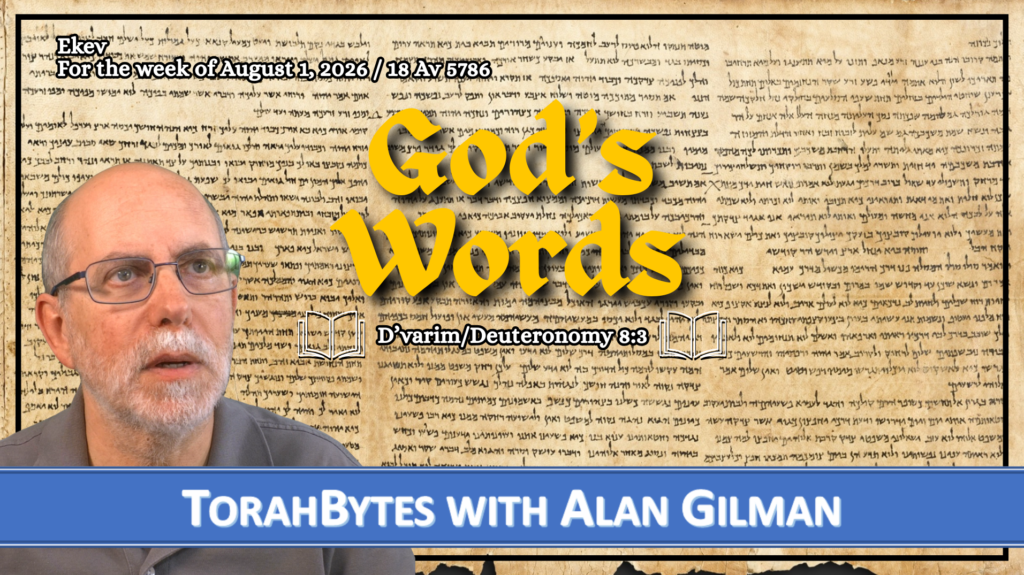
Click image to view video version
Ekev
Torah: D’varim/Deuteronomy 7:12 – 11:25
Haftarah: Isaiah 49:14 – 51:3
Originally posted the week of August 8, 2009 / 18 Av 5769 (updated)
And he humbled you and let you hunger and fed you with manna, which you did not know, nor did your fathers know, that he might make you know that man does not live by bread alone, but man lives by every word that comes from the mouth of the LORD. (D’varim/Deuteronomy 8:3)
As Moses recaps the forty-year journey of the people of Israel through the wilderness, he explains the purpose of the provision of manna. Manna was the food that miraculously appeared on the ground each day, except on Shabbat. Through this, God was teaching the people to rely upon him alone. The statement “man does not live by bread alone, but man lives by every word that comes from the mouth of the LORD” is often understood to mean that our lives depend not only on material sustenance but also on God. However, that is not what it says. What we actually have is two ways of living. One is “by bread alone”; the other is “by every word that comes from the mouth of the LORD”. Either we live life dependent on the fulfillment of our basic physical needs, or we live life dependent upon God. The people of Israel needed to learn that. For life to be lived the way God intended, they needed to depend on him alone.
Note that relying upon God is not described in vague terms, but with clear reference to his words. Moses didn’t say here that man lives by being dependent or by trusting in God, which would be true, but rather that “man lives by every word that comes from the mouth of the LORD”. Living life the way God intends requires strict attention to his every word.
What Moses says is of great importance for our understanding of the Bible’s inspiration. If the Hebrew Scriptures and the New Covenant Writings are indeed inspired by God, then to what extent are the words themselves inspired? Are the Scriptures only inspired in some general sense, or did God intend the words themselves to be written the way they were? The New Covenant asserts the latter:
And we have something more sure, the prophetic word, to which you will do well to pay attention as to a lamp shining in a dark place, until the day dawns and the morning star rises in your hearts, knowing this first of all, that no prophecy of Scripture comes from someone’s own interpretation. For no prophecy was ever produced by the will of man, but men spoke from God as they were carried along by the Holy Spirit (2 Peter 1:19-21).
Many Bible believers think that only the meanings of the words, not the words themselves, are inspired. This results in separating the words of Scripture from their supposed meanings. This makes us vulnerable to all sorts of concepts God never intended. Further, it is common to belittle the actual words of Scripture by asserting that they are relevant only to the time and culture in which they were written. Because the Bible writers saw the world so differently from how we do, it’s assumed that only the eternal principles, somehow contained within or behind the Bible’s words, are relevant to us today.
I don’t deny that the writers of Scripture saw the world very differently from us. But it was through those people writing in those times and places whom God chose to write the words he inspired. Understanding how to adapt ancient Scriptural truths to contemporary societies can be challenging, but it’s an essential challenge well worth the effort.
God’s words, not just his Word in some general sense, are inspired. Moses said (God through Moses actually) that we are to live by every word that comes from God’s mouth. God inspired the writers of Scripture to write the very words through which he has revealed both himself and his will to us. Perhaps if we truly lived by every word that came from God’s mouth, we would not only view the world the way he does, but we would also live the effective, godly lives he calls us to.
Scriptures taken from the English Standard Version
Background image: The Great Isaiah Scroll (Dead Sea Scrolls) / By Photographs by Ardon Bar Hama, author of original document is unknown. – Website of The Israel Museum, Jerusalem, see link., Public Domain, https://commons.wikimedia.org/w/index.php?curid=12149044