Your Story in Two Acts

For the week of July 25, 2026 / 11 Av 5786

Message information along with TorahBytes host, Alan Gilman, over a theatrical curtain opening to display a brilliant sun

Click image to view video version

V’etchannan/Nahamu
Torah: D’varim/Deuteronomy 3:23-7:11
Haftarah: Isaiah 40:1-26
Originally posted the week of July 28, 2018 / 16 Av 5778 (updated)

Comfort, comfort my people, says your God. Speak tenderly to Jerusalem, and cry to her that her warfare is ended, that her iniquity is pardoned, that she has received from the LORD’s hand double for all her sins. (Isaiah 40:1-2)

One cannot overstate the drama of Isaiah’s comfort call. The contrast of these words with what comes before is so great that scholars tend to assume that they are authored by a different speaker or writer. The contrast of tone isn’t the only reason for the common scholarly determination of more than one “Isaiah,” but I don’t find such a conclusion compelling. More importantly, I contend that identification of the author is nowhere near as important as what is being said.

What we have here is the beginning of a sequel or a new act. Act One had ended with the stage going dark. All hope is lost because Israel has spiraled down to the apparent point of no return. Act One closes with a most cynical tale of King Hezekiah, one of the greatest of all Jewish kings, receiving God’s message from Isaiah that even though he successfully overcame the Assyrian siege and was miraculously cured of a terminal illness, Babylon, the empire that would succeed Assyria, will vanquish his dynasty and take the people into exile. If that’s not bad enough, the hitherto noble king comforts himself with the news that this won’t happen until after he is long dead.

Act Two bursts onto the stage with the words: “Comfort, comfort my people,” says Israel’s God—judgment has run its course, warfare has ended; sin is forgiven. The Hebrew word for “comfort” (nacham) has two basic meanings, depending on its use. Either way, it denotes change. It could mean “to relent,” a change of intention—one plan of action replacing another. The meaning here, however, is “to comfort” or “to be comforted”—an emotional change in which one feels a certain way, usually bad, and is consoled, shifting their outlook on life.

Against the backdrop of despair and cynicism is the promise of comfort. The diagnosis was devastating; the sickness far worse than imagined. Under normal circumstances, such a road leads to nothing but complete destruction. But not in this case—not as far as God’s people are concerned. The God of enduring, covenant love always has a positive future in mind for his precious people, despite comparatively short-term hardship.

Israel’s desperate plight at the end of Act One typifies our own day in many ways. Despite previously unknown levels of affluence and the exceptional quality of life experienced by so many, societal and personal darkness pervades. From old and new terminal illnesses to political instability to levels of antisemitism not seen since the 1930s and the threat of nuclear annihilation, one little spark can set the whole world ablaze. At the same time, we are engulfed by a cloud of meaninglessness and hopelessness that saturates the global psyche, and many no longer grasp what it means to be human.

God’s word to Israel was that the day was coming when their suffering would cease, creation would be renewed, and peace would reign forever. The Jewish people’s incessant angst and anguish would finally and forever be transformed when chaos turns to order, destruction to rebuilding, sickness to health, and death to life. Therefore, be comforted. The darkness will not last forever. Light will not only return but will never fade again.

These words of comfort are not for Israel alone. God’s heart for the Jewish people reflects his desire for all peoples. Every human being has a story like Israel, albeit with a different cast of characters and unique subplots. Yet, whatever our heritage, the human story is the same: tragically dark and often hopeless, if we are honest. Yet, like Israel, your story needn’t end there. With God, there’s a second Act for you too.

You may have thought that your story ends with Act One. You may think there’s nothing beyond the darkness of your life. Or, like Hezekiah, you comfort yourself with short-term vision, making the best of your situation. “It could be worse,” you say. Yet you know if you would look beyond yourself, you couldn’t handle the state of the world.

But the story isn’t over. God will come through. He has proven that through the resurrection of the Messiah. You may already believe that, even though you have a hard time being comforted. It might be that you are still stuck at the end of Act One, thinking, in spite of your claim to faith, that darkness has the final word after all.

Excuse me while I flick off and on the lights. Intermission is over! There’s more to your story because there is more to God’s story. Not only does he win in the end, but he also invites you to be part of it. Perhaps that’s your problem. All the while you have been sitting in the audience, when you are actually a star in the show. You don’t only get to be part of the grand conclusion; you have an essential role to play.

I understand why you are sitting there. Life has been so painful and confusing. You have tried to comfort yourself to no avail. But that’s the problem. Right now, God wants to heal and restore you. And he will if you cooperate with him. You will be comforted once you allow him to comfort you on his terms.

Scriptures taken from the English Standard Version

Facebooktwitterredditpinterestlinkedinmail

Respecting National Diversity

For the week of July 18, 2026 / 4 Av 5786

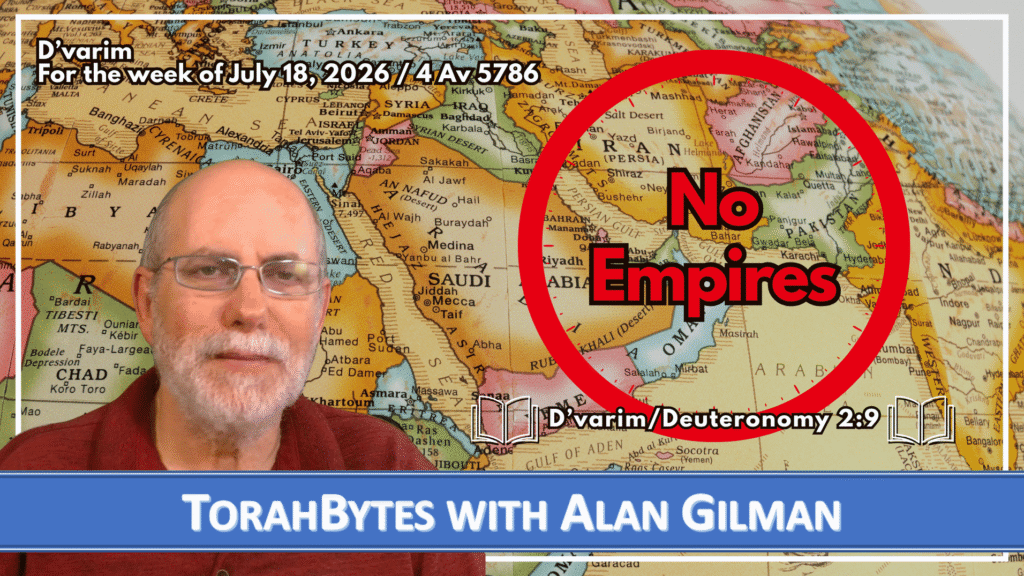
TorahBytes host, Alan Gilman, with message info against a map of the Middle East along with the words No Empires within a red circle


Click image to view video version

D’varim
Torah: D’varim/Deuteronomy 1:1 – 3:22
Haftarah: Isaiah 1:1-27
Originally posted the week of August 10, 2019 / 9 Av 5779 (updated)

And the LORD said to me, “Do not harass Moab or contend with them in battle, for I will not give you any of their land for a possession, because I have given Ar to the people of Lot for a possession.” (D’varim/Deuteronomy 2:9)

This is an excellent follow-up to last week’s message, Ideological Warfare, where I explained that understanding the current Middle East conflict is almost entirely about how the different sides view the world we live in. God’s call on the Jewish people has led us, often without realizing it, into a biblical worldview. Israel’s enemies and their official and unofficial allies often fail to grasp the actual framework within which the current conflict is being fought. This week’s message shows that Israel operates in a way very different from that of most people groups throughout history, a way, if heeded, could bring peace and prosperity to all.

Throughout the years of doing TorahBytes, I have sought to demonstrate the ongoing relevance of the Hebrew Scriptures, which are built on the foundation of the Torah, the Books of Moses. At times, I have done that by noting a specific principle found in one of God’s commandments or a lesson derived from a story. We might explore an aspect of the character of God, the nature of human beings, or the dynamics of how humans are to relate to God and to each other. But there’s more to learn from Scripture than principles and lessons. In fact, the principles and lessons of Scripture are deeply rooted in its general perspective on life. It’s in the soil of the Bible’s worldview that we discover how to navigate our complex existence.

It’s tragic when belief in Yeshua as Messiah results in the collapse of the breadth and depth of Truth as revealed in the Hebrew Scriptures into a detached, spiritualized, overly personal experience. There is almost nothing in life, big or small, that isn’t effectively addressed by Scripture. We’re going to look at something big this week.

I think it’s an astounding insight. It was brought to my attention while reading the book, The Philosophy of Hebrew Scripture by Yoram Hazony, and it is reflected in this week’s parsha (weekly Torah reading portion). Israel was preparing to enter the Promised Land and needed to journey through inhabited territory. They were given specific instructions on which territory they could take and which to leave alone. In this case, they were told not to “harass Moab,” because God allotted their land to these descendants of Abraham’s nephew Lot. Israel’s acquisition of land was to be under God’s direction. We can look elsewhere in the Torah to see that God was very specific about Israel’s borders. They were given no mandate to expand beyond what was allotted to them.

Think about that. God made clear to Israel that they were not to build an empire but were to be satisfied with the geographical limitations imposed upon them by God. This is all the more astounding when we realize that Israel understood their God, rightly so, not as some sort of regional deity, but the God of the whole world. The Bible begins with God creating the “heavens and the earth” (Bereshit/Genesis 1:1); God declares at Mt. Sinai, “all the earth is mine” (Shemot/Exodus 19:5); and Psalm 47 proclaims him as the king of all the earth and ruler of the nations. Be that as it may, instead of this “God of all the earth” commissioning his people to take over the whole world, he teaches them to respect national boundaries. And that was in spite of the imperialistic tendencies of world powers both then and now.

This respect for nationality was firmly grasped by the leadership of Yeshua’s early community. In those first decades, some attempted to centralize control of the emergent New Covenant community within an exclusively Jewish context. In the Book of Acts, chapter fifteen, as the leaders thrashed out the implications of how the Messiah’s message was reaching the non-Jewish peoples of their day, they realized that God was indicating that while the good news was for everyone, each people-group would be free through the direction of God’s Spirit to work out how God’s kingship in the Messiah would be expressed within their cultural setting.

Centuries later, when messianic faith was co-opted by the Roman government, respect for national and cultural differences faded away and was replaced by age-old ungodly imperialistic tendencies. Instead of continuing a decentralized mosaic of nationalities, who were to find their way in God’s Truth with God’s help, the church government aligned with political power to homogenize the nations under God.

Despite this, God continues to regard the diversity of people groups while valuing national distinctions. We would do well to do the same.

Scriptures taken from the English Standard Version

Facebooktwitterredditpinterestlinkedinmail

Ideological Warfare

For the week of July 11, 2026 / 26 Tammuz 5786

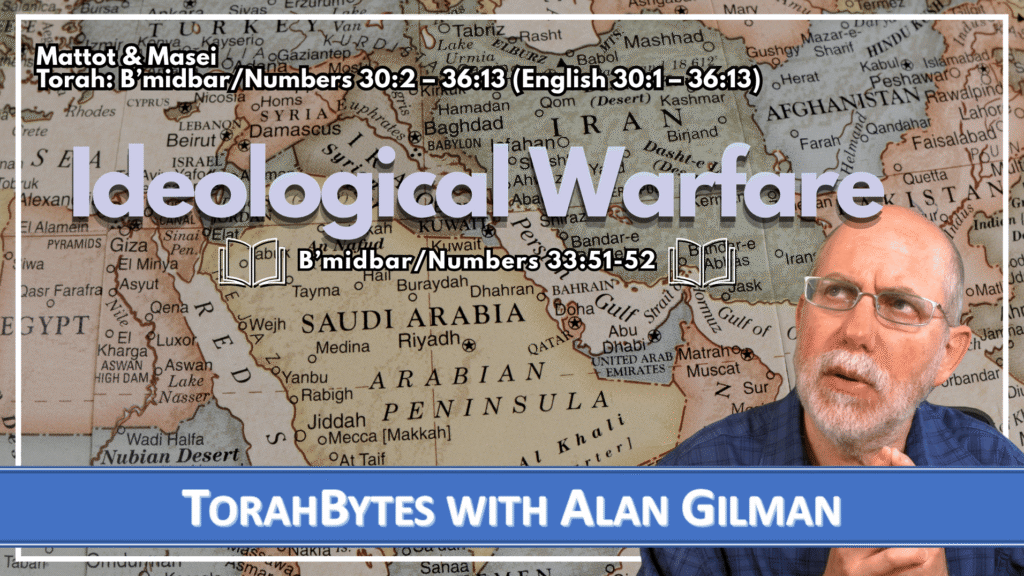
Message information along with TorahBytes host, Alan Gilman, over a map of the Middle East

Click image to view video version

Mattot & Masei
Torah: B’midbar/Numbers 30:2 – 36:13 (English 30:1 – 36:13)
Haftarah: Jeremiah 2:4–28, 3:4
Originally posted the week of July 26, 2014 / 28 Tammuz 5774 (updated)

Special note: July 2, 2026, marked the 1000th day since the October 7, 2023, massacre, the worst attack on the Jewish people since the Holocaust. Despite endless political deals and promises, this conflict, rooted in centuries-old animosity, seems destined never to end. My impression is that relatively few truly understand what is really going on. I posted the original version of the following message during the 2014 Gaza war. Reading it over again, including the article and the video mentioned, made me feel as if nothing had changed in twelve years. I contend that the only way any of us can effectively deal with these matters is by confronting the ideological battle with the truth of Scripture.

* * *

When you pass over the Jordan into the land of Canaan, then you shall drive out all the inhabitants of the land from before you and destroy all their figured stones and destroy all their metal images and demolish all their high places. (B’midbar/Numbers 33:51-52)

Like many others, I continue to be caught up in the tragic situation between Israel and its neighbors. The number of articles and videos is overwhelming. As you may know, if the issue includes Israel, we end up with an inordinate amount of emotionally charged attention and opinions.

Now and then, I come across an article or report that, in my opinion, stands out from the others for how the author avoids narrow definitions and simplistic conclusions. Richard Landes’s “Why the Arab World Is Lost in an Emotional Nakba, and How We Keep It There” examines the conflict through a worldview lens. Whether or not Landes’s evaluation is fully correct, he is right that the problem at hand is fundamentally ideological. How people see the world controls how they live life. Failure to accept that will undermine any attempt to resolve conflict, whether it be interpersonal or international.

But this is not the way many of us look at life. Instead, we prefer simplistic, superficial analysis along with quick, thoughtless solutions. A great example of this, as it relates to the current crisis, is Nina Paley’s three-and-a-half-minute animation, This Land Is Mine—a satirical retelling of the history of the region that features each people group being killed off by the next people group as their cartoon representatives seamlessly lip synch the song “This Land Is Mine” from the 1960 film, “Exodus.”

The appeal of Paley’s animation, apart from its humor, is its simplicity. But it’s a misguided simplicity that completely ignores the region’s historical reality. This version is stripped of any historical context whatsoever. The bigger picture that might inform and affect the behavior of the people involved is completely neglected, as if it were irrelevant. There is no consideration whatsoever for the various factions’ history, values, and aspirations. All the viewer is offered is a story of meaningless killing, along with the implied resolution being that if only the fighting stopped, everything would be okay. A cry of “why can’t we all get along!” may sound good, but it is devoid of any sense of authentic, not to mention lasting, justice.

What does this have to do with this week’s parsha (weekly Torah reading portion)? Everything. First, so much of the Bible is devoted to issues pertaining to the region in question. The backdrop to much of what is going on in Scripture can be termed “Middle East crisis.” By the Bible’s twelfth chapter, the claim to the Land of Israel is already a key theme. While many people are quick to draw personal spiritual lessons from the Bible’s stories, the context of both the Hebrew Scriptures and the New Covenant Writings primarily concerns the region’s geopolitical issues. Yet many readers of Scripture treat this context in the same way as Paley’s animation. The bigger story becomes irrelevant in our attempt to distill the meaning we wish to derive.

The verses I quoted from this week’s parsha demonstrate what the conflict in the region is really all about. When God called the people of Israel to take the Land, they were not only to drive out its inhabitants, but also to destroy the objects of their religions. They were not simply a migrant people looking for territory and annihilating anybody who stood in their way. Their God-given objective was to establish a godly community of truth and righteousness, while, at the same time, displacing the previous inhabitants. This was not indiscriminate, but was rather the God-ordained judgment on peoples whose evil behavior had become irreversible (see Bereshit/Genesis 15:16).

I am not proposing that the modern State of Israel should follow the same directions today that God gave through Moses over three thousand years ago. I don’t believe that the Bible supports that at all. Still, this reminds us that all conflict is fundamentally ideological. This is why Landes’s article is so helpful. He understands that the two sides differ in how they see the world. Additionally, Paley’s animation offers a more contemporary perspective that effectively skirts the real issues, while (hopefully unintentionally) insulting the people involved by belittling their concerns.

The Bible is God’s revelation of the way the world really is and calls us to make that truth known in the name of the Messiah. The players in the current conflict are caught up in this ideological battle, whether they know it or not. The only way we will ever find lasting resolutions to this and every other conflict is by gaining a better understanding of God’s perspective through his written Word.

Scriptures taken from the English Standard Version

Facebooktwitterredditpinterestlinkedinmail