Waiting

For the week of December 19, 2020 / 4 Tevet 5781

Young boy sadly looking out a window on a very rainy day

Miketz
Torah: Bereshit/Genesis 41:1 – 44:17
Haftarah: 1 Melachim/1 Kings 3:15 – 4:1
Originally posted the week of December 4, 2010 / 27 Kislev 5771
The following revised version taken from the book  “Torah Light: Insights from the Books of Moses” by Alan Gilman (more info here)

Download Audio [Right click link to download]

After two whole years, Pharaoh dreamed that he was standing by the Nile. (Bereshit/Genesis 41:1)

The Torah—like the whole Bible, in fact—is not wordy. Perhaps that is due to the scarcity and cost of writing materials in the days it was written. In any case, the lack of lengthy description in no way diminishes its literary depth. So much is communicated in surprisingly few words. An example of this is found in the short phrase at the beginning of our verse: “After two whole years.” The Hebrew reads: “Va-yehi miketz shenatayim yamim,” more literally translated as, “And it was at the end of two years of days.” This expression underscores for us how long a time it really was. Our translation tries to get this across with “two whole years,” but since readers of English tend to take statements of time simply as calendar references, this may come across as nothing more than “two years later, Pharaoh had a dream.” By contrast, “two years of days” draws us into the experience of Joseph, who after correctly interpreting the dreams of his influential fellow inmates had to endure over seven hundred more individual days in a horrible dungeon.

Throughout the Bible we have stories of people who had to endure great hardship for long periods of time. When we read these accounts, the waiting periods fly by in an instant unless we stop to think about it. In Joseph’s case in particular, the wording, at least in the original Hebrew, draws our attention to what the passing of time must have been like for Joseph after all he had gone through. First, he was hated by his own brothers, who sold him into slavery, and then he was unjustly incarcerated in an Egyptian dungeon. While God was with him and gave him favor in these difficult circumstances, we cannot underestimate how difficult it must all have been.

God doesn’t work according to our expectation of time. If we had our druthers, we would get everything instantly. We think that getting something faster is almost always better. But that is not God’s way. Living things develop over time. Good food takes time to grow. Good food takes time to prepare. It takes time to manufacture quality products. Good character takes a lifetime.

It is likely that before Joseph experienced his hardships he wasn’t ready for the kind of leadership to which God destined him. I don’t think a person like Joseph, who had no issue telling on his brothers and broadcasting dreams that foretold his place of prominence among them, would necessarily treat his family (or anyone else) with the type of kindness he ended up extending to them. It is possible that the time delay was designed to allow for deep work in Joseph’s heart to take place. I am aware that the Torah gives no comment as to the work of God in Joseph’s life, but we do know he endured abusive and oppressive circumstances for a long time and that something about those last two years in particular was especially long.

Whatever God was doing in Joseph’s heart and life, is this not what many of us go through? There is a proverb that reads, “Hope deferred makes the heart sick, but a desire fulfilled is a tree of life” (Mishlei/Proverbs 13:12). Waiting for God-given expectations to be fulfilled can be sickening. Those of us who have experienced this may sometimes think we would be better off without the hopes than having to wait and be given glimpses of our hope’s fulfillment only to have to wait again. But God knows what he is doing. His timing is perfect. We will never know all that he is accomplishing during our periods of waiting, but we can be assured that if we truly love God, then he is doing everything necessary to accomplish his purposes in us and through us.

Scriptures taken from the English Standard Version

Facebooktwitterredditpinterestlinkedinmail

The Separated Land

For the week of December 12, 2020 / 26 Kislev 5781

A flag of Israel superimposed upon a map of Israel

Vayeshev & Hanukkah
Torah: Bereshit/Genesis 37:1 – 40:23 & B’midbar/Numbers 7:18-29
Haftarah: Zechariah 2:14 – 4:7 (English 2:10 – 4:7)

Download Audio [Right click link to download]

And the LORD will inherit Judah as his portion in the holy land, and will again choose Jerusalem. (Zechariah 2:16 [English: 2:12])

This verse is part of this week’s special Haftarah reading (supplemental reading recited on Shabbat and other holy days). It was most likely chosen due to its inclusion of the prophet’s vision of the temple menorah (English: lampstand), which is a feature of the commemoration of the eight-day festival of Hanukkah, which begins this year, Thursday evening, December 10.

What caught my attention is the reference to “holy land,” a term I have never been very keen on. To me, holy land conjures up images of religious pilgrims visiting religious sites having religious experiences. It’s not that “religious” or “religion” are bad terms in themselves. It’s that for some, religion becomes an end in itself, a compartment of one’s life detached from the other aspects of life. As a result, it takes on a sense of being unreal.

The teachings of Scripture, both the Hebrew Bible and the New Covenant Writings (the New Testament), are anything but unreal. They are so down to earth, whether in their narrative context of real people in real-life situations or their reflections on those events. When it comes to their exposition of life principles, besides the fact that the vast majority of these emerge out of real life, they themselves are practical, down-to-earth directions on how to live a good and fruitful life.

It seems to me that when some people think of the “holy land,” it’s a version of Israel separated from reality. Despite awareness of historical events that have occurred there, the actual Israel morphs into a fabricated backdrop, framing pre-determined spiritual sentiments. When such people visit the “holy land,” the real sights and sounds of what is perhaps the most vibrant and dramatic region on earth, becomes nothing more than fodder to fuel preconceived notions of disconnected faith.

But the term “holy land” is found in the Bible, appearing in the verse I quoted at the beginning as well as in Tehillim/Psalms 78:54: “And [the LORD) brought them to his holy land, to the mountain which his right hand had won.”). It’s not that I have a problem with the term itself. It’s that, as I just mentioned, it has been used to separate the Israel of the Bible from the Israel of real life. Ironically, the Hebrew word for “holy,” kodesh, means “separate.” This separateness of the land is not a separation from reality unto a disconnected spirituality. Rather, it is a statement of claim on the part of the God of Israel that he has separated this geographical region unto his particular purposes.

These purposes are anything but disconnected from real life, no less the real-life Israel of today. Core to the biblical record is God’s commitment to Abraham and his natural descendants that our destiny would be deeply entwined with the holy land (I write “our,” since I am one of those descendants). To separate the land from the people to whom God gave it is to separate it from God and his Word. In order to appreciate the holy land as the separated land it really is, we must reconnect it to its holy purposes.

This is what Hanukkah is about as it commemorates a time when evil sought to redefine the purpose of the holy land. Assimilation forces almost succeeded in absorbing Israel into the pervading culture. Unity and sameness almost overcame the God-ordained uniqueness of Israel. It took the bravery and determination of the Maccabees to restore both land and people to their holy purpose, a purpose to illumine the world with God’s love and goodness.

The separate nature of the land reminds us what true holiness is all about. Those who belong to the God of Israel by faith in Israel’s Messiah have been separated unto him and his purposes within the context of all of life. We need to guard against a false separation unto an unreality of superficial spirituality. Instead, we need to discover (or re-discover) our real-life calling unto what God has separated us unto in these interesting times.

Scriptures taken from the English Standard Version

Facebooktwitterredditpinterestlinkedinmail

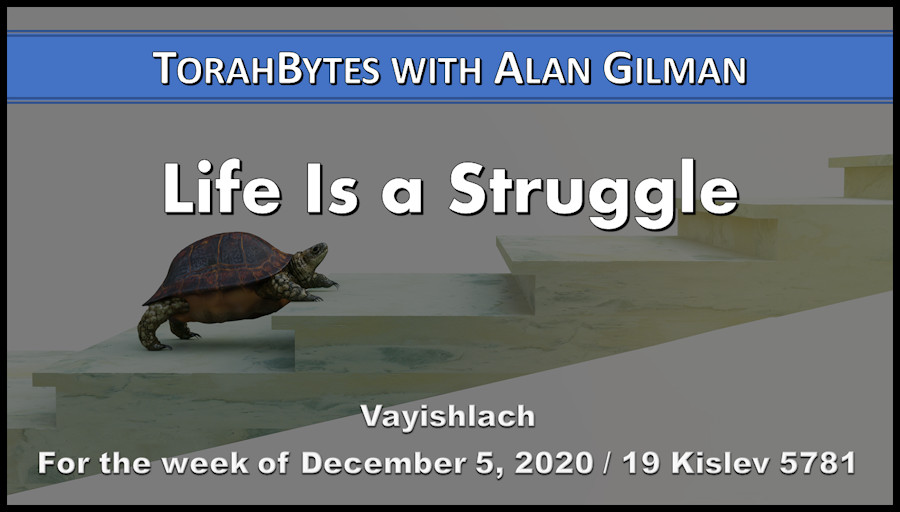
Life Is a Struggle

For the week of December 5, 2020 / 19 Kislev 5781

Turtle walking up stairs

Vayishlach
Torah: Bereshit/Genesis 32:4 – 36:43 (English: 32:3 – 36:43)
Haftarah: Hosea 11:7 – 12:12

Download Audio [Right click link to download]

And Jacob was left alone. And a man wrestled with him until the breaking of the day. When the man saw that he did not prevail against Jacob, he touched his hip socket, and Jacob’s hip was put out of joint as he wrestled with him. Then he said, “Let me go, for the day has broken.” But Jacob said, “I will not let you go unless you bless me.” And he said to him, “What is your name?” And he said, “Jacob.” Then he said, “Your name shall no longer be called Jacob, but Israel, for you have striven with God and with men, and have prevailed.” (Bereshit / Genesis 32:24-28)

The profound nature of the biblical stories is found not only in how remarkably they reflect common human experiences, but how they call us to become the kind of humans God designed us to be. It is this that prompts people like the controversial Canadian psychologist and professor Jordan B. Peterson to be passionate about the Bible even though he denies its historicity. The introduction to his biblical lecture series reads:

[The Bible] contains the most influential stories of mankind. Knowledge of those stories is essential to a deep understanding of Western culture, which is in turn vital to proper psychological health (as human beings are cultural animals) and societal stability. These stories are neither history, as we commonly conceive it, nor empirical science. Instead, they are investigations into the structure of Being itself and calls to action within that Being (https://www.jordanbpeterson.com/bible-series/).

Having listened to this series and other things he has said about the Bible, I don’t think Peterson has fully faced that the reason these stories are so profoundly relevant is because they really happened. These are not the projections of some highly developed human mind, creating archetypical stories for us to emulate. They are real-life encounters informed by the mind of God, designed to equip us for living effective godly lives (see 2 Timothy 3:16-17).

Despite Peterson’s denial of the Bible’s historicity, he well captures how its stories portray the intricacies and challenges of life. Many Bible readers, while honoring its divine inspiration and being adamant that it reports actual events, tend to treat it superficially (for more on this, see my blog/podcast, “In Celebration of Biblical Narrative: A Biblical Critique of Jordan B. Peterson”).

The story of Jacob’s wrestling with God is a case in point. Its significance begins with informing the reader of how Jacob became the patriarch he was called to be. Up until this point he had striven for success, but now he strives with God and discovers true blessing. The God whom he considered as only that of his father and grandfather finally becomes his God.

Jacob’s experience is not for Jacob alone. While few, if any, have literally wrestled with God, untold numbers have been through the process of agonizing prayer. This story presents Jacob as our model, metaphorically of course: hold on until God blesses us even if it hurts.

There’s more. Jacob’s wrestling with God is a picture of life in general. From the moment of conception, we face all sorts of challenges which must be overcome in order to live, not to mention, live well. Some struggles are easier than others. Some are impossible. But each and every struggle is designed to craft us into what we are meant to be. It’s in this sense we can say that life itself is wrestling with God.

Life is a struggle. As we grow up, we learn, one way or another, how to navigate that struggle. We may confront it, roll with it, run away from it, or deny it. We may blame it on others or numb ourselves against it. Not every tactic is the wisest or most beneficial. So while Jacob’s wrestling match on one hand reflects the general struggles of life, on the other, the key to truly overcoming them isn’t found in human effort alone. We should also note that unlike Jacob’s brother Esau, who threw his birthright away to satisfy a need, dire as it seemed in the moment, Jacob held on to the God of Israel until he prevailed. Only then did he become the man he was called to be.

I don’t know what you are going through right now. Whatever it is, remember, life is a struggle. Don’t give up. But don’t simply endure either. Hold on to the God of Israel until he blesses you.

Scriptures taken from the English Standard Version

Facebooktwitterredditpinterestlinkedinmail

Anybody Home?

For the week of November 28, 2020 / 12 Kislev 5781

A man unlocking his front door, and entering his house

Vayetzei
Torah: Bereshit/Genesis 28:10-32:3 (English 28:10 – 32:2)
Haftarah: Hosea 12:13-14:10 (English 12:12 – 14:9)

Download Audio [Right click link to download]

Then Jacob awoke from his sleep and said, “Surely the LORD is in this place, and I did not know it.” (Bereshit/Genesis 28:16)

Have you ever entered your house and called, “Is anybody home?” If no one answered, what did you do next? Did you immediately conclude that you were alone, or did you call out again in the same manner? If you called again and still no answer, what then? What did it take before you were satisfied that no one else was there? I imagine most of us would call out a couple of times and that would be enough. But have you really thought this through? Maybe someone is home, but they have their earbuds in and cannot hear. Maybe they are in the shower. Or they are sleeping. They may even be hiding.

Of course, depending on the situation and the people involved, we are most often capable of accurately sizing up situations like these. On the other hand, I suspect that some of you have funny, embarrassing, or frightening stories of when you thought you were alone but were not. This goes to show that it is very difficult, if not impossible, to prove the non-existence of something. Even if you scoured your entire house, you could never be completely certain that there was no one else there. All you can do is make a tentative conclusion based on reasonable evidence.

In Jacob’s case, he had been in the presence of God and wasn’t aware of it. Only upon awakening from his inspired dream did he realize that God had been there. You might think that since his experience was within a dream, it didn’t indicate anything about God’s actual presence in that place. Didn’t Jacob know the difference between a dream and reality? Perhaps Jacob overstated the significance of the dream. Yet, his statement reflects his general lack of God-awareness.

Until this point, we have no record of prior interaction between Jacob and God. In fact, the only mention of God from Jacob’s lips before this, was when he took the Lord’s name in vain while attempting (and succeeding) to steal his brother’s blessing (see Bereshit/Genesis 27:20). So, whether or not Jacob was correct in his understanding of how God’s presence manifested in the place he named “Beit-el,” he had been generally unaware of God altogether. Despite this experience, it would be many years before he would fully reckon with God’s reality in the world. Until his dramatic and painful encounter with God upon his return to the Promised Land (see Bereshit/Genesis 32:22-32), Jacob would continue to live his life as if God didn’t exist.

Many people have dismissed God’s reality because they concluded the evidence speaks against his existence. It doesn’t seem like anyone’s home, so we must be alone. I understand that God’s invisibility lends itself to such a conclusion. But if there are personal invisible forces at work in the universe, then we wouldn’t be able to see them. Evidence for their existence would need to be of a non-material sort. The problem is we process information via our physical senses. Thankfully, God is aware of that. After all, he made us this way. And that’s why he has made himself known through means which we can perceive.

Dreams are not the only way that God makes himself known. He is reflected in the grandeur, variety, and precision of nature; he demonstrates his power through unusual events; he reaches out to us through human kindness and love; and he is most clear through his written Word, especially with regard to the coming of the Messiah. For those who are openhearted and are willing to seek him out, the evidence for God’s existence is readily available. There really is someone home. God is not hiding. It is we who are too quick to conclude otherwise.

This is not simply a message for the unbeliever, the atheist, the God denier. We may confidently claim to believe in the existence of God, yet still live our lives as if no one is home. Just because he doesn’t impress himself upon us in the ways we might prefer, he expects us to be far more aware of his presence than we are normally. God is with us as he was with Jacob. We shouldn’t have to wait until things get drastic before we take him seriously. On the contrary, the times we are in currently are far more drastic than we know. It’s time we accepted that the Lord is in this place and act accordingly.

All scriptures, English Standard Version (ESV) of the Bible

Facebooktwitterredditpinterestlinkedinmail

What’s Your Birthright Worth?

For the week of November 21, 2020 / 5 Kislev 5781

Marble relief of Esau selling his birthright to Jacob. From the facade of the Milan Cathedral, Milan, Italy.

Marble relief of Esau selling his birthright to Jacob. From the facade of the Milan Cathedral, Milan, Italy.

Toldot
Torah: Bereshit/Genesis 25:19-28:9
Haftarah: Malachi 1:1 – 2:7

Download Audio [Right click link to download]

Once when Jacob was cooking stew, Esau came in from the field, and he was exhausted. And Esau said to Jacob, “Let me eat some of that red stew, for I am exhausted!” (Therefore his name was called Edom.) Jacob said, “Sell me your birthright now.” Esau said, “I am about to die; of what use is a birthright to me?” Jacob said, “Swear to me now.” So he swore to him and sold his birthright to Jacob. Then Jacob gave Esau bread and lentil stew, and he ate and drank and rose and went his way. Thus Esau despised his birthright. (Bereshit/Genesis 25:29-34)

For much of history it was common that the first-born male inherited the entire or main share of his father’s estate. To us today this seems completely unjust, but it appears that part of the reason for the custom was not a matter of unfair material advantage, but responsibility. It fell upon the first-born male to oversee the future of the family line. Do note, however, that despite the general practice of this custom in ancient Israelite society, in the Torah it was often the younger or youngest who carried on God’s mission in the world, be it Seth not Cain, Isaac not Ishmael, and—from this week’s parsha (Torah reading portion)—Jacob not Esau.

This custom, which has come to be known as “primogeniture,” provides the background for the powerful lesson we may learn from this story. However distasteful we may find primogeniture, Esau, as the older of the two twins, was set to inherit their father’s estate. This would have included the promises that God had given to their grandfather Abraham via their father Isaac. These promises were divine guaranties of national greatness, the land of Canaan, and being a powerful positive influence (blessing) among the nations of the world.

Before I continue, I can hear the more theologically minded saying, hold on. Esau would have never inherited these promises because God had determined otherwise. The issue of predeterminism is way bigger than what I can cover in a message like this. Regardless, let me be clear that thinking along those lines completely misses the point. We don’t have this story to fill us in on how God manipulates human affairs, which I don’t believe he does, by the way. What we do have here is a serious warning against giving in to a common human tendency that lurks inside each one of us.

By virtue of the customs of their day, both Esau and Jacob expected Esau to inherit his father’s estate. Yet, this story tells us that in a moment of great exhaustion, Esau was willing to give up his future inheritance for a bowl of stew. For the reader who understands what’s at stake, this may seem ridiculous. Perhaps Esau didn’t understand the value of what was rightfully his. In his mind, he may have been trading something of little to no value for a single meal. That’s doubtful, unless somehow Jacob was aware of God’s promises, while his brother was not. If that’s the case, then Esau’s devaluing of his birthright started well before this incident. He either knew what it meant and didn’t care, or he didn’t take the time to know. By the reader not knowing the contributing factors, the story covers all sorts of possibilities that may lead a person to make such a rash and foolish decision. Whatever Esau’s understanding was, this still is a tragic story. His nearsighted decision to satisfy a momentary physical desire cut himself off from God’s blessing.

One may think that Jacob was not much better, having used his brother’s weakness against him for personal gain. Moreover, there’s every reason to believe that Jacob didn’t fully understand the implications of the birthright. He would have some difficult lessons to learn moving forward. Yet, unlike his brother, he knew that his father’s estate was worth contending for.

God will deal with Jacob’s issues later, but for now, let’s not miss the opportunity to learn from Esau’s mistake. Esau represents the age we live in. Never before are we able to satisfy our desires in an instant as Esau did that day. And like Esau, we don’t know for what we are selling ourselves out in return. We get we want when we want it and that’s without the level of desperation Esau felt. Note that it’s not easy access to goods and services that’s our problem. It’s that we have been taught for some time now that satisfying self is a virtue. We love instant gratification so much, not only because it feels good in the moment, but because to deny our desires is one of today’s greatest sins. We are taught that to resist our desires is to diminish the very essence of who we are. If it’s stew we want, it’s stew we must have, whatever the cost. Replace “stew” for your desires.

Every human being has a birthright. Made in God’s image, we are to be conduits of his blessing to the world. Called to be royalty under the Heavenly King, we too cheaply sell off our divine inheritance in order to satisfy our desires in the moment. If we are going to live effective genuine lives in the way God designed us to, we need to grasp the value of our birthright and resist the temptation to sell it off.

All scriptures, English Standard Version (ESV) of the Bible

Facebooktwitterredditpinterestlinkedinmail

Give It Up

For the week of November 7, 2020 / 20 Heshvan 5781

Painting: The Sacrifice of Isaac, Marc Chagall, 1966

Painting: The Sacrifice of Isaac, Marc Chagall, 1966

Vayera
Torah: Bereshit/Genesis 18:1 – 22:24
Haftarah: 2 Melachim/ 2 Kings 4:1-37

Download Audio [Right click link to download]

By myself I have sworn, declares the LORD, because you have done this and have not withheld your son, your only son, I will surely bless you, and I will surely multiply your offspring as the stars of heaven and as the sand that is on the seashore. And your offspring shall possess the gate of his enemies, and in your offspring shall all the nations of the earth be blessed, because you have obeyed my voice. (Bereshit/Genesis 22:16-18)

“The Binding of Isaac,” as it is called in Jewish tradition, is a most disturbing story. Readers have struggled with how it could be that the God who reveals himself as “abounding in steadfast love and faithfulness” (Shemot/Exodos 34:6) could demand the sacrifice of another human being, let alone one’s own son. Clearly it was never God’s intention that he would go through with it since he stops Abraham at the last moment. While God was not going to allow Isaac to be sacrificed, what was the purpose of telling Abraham to do so in the first place?

The answer is in what God said to him following: “Now I know that you fear God, seeing you have not withheld your son, your only son, from me” (Bereshit/Genesis 22:22). God was testing the state of Abraham’s relationship with him based on whether or not he would withhold Isaac from him. The result was an affirmation of God’s earlier promises to him. Isaac was key to the fulfilment of the promises to be a great nation that would bless the entire world. The passing of this test was essential for these promises to come to fruition.

Abraham had gone through so much between God’s call on his life and this point. Leaving family and the familiar behind, he travelled to a strange and hostile land. Already well advanced in years, he and his wife were childless. This did not prevent Abraham from trusting God’s promise of becoming a great nation and possessing this land one day. He had no clue that it would be twenty-five years before the son of promise would be born. And now, everything hinged on Isaac. It was on Mount Moriah, where one day the Jerusalem Temple would be built, that God called for extreme relinquishment in order to move forward in the unfolding of his plan. Why was that so necessary?

Let’s fast forward two thousand years. Overlooking Mount Moriah, the Temple Mount, is the Mount of Olives. It’s there the Messiah would face his own test of relinquishment. After spending three years of teaching on God’s Kingdom and demonstrating its power, preparing his followers to carry on his mission, he had a date with destiny. Prior to this, he had sought to explain to his followers several times that it was necessary for him to suffer, die, and rise back to life. They couldn’t comprehend that the Messiah would do anything but lead them and the nation of Israel in victory over their oppressors by military means. Regardless, he was resolute that he must face a deadly onslaught of darkness. However, on the eve of his arrest, knowing what he would have to endure, he pleaded with his Father in heaven in agonizing prayer for a way out. Perhaps there might be some other way to fulfill God’s plan without having to suffer under the misrepresentations, mockery, beatings, and execution that lay before him. Despite his earnest desire for an alternative, he was clear: “not as I will, but as you will” (e.g. Matthew 26:39). Once he fully relinquished his claim on his life, he was ready to complete the task before him.

What may not be obvious is how for both Abraham and Yeshua these acts of extreme relinquishment work against the thrust of the curse that has oppressed the world since Adam and Eve. God’s original design for the creation called for human beings to oversee Planet Earth under God’s rule. Instead, our first parents turned from God to the Evil One, resulting in our becoming subservient to the creation rather than being its masters.

It is this oppressive situation that God sought to resolve from the beginning. He initiated a plan to break the curse, a plan which began with Abraham and developed over time within the context of the people of Israel and came to fruition in Israel’s Messiah. In order to be restored to our rightful place as stewards of the creation under God, we like Abraham and Yeshua need to relinquish our claim upon our own lives. It is when we die to self and the things of the world, that we begin to truly live.

Scriptures taken from the English Standard Version unless otherwise indicated

Facebooktwitterredditpinterestlinkedinmail

Be a Blessing

For the week of October 31, 2020 / 13 Heshvan 5781

Hands planting young plant in dark soil

Lech Lecha
Torah: Bereshit/Genesis 12:1-17:27
Haftarah: Isaiah 40:27 – 41:16

Download Audio [Right click link to download]

Now the LORD said to Abram, “Go from your country and your kindred and your father’s house to the land that I will show you. And I will make of you a great nation, and I will bless you and make your name great, so that you will be a blessing. I will bless those who bless you, and him who dishonors you I will curse, and in you all the families of the earth shall be blessed.” (Bereshit/Genesis 12:1-3)

God’s promise to Avram, whose name would later be changed to Avraham, sets the course for the entire Bible. Bereshit, the book of Genesis, informs us that human beings had been assigned the task of representing the Creator’s interests within his creation. Doubting God’s good intentions, they fell prey to temptation’s lure, plunging not only themselves and the whole human family, but the entire creation into corruption. It is not until Avram that we encounter the beginnings of God’s rescue plan for Planet Earth.

God’s rescue of his creation from the effects of Adam and Eve’s rebellion is described in terms of blessing. The Hebrew word for blessing is “barach,” which means, “to fill something with the potential for life.” It’s the opposite of “arar,” cursed, that which removes life or, in other words, brings death. The disobedience of our first parents brought God’s curse upon the creation. The promise to Avram is the beginning of God’s confrontation of the curse, culminating with the restoration of all things through Avram’s greatest descendant, the Messiah.

From the time God spoke these words until the future day of Messiah’s return, Avram’s descendants, natural and spiritual have been a blessing – not all of them all the time, nor, with the exception of the Messiah, no individual in an absolute and complete way. Still, so much of the goodness experienced throughout history has come to our broken world through God’s work in and through his people. For the blessing through God’s instruments are ultimately rooted in God himself and revealed through his Word. Tragically most people are not aware that the Hebrew Bible and the New Covenant Writings are the source of so many of the blessings we take for granted today, including the value of all human beings, the rule of law, personal responsibility, care for the poor and infirm, universal literacy, racial equality, ecology, the importance of family, the undermining of superstition, the importance of both work and rest, and so on.

Equally tragic is how the mishandling of biblical truth has been blamed on the Bible. For example, many fail to understand that despite the prevalence of slavery in so-called Christian societies that, without the teaching of Scripture, the transatlantic slave trade may have never been abolished. It was because God’s blessing as promised to Avram found fruition through some who were both blessed and were a blessing.

God was well aware of the twisty road between his calling Avram and the eventual day of permanent blessing through the Messiah. Through this time, he has looked for those who would be his instruments of blessing. That God will set all things right eventually doesn’t mean we should wait passively for that day. It’s truly heart-warming to know that the burden of the curse will finally be lifted, but until then we are not to stand back and passively wait, but rather we must do everything we can in our day to be a blessing.

It’s not easy to be a blessing. It’s much easier to let things be. But when we let things be, they don’t stay the way they are, they go bad or get worse. This is how the dynamic of the curse works: things left to themselves decay. It’s only through the power of life-giving blessing that we effect positive change.

That means we need to follow Avram’s example. He obeyed God’s call to leave family and the familiar and venture into hostile territory. He didn’t know how that would make a difference. In fact, he didn’t need to know. He just needed to be willing to face the challenges of uncertainty as he trusted God to guide him. What that looks like for you or me will be different, except it always means we need to be open to God’s voice and be willing to do whatever he says.

Scriptures taken from the English Standard Version unless otherwise indicated

Facebooktwitterredditpinterestlinkedinmail

System Reboot

For the week of October 24, 2020 / 6 Heshvan 5781

A restart symbol superimposed upon a view of earth from outer space

Noach
Torah: Bereshit/Genesis 6:9-11:32
Haftarah: Isaiah 54:1 – 55:5

Download Audio [Right click link to download]

And God blessed Noah and his sons and said to them, “Be fruitful and multiply and fill the earth.” (Bereshit/Genesis 9:1)

I am the main computer person at home. It helps that for years I worked in high-tech, including providing computer training and technical support. Most of the time, my wife and kids have no issues with their various technical devices, but every now and then, they need my help: the screen is frozen, the mouse is stuck, the sound isn’t working, the web browser is too slow, a program won’t open, etc. These things don’t happen as often as they once did, but when the solution isn’t obvious, I often suggest restarting, or as it’s commonly called, rebooting. Rebooting clears out any data that may be lodged in memory and resets the computer, tablet, or phone. There are times when this is not the answer. Depending on the device, loose cables may need tightening, programs may need to be reinstalled, a virus might be present, and so on. The solutions to many of these problems are also pretty simple, except for viruses. Rebooting won’t repair physical damage, of course, but before taking more drastic measures, it’s always worth a try. But do remember before rebooting, save all open documents, if you can. Otherwise certain information may be lost forever.

Our planet is a very complex system within a larger complex system, the universe. This week’s Torah portion is about the time when the system of life on earth was so problematic, it needed to be rebooted. After Adam and Eve rebelled against God’s directions, human existence went from bad to worse. Near the end of last week’s portion it reads: “The LORD saw that the wickedness of man was great in the earth, and that every intention of the thoughts of his heart was only evil continually” (Bereshit/Genesis 6:5). Every intention of the heart continually evil! That’s pretty bad. The passage goes on to say: “And the LORD regretted that he had made man on the earth, and it grieved him to his heart” (Bereshit/Genesis 6:6). It is difficult for us to conceive how God could regret his original plan or how he might experience grief, but he did. Time to reboot!

I imagine he could have completely destroyed the earth instead, but he didn’t. Having found one man who was in right relationship with him, Noah, he restarted the human race through him and his family. He then blessed him to “Be fruitful and multiply and fill the earth,” the same words he had said to Adam and Eve (see Genesis/Bereshit 1:28).

By rebooting the earth rather than replacing it altogether, God demonstrates his commitment to the system he created. The creation is essential to the plan of God. That might be hard for some people to understand or accept, for there is a tendency for spiritually minded people to view the material world as somewhat of a mistake. Associating evil with the creation itself is contrary to how the Bible regards life. Scripture views the material and the spiritual aspects of the creation as an integrated whole. We are called to love and serve God within the material world as integrated material/spiritual beings. The New Covenant Writings tell us that God’s motivation for sending the Messiah was that he “loved the world” (John 3:16). The Greek word for “world” here is “cosmos,” referring to the whole of creation, not just the people in it. Not only does God love the creation, he continues to work out his plans and purposes within it, the culmination of which will be a new heavens and a new earth (see Isaiah 66:1-24; esp. v.22).

The new heavens and the new earth are not a reboot, but an upgrade. While there are aspects of the current system that will carry-over to the new, there will be brand new features, some of which we have a taste of today through Yeshua the Messiah, including right relationship with God, forgiveness, and healing. The new system will feature God’s personal presence on earth forever along with the complete eradication of evil, sickness, and death.

You can experience the preliminary features of the coming upgrade right now, but for a limited time only! All you need to do is turn from self to God and trust in Yeshua’s death and resurrection. Your sins will be forgiven, you will have an intimate relationship with God, and you will live forever in his new creation. Act now before it’s too late!

Scriptures taken from the English Standard Version unless otherwise indicated

Facebooktwitterredditpinterestlinkedinmail

This Is My Father’s World

For the week October 17, 2020 / 19 Tishri 5781

Laughing young child with apple

Bereshit
Torah: Bereshit/Genesis 1:1 – 6:8
Haftarah: 1 Samuel 20:18-42

Download Audio [Right click link to download]

And God saw everything that he had made, and behold, it was very good. And there was evening and there was morning, the sixth day. (Bereshit/Genesis 1:31)

Many years ago, I was working as an instructor at a business college in Vancouver, British Columbia. As far as I know, I was only one of two believers among the staff. One day he and I were sitting in the lunchroom by ourselves, as he was enjoying the sort of large, very red apple that grows in British Columbia and Washington State. I pointed at his apple and exclaimed, “Our Father made that!” Instead of receiving the positive response I expected, he said something to the effect of: “I don’t necessarily share your perspective.” He might as well have added, “You fundamentalist simpleton, living in a fantasy land you call ‘faith!’ Don’t you know the slightest thing about botany? This apple is a cultigen, the product of ‘a plant that has been deliberately altered or selected by humans; …the result of artificial selection’ (https://en.wikipedia.org/wiki/Cultigen; cf. https://en.wikipedia.org/wiki/Red_Delicious).”

I was saddened by his reaction. It reminded me of my father-in-law’s concern when we were still fairly new parents. He had asked a couple of our young children if they knew where they came from. As a devout atheist himself, he didn’t appreciate that their answer was “from God.” He made it clear to us that he hoped we would eventually teach them “the truth.”

I was less surprised by my father-in-law’s reaction than that of my “brother in the Lord.” That atheists reduce life to nothing besides nature is understandable. To them, bringing in God at all is dismissed as make believe or worse. But for a theist to detach the fruit (literal fruit in this case) from God’s creativity completely undermines the essence of his creation.

Pitting science against faith reflects misconceptions about each. Science is a useful tool in the analysis of nature. It can reveal how the natural world works. I find it curious however, that it is often presented not only as a system of exhaustive knowledge of everything there is to know, but also as a complete unchanging body of thought. For example, we hear politicians claiming that their particular policy on a certain issue is based on “the science.” Not only is science, good science at least, an ongoing investigation of observable natural entities and processes, it is always open to new information, which should challenge previous conclusions. Moreover, science is not the knowledge of everything. By itself, it is not very useful in determining its application. Just because we discover something can be done, doesn’t mean it should be done.

Faith, at least of the biblical variety, which I hold to be its only legitimate form, is not a denial of the natural world. Far from it! Faith is the lens by which we can most clearly observe the world in which we live. Well-informed biblical faith enables us to discover the “shoulds” of life, not by being blind to the world, but by the best understanding of it.

I know full well that my colleague’s apple was the result of years of careful cultivation on the part of human beings, just like I (and my children) know how babies are made. But life is far more than mechanical, naturalistic processes. The universe we inhabit is a vast and complex dynamic system designed, implemented, and sustained by God within which his plans and purposes are worked out. The Creator has assigned human beings to represent him by overseeing and caring for his creation. Our lives are to reflect God and his character in everything as we hear his voice and do his will. He then, as our ultimate Father, demonstrates his love through his providential care in and through the creation, including you, me, and others. This is most fully expressed in the gift of his Son in the person of the Messiah, through whom we are reconciled to him.

It is when we are in right relationship with God through Yeshua that we can appreciate the basic, though broken, goodness of the creation. Faith is that which enables us to see the creation’s goodness for what it really is. How the mechanics of the entire system of creation works, I don’t know. God bless the scientists as they do their work. What I do know is that every apple, every child, every good thing we enjoy, is a precious and deliberate gift from our loving Heavenly Father. To miss that is to miss what creation is all about.

Scriptures taken from the English Standard Version unless otherwise indicated

Facebooktwitterredditpinterestlinkedinmail

Joyful Torah

For the week of October 10, 2020 / 22 Tishri 5781

Painting: The Feast of the Rejoicing of the Law at the Synagogue in Leghorn, Italy by Solomon Hart, 1850

Painting: The Feast of the Rejoicing of the Law at the Synagogue in Leghorn, Italy by Solomon Hart, 1850. Public Domain.

Shemini Atzeret
Torah: D’varim/Deuteronomy 14:22 – 16:17; B’midbar/Numbers 29:35 – 30:1
Haftarah: 1 Melachim / 1 Kings 8:54-66

Download Audio [Right click link to download]

So Moses told the people of Israel everything just as the LORD had commanded Moses. (B’midbar/Numbers 29:40)

This weekend brings the annual high holy day season to a close. Beginning with Rosh Hashanah, the new year, the traditional expression of the biblical Feast of the Blowing of the Shofar (ram’s horn); followed ten days later by Yom Kippur (the Day of Atonement), a national day of humility; it culminates with Sukkot (the Feast of Booths), a week-long harvest thanksgiving festival that commemorates God’s care and provision of the Israelites during the forty years in the wilderness prior to entering the Promised Land.

Sukkot lasts seven days plus one. Each year, after the people of Israel live in temporary dwellings for seven days, we were to move back into our permanent dwellings and observe an additional holy day. Thus, it became known as Shemini Atzeret, the eighth day of assembly, which this year begins Friday evening, October 9; coinciding with Shabbat.

A feature of Shemini Atzeret is that it marks the restarting of the annual Torah reading cycle. This celebration, called Simchat Torah (English: Rejoicing Over the Torah) is one of the most joyous Jewish occasions of the year. The Torah Scrolls are removed from their special cabinet and carried inside and outside the synagogue with exuberant singing and dancing. In Israel, Simchat Torah is observed the same day as Shemini Atzeret. While in the diaspora, it is the following day (this year, beginning the evening of October 10).

Non-Jews familiar with the Bible may find it curious to associate rejoicing with what is commonly known as “the Law.” Doesn’t the New Testament teach that the Law was the heavy yoke that crushed the ancient Israelites (see Matthew 11:28-30 and Acts 15:10), and that its only purpose was to demonstrate the sinfulness of human nature (see Romans 3:19-20)? But if that is the case, why then would King David write: “the precepts of the Lord are right, rejoicing the heart” (Psalm 19:8)?

The negative caricature of the Torah, supposedly derived from the New Covenant Writings, is one of the greatest tragedies of history. The true purpose of Torah has been obscured by confusing it with the system of the Sinai Covenant along with additional overbearing obligations forced upon people by religious leaders over time. Moreover, Torah’s illumination of human nature is a good thing designed by God to lead people to depend on him for the godliness delineated in Torah, not to disparage it nor discard it.

All of God’s written Word, beginning with the Torah as its foundation, is life giving. Through its pages we are instructed in his perfect ways. From sexuality to hygiene to politics to agriculture to business, God’s Torah, his instruction, guide our lives in a path of goodness, health, and life.

Torah was given to Israel at Mount Sinai and eventually shared with the world through the followers of the Jewish Messiah. The ways of God as revealed in Scripture are not principles developed by reason or higher consciousness; they are a gift from heaven. A gift certainly worth celebrating!

Scriptures taken from the English Standard Version unless otherwise indicated

Facebooktwitterredditpinterestlinkedinmail