For the week of September 26, 2026 / 15 Tishri 5787
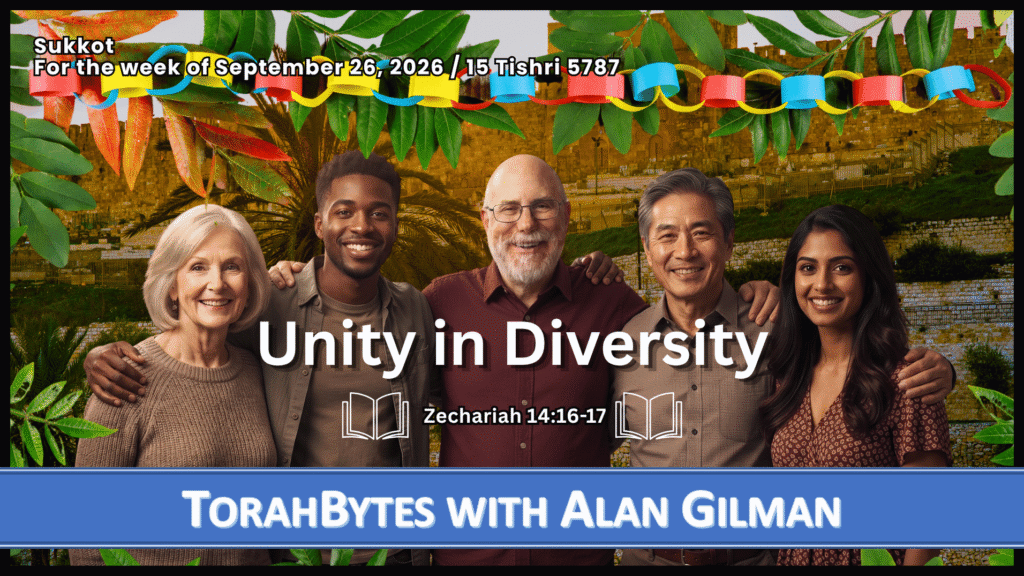
Click image to view video version
Sukkot
Torah: Vayikra/Leviticus 22:26 – 23:24; B’midbar/Numbers 29:12-16
Haftarah: Zechariah 14:1-21
Originally posted the week of October 3, 2020 / 15 Tishri 5781 (updated)
Then everyone who survives of all the nations that have come against Jerusalem shall go up year after year to worship the King, the LORD of hosts, and to keep the Feast of Booths. And if any of the families of the earth do not go up to Jerusalem to worship the King, the LORD of hosts, there will be no rain on them. (Zechariah 14:16-17)
One of the most difficult issues faced by Yeshua-followers—and not just Yeshua-followers, but the entire world—is the tension between unity and diversity. From the beginning, the human family has been fractured, starting with God’s cursing of Adam and Eve, which created tension between males and females (see Bereshit/Genesis 3:16b), and was quickly followed by the murder of their son Abel by his jealous brother, their firstborn, Cain (see Bereshit/Genesis 4:1-16). This explodes when, as a consequence of the misguided Babel-building project, the world divided into people groups due to the confusion of languages (see Bereshit/Genesis 11:1-9).
Since then, most attempts to unify human beings have been by brutal tyrannies, which at best have been partial, fragile, destructive, and, obviously, temporary. Temporary, that is, until the proclamation of the Kingdom of God through the Good News of the Messiah Yeshua. God’s plan was always to rectify the disunity resulting from Babel and rooted in sin. God’s desire to unite the human family lies at the very core of biblical faith. It is not only core to a genuine relationship with God in Yeshua, but God’s Spirit, poured out upon those who truly trust in the Messiah, is also the only power that can mend the systemic brokenness that continues to plague our planet.
Tragically, however, the unity God is seeking to restore has been grossly misunderstood as uniformity. While I assume no one even slightly aware of the biblical teaching on this subject believes we are all to be identical to each other, when it comes down to it, there tends to be an underlying discomfort with diversity, especially regarding national or ethnic expression.
Certainly, this is a much larger subject than can be adequately covered in a short message like this. But let me share something from this week’s readings that should powerfully inform our thinking. These readings are special for the first day of Sukkot (English: Booths or Tabernacles), the people of Israel’s week-long harvest thanksgiving festival, which also commemorates God’s provision and care for the people during the wilderness wanderings following the Exodus from Egypt. As usual, whenever a major festival falls on Shabbat, the regular readings are replaced by special ones relevant to the occasion.
The Haftarah (reading from the Prophets) for the first day of Sukkot is from Zechariah. At the end of his book, the prophet provides details about what the Bible understands as the olam ha-ba (English: world or age to come). That was Israel’s great expectation: God’s restoration of the creation when he would establish his rule on Earth forever. One aspect of this, according to Zechariah, is that in that time the nations would come to Jerusalem to celebrate Sukkot.
I know that this idea evokes all sorts of questions—not to mention controversies—but I want to point out one thing: the nations come to Jerusalem. That means that at the restoration of all things, the nations as defined and distinct entities will still exist. Some think this is reserved for a limited golden age between now and the final restoration. The problem with this is that the Bible doesn’t see it that way. For example, the book of Revelation echoes Zechariah. At the end of Revelation, we have a description of the new heavens and new earth, an aspect of which is the coming down of the new Jerusalem from heaven to earth (see Revelation 21:1–2). This is clearly the age to come, the time when God makes everything right. We read:
And I saw no temple in the city, for its temple is the Lord God the Almighty and the Lamb. And the city has no need of sun or moon to shine on it, for the glory of God gives it light, and its lamp is the Lamb. By its light will the nations walk, and the kings of the earth will bring their glory into it, and its gates will never be shut by day—and there will be no night there. They will bring into it the glory and the honor of the nations (Revelation 21:22-26).
Just as Zechariah predicted, the nations will still exist. Moreover, they will have an essential relationship to future Jerusalem. The unity of all peoples in no way blends everyone into one singular nation. Unity in the Messiah connects us with God’s purposes and plans in and through Israel without nullifying our unique distinctions.
Reckoning with our destiny as God’s family in a way that retains national distinctives is a first step toward the unity in diversity God calls us to today.
Scriptures taken from the English Standard Version