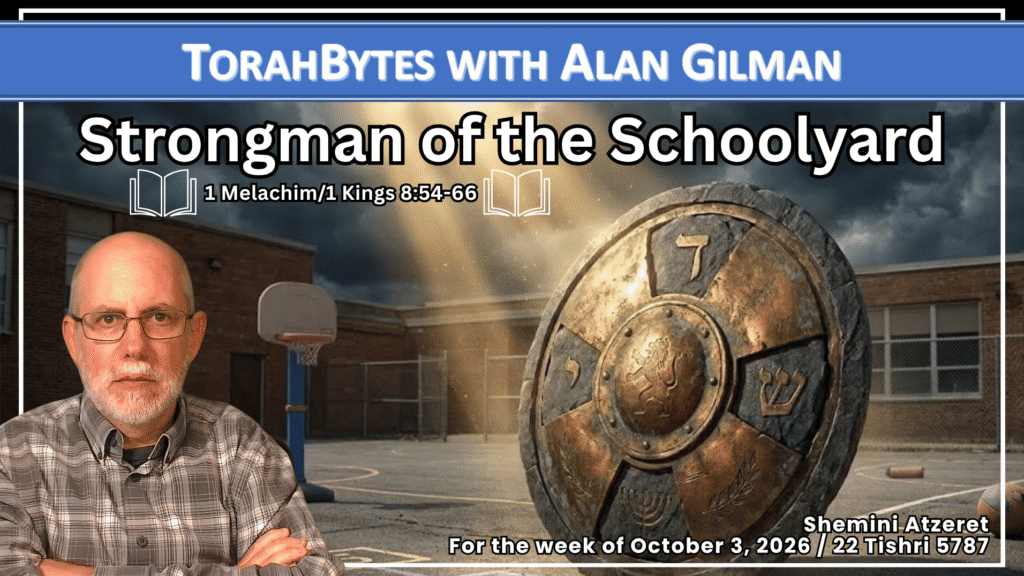
God’s Forgiveness

For the week of September 19, 2026 / 8 Tishri 5787

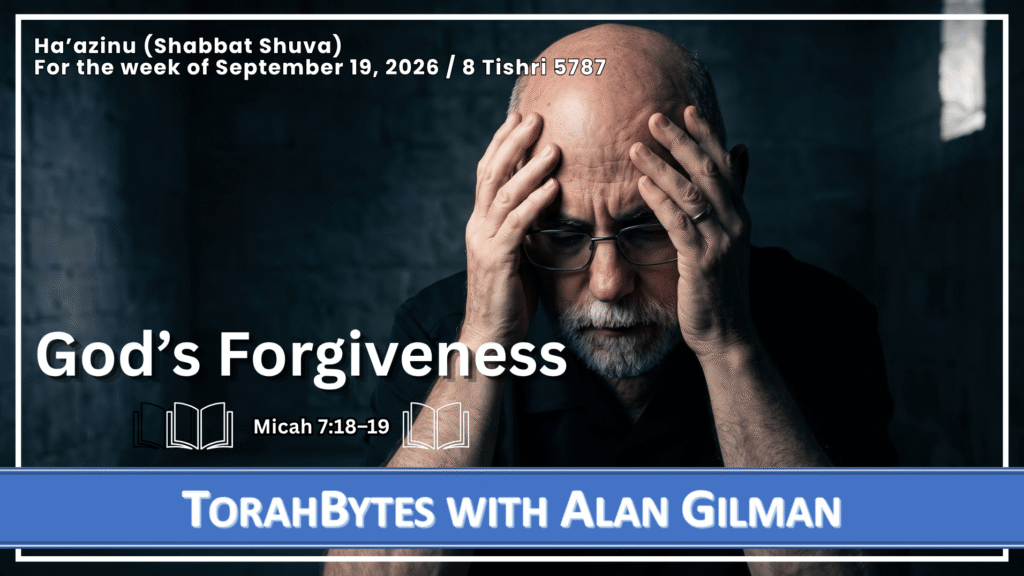
Message information over an AI-generated graphic of TorahBytes host, Alan Gilman, looking dejected in a prison-like room

Click image to view video version

Ha’azinu (Shabbat Shuva)
Torah: D’varim/Deuteronomy 32:1-52
Haftarah: Hosea 14:2-10 (English: 14:1-9); Micah 7:18-20; Joel 2:15-17
Originally posted the week of October 1, 2022 / 6 Tishri 5783 (updated)

Who is a God like you, pardoning iniquity and passing over transgression for the remnant of his inheritance? He does not retain his anger forever, because he delights in steadfast love. He will again have compassion on us; he will tread our iniquities underfoot. You will cast all our sins into the depths of the sea. (Micah 7:18–19; ESV)

We are currently in the High Holy Day season, particularly “the Ten Days of Awe,” the time between Rosh Hashanah (the Jewish New Year, the biblical Feast of the Blowing of the Shofar) and Yom Kippur (the Day of Atonement). This week’s Haftarah readings are excerpts from three Hebrew prophets and fit the season’s themes.

I find the concept of God’s forgiveness so striking. Whether or not I have done anything seriously wrong, I can easily be burdened by wondering whether what I said or did was the right thing or not. I struggle with perfectionist tendencies and an inordinate desire for other people’s approval. Some of you can relate, I am sure. “Should I have said that? What are they thinking? I am sure it was the right thing to do, but I probably could have done better. Perhaps if I had said it differently. But am I responsible for how other people react or perceive me?” It’s exhausting!

Then the thought comes to me: I am forgiven; God forgives me. I am not saying I shouldn’t take responsibility if I’ve done something truly wrong. Believe me, I am not saying that! It’s that I am impressed by how, objectively speaking, my life rests upon a foundation of forgiveness. Because of what God has done for me through the sacrifice of the Messiah, I am right with God. You may think that someone as biblically and theologically savvy as I am should have this down pat. But for me, like many of you, that’s easier said than done. The fact is, whenever it hits me that I am actually and truly forgiven, it’s as if I am experiencing it for the very first time.

As I have thought about this, I realized that since I have been made right with God, I am also right with the universe. Sorry if that sounds too mystical, but stay with me for a second. The term “sin,” is a biblical concept to describe the way human beings fail to meet God’s standards. It’s something we do (or don’t do) that is rooted in that part of our nature that’s been inherited from the beginning when our first parents, Adam and Eve, disobeyed God. The result of sin is God’s cursing of the human family and the entire creation in which we live. It’s as if everything is tainted or broken as a result of human rebellion against God.

When Messiah came and presented himself as a perfect offering, he repaired the brokenness affected by the curse. Since then, history has been in a process of renewal that will culminate upon his return, when he will judge all who have ever lived and will fully establish God’s reign forever. Trusting in the Messiah reconciles us with God and connects us to God’s restorative power now. While we continue to interact with the world’s current broken state, it’s as if we do so within the context of the final restoration.

Forgiveness releases the believer from the control and effects of sin. Sin no longer defines who we are or determines our destiny. The barriers between God and us have been removed. As a result, the resources of heaven, God’s goodness and power, are at our disposal. Our restored relationship with God changes our relationship to the entire creation. The broken creation will continue to trouble us, however. Yet, because of God’s forgiveness, it needn’t have the upper hand in my life. God isn’t holding my sin against me any longer. Instead, his love and presence are guaranteed.

The prophet Micah foretold that God would “cast all our sins into the depths of the sea” (Micah 7:19). This is where the custom of “tashlikh” comes from. Usually performed on the first day of Rosh Hashanah, people go to a flowing body of water and take food, usually bread, and cast it from their pockets into the water to symbolize God’s casting our sins into the sea. Because God has cast away our sins, we needn’t be burdened by them anymore.

Scriptures taken from the English Standard Version

Facebooktwitterredditpinterestlinkedinmail

Connecting with God’s Reality

For the week of September 12, 2026 / 1 Tishri 5787

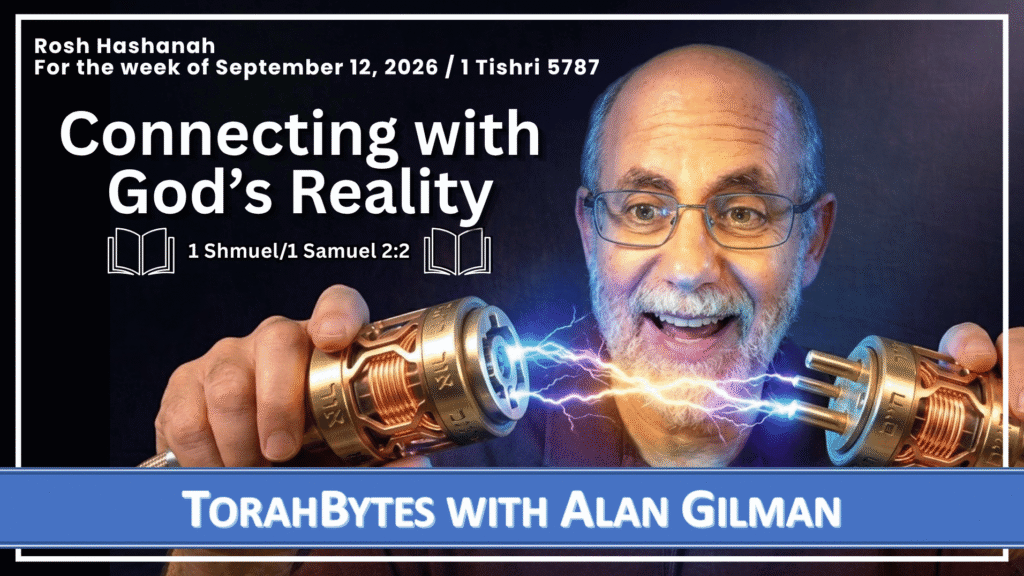
Message information along with an AI-generated image of the TorahBytes host, Alan Gilman, about to connect a large power cable

Click image to view video version

Rosh Hashanah
Torah: Bereshit/Genesis 21:1-34; B’midbar/Numbers 29:1-6
Haftarah: 1 Shmuel/1 Samuel 1:1–2:10
Originally posted the week of September 19, 2009 / 1 Tishri 5770 (updated)

There is none holy like the LORD; there is none besides you; there is no rock like our God. (1 Shmuel/1 Samuel 2:2)

God gets a lot of attention. We hear about him all the time from the mouths of believers and non-believers alike. He is adored, he is scorned, he is exalted, he is mocked. Though many try, he cannot be ignored. I don’t think there is a being or concept in all of human experience upon which so much effort has been spent trying to disprove. As for those who choose not to ignore him, how to relate to him has been far from straightforward. Millions of people claim some sort of belief in God, but the differences among the various versions of him are so great that they turn off many curious seekers, who think it impossible to come to any definite understanding. However, it doesn’t have to be this way.

To some, the Bible is just a book of superstitions and myths—one of a multitude of human attempts to define supposed spiritual reality. That it claims to reveal the one true God is taken to be no different from all the other so-called sacred texts in existence. Yet, there is something about how God is presented in the Bible that sets it apart from everything else. The Bible doesn’t try to convince us to accept a God who is distant and unknowable. On the contrary, it invites us to know God intimately and to encounter his reality for ourselves.

This week’s Haftarah is special for the Jewish New Year, Rosh Hashanah (this year, starting Friday evening, September 11). It was likely chosen to parallel the special holiday Torah reading that speaks of the miraculous birth of Abraham and Sarah’s son, Isaac. The Haftarah speaks of another special birth, that of the prophet to be, Shmuel/Samuel. In both cases, the mothers-to-be were unable to conceive. Channah/Hannah, Shmuel’s mother, was desperate for a child—a desperation she took to God. We might miss how profound her request was. She performed no complex ritual nor pronounced some elaborate incantation. Rather, from an honest but hurting heart, she cried out to the invisible creator God, who, since he had made the universe and had given her ancestor Sarah a child in her old age, could certainly give her, another barren woman, a child. And he did.

When Channah fulfilled her promise to God by dedicating Shmuel to his service, she broke out in an exuberant song, proclaiming her understanding of God. What makes her song special is that it emerged from a reality that, until that moment, had been hypothetical. It’s not that she didn’t know God before. Obviously she did, or else she would not have prayed as she did. But God’s provision of a son confirmed what she already believed, thus allowing her to walk in God’s reality at a much deeper level.

God doesn’t expect us to only know him theoretically. That which we know about him in theory is meant to be responded to. His reality is meant to be proven through lives willing to take him at his word. We may not be as desperate as Channah was, but as we earnestly pursue him, we will find him. Channah is but one example of people just like us, whom God is inviting to experience his reality as she did.

At this, the beginning of another year, we have an opportunity to see whether our understanding of God is merely theoretical or a proven reality. The Bible claims that God wants to be real in our lives. We are not expected to pretend, get hyped up, or be content in our confusion and emptiness. On the contrary, there is a reality beyond our wildest dreams waiting for us to take hold of, if we are willing to let it take hold of us.

All scriptures, English Standard Version (ESV) of the Bible

Facebooktwitterredditpinterestlinkedinmail

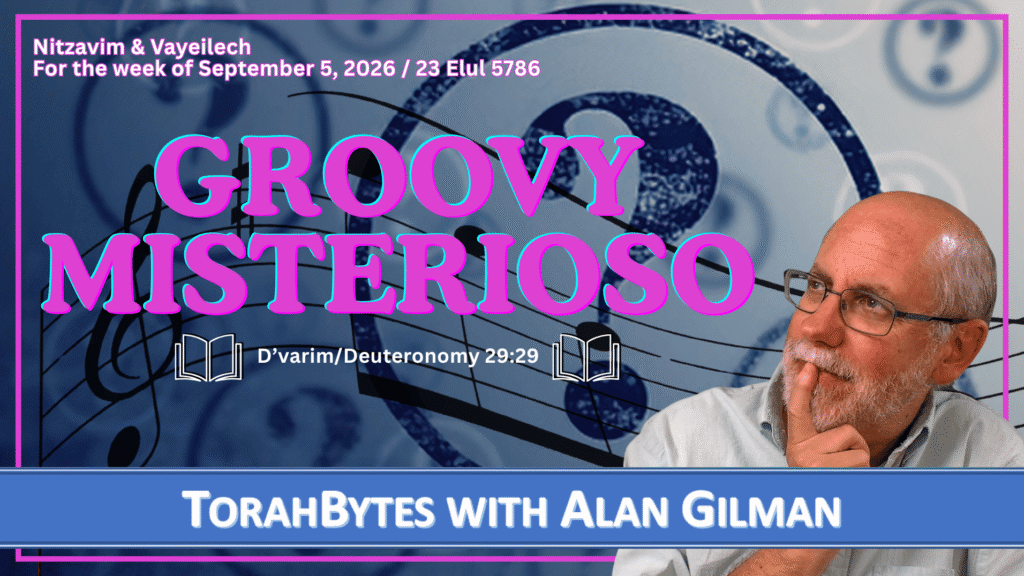
Groovy Misterioso

For the week of September 5, 2026 / 23 Elul 5786

TorahBytes Host, Alan Gilman, with message info over a musical, mysterious background

Click to view video

Nitzavim & Vayeilech
Torah: D’varim/Deuteronomy 29:9 – 31:30 (English: 29:10 – 31:30)
Haftarah: Isaiah 61:10 – 63:9
Originally posted the week of September 4, 2021 / 27 Elul 5781 (revised)

The secret things belong to the LORD our God, but the things that are revealed belong to us and to our children forever, that we may do all the words of this law. (D’varim/Deuteronomy 29:29)

Back in the 1970s, I played drums in my high school jazz band in Montreal. One of my favorite pieces was the “Pink Panther Theme” by Henry Mancini. As you may know, many pieces of music begin with an instruction in Italian to denote the tempo and feel of the piece. The Pink Panther uses the unique instruction “groovy misterioso” to denote a mysterious yet jazzy, cool feeling.

When something is mysterious, it is in the realm of the unknown. Mystery stories and movies are driven by key components hidden from the reader or viewer. Someone dies, for example, and we are led to suspect foul play. The story then anticipates the revealing of what’s hidden. If the mystery remains unsolved by the end, most people wouldn’t find the story satisfying.

Yet many readers of the Bible seem fairly content with unsolved mysteries. It is common for a teacher to assert a difficult-to-understand concept and say, “Ah, that’s a mystery,” expecting their students to respond with awe and wonder. God himself is often described as a mystery. The problem with this is that the Bible doesn’t describe him that way. Instead, he is accessible, knowable, and personable.

The Bible, the New Covenant Writings in particular, does use the word mystery, however. It’s the Greek word (no surprise!) “mystērion,” which appears twenty-seven times, mainly in Paul’s writings; once each in Matthew, Mark, and Luke, all in the context of Yeshua’s teachings on parables; and four times in the Book of Revelation. But it isn’t used to describe that which is unknown or too difficult for us to understand. Rather, it is used to describe truths that were previously unknown which have now been made known. One example is found in Ephesians, chapter three, where Paul explains that God’s intentions to include people of the nations in his messianic plan had been unknown until the good news of Yeshua was proclaimed by his followers.

This kind of mystery is very different from common mystery stories, where we are aware that something is going on but don’t know what it is, leaving us with a puzzle to solve. Bible mysteries are not puzzles, however. Yet that doesn’t stop some people from assuming that there are codes to crack and hidden messages to decipher. Biblical mysteries are also not unknowable knowables – the stuff of “you just need to accept what I am telling you even though you will never be able to understand it, because it’s a mystery!”

That doesn’t mean that everything about God and life, be it in the Bible or elsewhere, is knowable. Far from it! There is information that is not accessible to human beings. There are things that we simply can’t understand. That’s what Moses says in this week’s parsha (weekly Torah reading portion): “The secret things belong to the LORD our God, but the things that are revealed belong to us and to our children forever, that we may do all the words of this law (the English word, ‘law’ is torah in Hebrew)” (D’varim/Deuteronomy 29:29). This tells us that there exist knowable and unknowable things. God has deemed some matters to be secret, known only to him. They are not mysteries to solve. Instead, they are none of our business. Then there are the revealed things. These are our business. We are to learn them, do them, and pass them on to our children.

This is not to say that there aren’t knowable, but hard-to-understand, things as well. But they are not hidden. They are not mysteries. Sometimes we have to put in considerable effort through prayer and study to discover truth and how best to live accordingly.

The Torah tells us that God has graciously revealed in his Word all we need to know in order to live effective, godly lives. And that’s groovy!

To watch the Pink Panther Theme with Mancini himself on piano, click here.

All scriptures, English Standard Version (ESV) of the Bible

Facebooktwitterredditpinterestlinkedinmail