For the week of September 5, 2026 / 23 Elul 5786
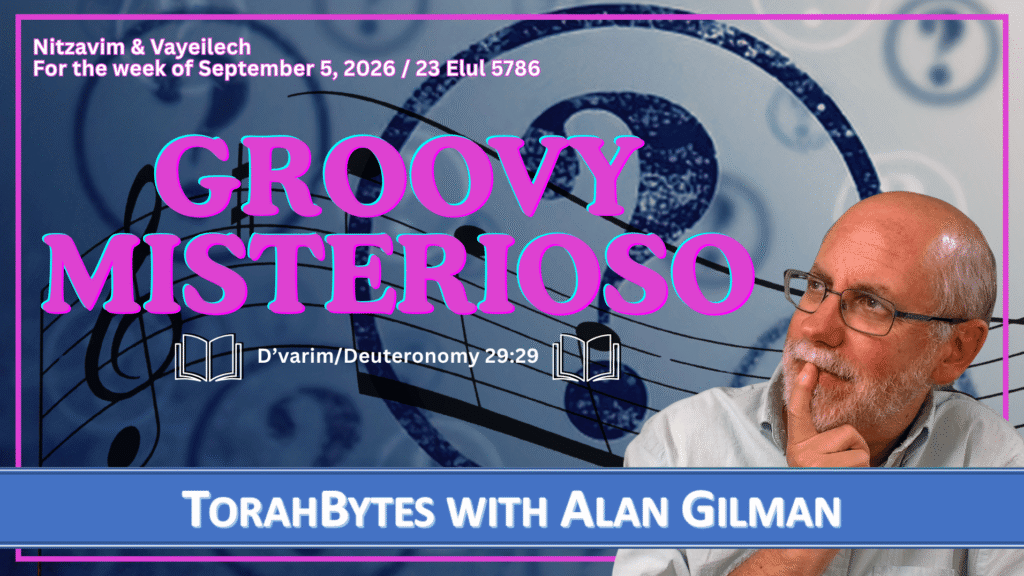
Click to view video
Nitzavim & Vayeilech
Torah: D’varim/Deuteronomy 29:9 – 31:30 (English: 29:10 – 31:30)
Haftarah: Isaiah 61:10 – 63:9
Originally posted the week of September 4, 2021 / 27 Elul 5781 (revised)
The secret things belong to the LORD our God, but the things that are revealed belong to us and to our children forever, that we may do all the words of this law. (D’varim/Deuteronomy 29:29)
Back in the 1970s, I played drums in my high school jazz band in Montreal. One of my favorite pieces was the “Pink Panther Theme” by Henry Mancini. As you may know, many pieces of music begin with an instruction in Italian to denote the tempo and feel of the piece. The Pink Panther uses the unique instruction “groovy misterioso” to denote a mysterious yet jazzy, cool feeling.
When something is mysterious, it is in the realm of the unknown. Mystery stories and movies are driven by key components hidden from the reader or viewer. Someone dies, for example, and we are led to suspect foul play. The story then anticipates the revealing of what’s hidden. If the mystery remains unsolved by the end, most people wouldn’t find the story satisfying.
Yet many readers of the Bible seem fairly content with unsolved mysteries. It is common for a teacher to assert a difficult-to-understand concept and say, “Ah, that’s a mystery,” expecting their students to respond with awe and wonder. God himself is often described as a mystery. The problem with this is that the Bible doesn’t describe him that way. Instead, he is accessible, knowable, and personable.
The Bible, the New Covenant Writings in particular, does use the word mystery, however. It’s the Greek word (no surprise!) “mystērion,” which appears twenty-seven times, mainly in Paul’s writings; once each in Matthew, Mark, and Luke, all in the context of Yeshua’s teachings on parables; and four times in the Book of Revelation. But it isn’t used to describe that which is unknown or too difficult for us to understand. Rather, it is used to describe truths that were previously unknown which have now been made known. One example is found in Ephesians, chapter three, where Paul explains that God’s intentions to include people of the nations in his messianic plan had been unknown until the good news of Yeshua was proclaimed by his followers.
This kind of mystery is very different from common mystery stories, where we are aware that something is going on but don’t know what it is, leaving us with a puzzle to solve. Bible mysteries are not puzzles, however. Yet that doesn’t stop some people from assuming that there are codes to crack and hidden messages to decipher. Biblical mysteries are also not unknowable knowables – the stuff of “you just need to accept what I am telling you even though you will never be able to understand it, because it’s a mystery!”
That doesn’t mean that everything about God and life, be it in the Bible or elsewhere, is knowable. Far from it! There is information that is not accessible to human beings. There are things that we simply can’t understand. That’s what Moses says in this week’s parsha (weekly Torah reading portion): “The secret things belong to the LORD our God, but the things that are revealed belong to us and to our children forever, that we may do all the words of this law (the English word, ‘law’ is torah in Hebrew)” (D’varim/Deuteronomy 29:29). This tells us that there exist knowable and unknowable things. God has deemed some matters to be secret, known only to him. They are not mysteries to solve. Instead, they are none of our business. Then there are the revealed things. These are our business. We are to learn them, do them, and pass them on to our children.
This is not to say that there aren’t knowable, but hard-to-understand, things as well. But they are not hidden. They are not mysteries. Sometimes we have to put in considerable effort through prayer and study to discover truth and how best to live accordingly.
The Torah tells us that God has graciously revealed in his Word all we need to know in order to live effective, godly lives. And that’s groovy!
To watch the Pink Panther Theme with Mancini himself on piano, click here.
All scriptures, English Standard Version (ESV) of the Bible
More on this week's reading (Beta version)
Note: The following link will open a list of other messages for this parsha (Torah reading portion). This feature is experimental. Some links may not work, especially if no message was produced for that week that year.
Click to see more messages for this week's readings
- Jewish Year 5787
- Jewish Year 5785
- Jewish Year 5784
- Jewish Year 5783
- Jewish Year 5782
- Jewish Year 5781
- Jewish Year 5780
- Jewish Year 5779
- Jewish Year 5778
- Jewish Year 5777
- Jewish Year 5776
- Jewish Year 5775
- Jewish Year 5774
- Jewish Year 5773
- Jewish Year 5772
- Jewish Year 5771
- Jewish Year 5770
- Jewish Year 5769
- Jewish Year 5768
- Jewish Year 5767
- Jewish Year 5766
- Jewish Year 5765
- Jewish Year 5764
- Jewish Year 5763
- Jewish Year 5762
- Jewish Year 5761
- Jewish Year 5760
- Jewish Year 5759
- Jewish Year 5758