The Days of Noah

For the week of October 17, 2015 / 4 Heshvan 5776
NoahsArk02_600

No’ah
Torah: Bereshit/Genesis 6:9 – 11:32
Haftarah: Isaiah 54:1-55:5

Download Audio [Right click link to download]

This is like the days of Noah to me: as I swore that the waters of Noah should no more go over the earth, so I have sworn that I will not be angry with you, and will not rebuke you. (Isaiah 54:9)

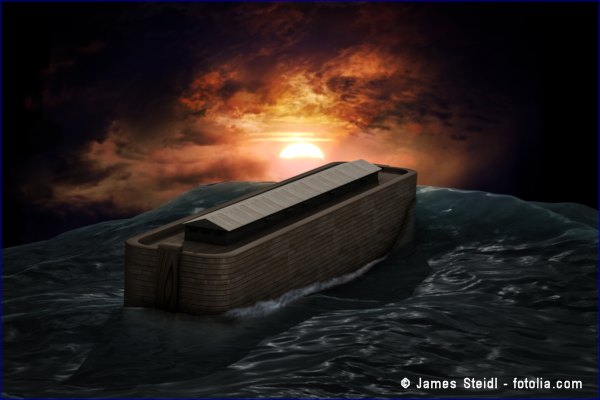
This week’s Haftarah (extra reading portion from the Prophets) was obviously chosen long ago because it included a reference to a key event in its associated Torah portion. The story of Noah and the flood is one of the greatest tragedies recorded in Scripture. The world had become so evil that “the LORD regretted that he had made man on the earth, and it grieved him to his heart” (Bereshit/Genesis 6:6). The word translated “regretted” is actually based from the same root word, “naham,” from which Noah’s name is derived. In some contexts, it can also mean “to comfort,” which appears to have been his father’s intention when he named him (see Bereshit/Genesis 5:29). This breadth of meaning encompasses the great irony of it all. God’s grief over extreme moral decay led to an extreme solution through Noah.

If in reference to times in which we live, I said, “this is like the days of Noah,” you may assume that I was making a statement about current moral decline. You might think that I was implying that we are on the brink of judgment, something similar to the devastating flood that wiped out all land and air creatures, except for Noah, his family and the animals on the ark. While that’s a reasonable conclusion, that’s not what God is saying through Isaiah in the quote I read at the beginning. Stating “this is like the days of Noah” in this context is not about the threat of judgement at all. On the contrary, it is a statement reaffirming God’s commitment to protect his people from such threats.

Soon after the flood, once the ground was sufficiently dry and Noah, his family, and the animals were able to leave the ark, God promised to never again destroy the world by a flood (see Bereshit/Genesis 9:11-17). The rainbow was to forever serve as a sign of God’s commitment to us. So many centuries later this is still the case. While flooding still poses a threat in the world, we needn’t fear the possibility of a flood of the magnitude of Noah’s day again. While that is good news for everyone everywhere, think what it must have meant to Noah’s generation. Talk about Post-traumatic stress disorder! While grateful for being preserved, what a horrific experience it must have been to witness the drowning of so many, and then to have to endure a whole year in a dark, cramped, smelly enclosed box, not to mention bobbing on the water for much of that time. Every drop of rain after that would have brought back extreme nightmarish memories. But every time the rainbow appeared the people would be reminded of God’s faithfulness.

This makes me wonder if the story of Noah’s ark isn’t more about not fearing dangerous threats than about the judgement that befell the world through the flood. It’s probably both, but I don’t think we spend enough time focused on God’s commitment to preserve his people.

But what are the days that are “like the days of Noah” spoken by Isaiah? Is this a general statement to the people of Israel to not fear hard times whenever they may occur? That’s a good principle to live by, but that’s not what’s going on here. God through his prophet is referring to another time, a time in the future that will be “like the days of Noah.” Through many of the Hebrew prophets we learn of such a day, when the threat of judgment will be no more. A day when Israel’s relationship with God will not only be restored but permanently established, never to be broken again. Due to the New Covenant as established by the Messiah, sin will be forgiven, the Torah (God’s teaching) will be internalized, and Israel will be God’s people forever (see Jeremiah 31:31-33). “Like the days of Noah,” but only more so, there will be nothing to fear ever again.

Until then, we can have a foretaste of that kind of security in God now. By putting our trust in Yeshua the Messiah’s death and resurrection, we, like Noah and his family, will be preserved in the midst of horrific circumstances. And even while the storms of life wage on, we needn’t be traumatized. Just as God has preserved us until now, he will continue to do so forever.

—

Scripture quotations are from The Holy Bible, English Standard Version®, copyright © 2001 by Crossway Bibles, a publishing ministry of Good News Publishers. Used by permission. All rights reserved.


Facebooktwitterredditpinterestlinkedinmail

God’s Development Plan

For the week of October 10, 2015 / 27 Tishri 5776

GodsDevPlan01_600

Bereshit
Torah: Bereshit/Genesis 1:1 – 6:8
Haftarah: Isaiah 42:5 – 43:11

Download Audio [Right click link to download]

But the LORD God called to the man and said to him, “Where are you?” And he said, “I heard the sound of you in the garden, and I was afraid, because I was naked, and I hid myself.” He said, “Who told you that you were naked? Have you eaten of the tree of which I commanded you not to eat?” (Bereshit/Genesis 3:9-11)

I have the impression that there is a misconception as to our first parents’ moral state at the time of their temptation. It’s actually a misconception we have about the creation in general. I hear people speak of that time of history as being perfect. That not only was life the way it should be at the time, there was no need for further development at all. I agree it was the way it should be, because God created it as such and pronounced it as “very good” (Bereshit/Genesis 1:31). But it should be obvious from the scriptural text that further development was essential to God’s plan. The creation of Planet Earth was not an end, but a beginning – a beginning of a vast development project to be supervised by human beings under the direction of God.

To describe the creation in general or Adam and Eve in particular as perfect confuses our understanding of the necessary development of life on earth, including that of the human family. Adam and Eve were created with particular capabilities given to them by God. But there is no reason to assume that those capabilities were functioning to their full potential from the moment of consciousness. Like their offspring to be, they had much to learn. What that learning would have been like had they not succumbed to the serpent’s deception, we don’t know.

So if we understand “perfect” as fully developed and functioning according to a thing’s potential – something we call “maturity” – Adam and Eve were not perfect, at least not yet. What they were was innocent, but they were also naïve. I used to think that the statement, “And the man and his wife were both naked and were not ashamed” (Bereshit/Genesis 2:25), meant that they were in a state of great moral purity along the line of the kind of perfection I was referring to. But this doesn’t seem to be the case. The reason why they were not ashamed of their nakedness was that they didn’t know they were naked. This is evident by what happened after they ate the forbidden fruit: “Then the eyes of both were opened, and they knew that they were naked. And they sewed fig leaves together and made themselves loincloths” (Bereshit/Genesis 3:7).

It is also the awareness of nakedness that caused them to try to hide from God. God’s response to this was to confront them with the question, “Who told you that you were naked?” God’s will for them at this point in their development didn’t include this aspect of self-awareness. As I mentioned, we’ll never know God’s original human development plan because they undermined it so early on. But might have lessons in self-awareness, sexuality, gender differences, and so on been on God’s agenda for them? We might assume so, since such things are addressed in God’s subsequence teaching through Moses and the rest of Scripture.

Sometimes people speak of God’s future restoration of the creation as a return to the Garden of Eden. Certainly there are aspects of that initial goodness and innocence that are essential to the age to come. However, there is no sense in Scripture that we are destined to return to the simplicity and naivety of those early days. The Scriptures anticipate a city, not a garden. We read of throngs of people and kings of nations worshipping the God of Israel (see Revelation 21-22). Might something similar have been God’s development plan all along? Again, we don’t know for sure, but certainly it was not to remain as it was.

While Adam and Eve’s sin is unique in that it brought God’s curse upon all of creation until the time of the full restoration when Yeshua returns, there is a something about their temptation experience that is practically relevant to us today. In fact, properly dealing with this dynamic is key to living truly godly lives. Even though unlike our first parents we carry from birth the burden of the curse upon us, we continually face the same sort of decision that they did that day. Throughout our lives, moment by moment, we hear as they did the Evil One contradicting the voice of God. Though his Word and by his Spirit, God seeks to direct us in the path of life. At the same time, the Evil One tries to convince us that God doesn’t really have our best interests in mind. He relentlessly seeks to make us think that it is preferable to assess life’s opportunities based on our own perceptions rather than God’s. Every time we do that, we head further down a destructive path.

But it doesn’t have to be that way. Through the Messiah, we can be part of God’s development plan again. By trusting in Yeshua’s death and resurrection, we need not repeat our first parents’ grave mistake. By his grace he gives us all we need to resist temptation and fulfill his instructions until we become perfected in him in every way.

Facebooktwitterredditpinterestlinkedinmail

Super Blood Moon

For the week of October 3, 2015 / 20 Tishri 5776

SuperBloodMoon01_600

Sukkot
Torah: Shemot/Exodus 33:12 – 34:26; Bemidbar/Numbers 29:26-34
Haftarah: Ezekiel 38:18-39:16

Download Audio [Right click link to download]

And my holy name I will make known in the midst of my people Israel, and I will not let my holy name be profaned anymore. And the nations shall know that I am the LORD, the Holy One in Israel. (Ezekiel 39:7)

The special Haftarah selection (reading from the prophets) for the festival of Sukkot (English: Tabernacles or Booths) is especially fitting. You may be aware of the great interest in the rare coalescing of several celestial and religious events happening at this time. The first evening of Sukkot this year (evening of September 27) is being marked by a potentially remarkable full lunar eclipse, referred to as a blood moon due to its telltale reddish color. It’s remarkable due to the full moon being the largest of the year. Four to six times a year we get larger than normal full moons, called supermoons, due to the moon’s closer proximity to the earth, but this one is the closest of the last 12 months. That in itself isn’t remarkable as it is an annual occurrence, but that it is also a full lunar eclipse – the first supermoon full lunar eclipse in over thirty years – has the potential of making it a spectacular sight. What has caught the attention of some students of the Bible is that this Sukkot lunar eclipse is part of a tetrad, which is the technical term used when four lunar eclipses in a row are all blood moons. What makes it more interesting is that the other three fell on the last two occurrences of Pesach and last year’s Sukkot.

Some claim that tetrads, especially when they fall on Jewish festivals, coincide with extraordinary events that significantly affect the Jewish people. But what does this have to do with our Haftarah portion? There’s no reference here to anything to do with moons at all. Well, as it turns out this passage has often been interpreted as describing a catastrophic scene that marks the end of the world as we know it, the kind of thing that may coincide with our super blood moon. Here we read about Gog and Magog, who come against the Land of Israel, but unknowingly have been drawn on their destructive quest by God himself, who through several cataclysmic events utterly destroys them. The result is that both Israel and the nations know who God really is once and for all.

Will the events of Ezekiel’s prophesy begin to unfold in the next few days? Might the super blood moon be a sign that the end (or the beginning of the end) is upon us? That is extremely possible, and I’ll tell you why.

Judgement is coming. Maybe it’s already here. Maybe things are going to take a turn for the worse. Or maybe it will get better before it gets worse. Maybe your life is already as bad as it will get. Or maybe you had it too good for too long. I don’t know. But what I do know is that at some point you and I will have to give an account for our lives. Every deed, every thought exposed, scrutinized, and judged. Judged by the Almighty. The rightful King is coming. He was already established as such following his death and resurrection. Since then he has been extending his rule by his Spirit, through his people, calling everyone everywhere to get right with the God of Israel before it is too late. For many it is already too late. The dead care little about blood moons and prophetic predictions. Perhaps you care too much. Are you more interested in prophetic speculations then you are about getting ready to face your Maker?

If you are reading this, then it’s not too late. The first evening of Sukkot promises to be spectacular, depending on where you live and if the sky is clear. But think of how much more spectacular it will be if through the Messiah Yeshua, you got your life in order. Then again, perhaps, you’re doing okay. Really; I’m not making fun. You may truly be one of the humble ones with a heart open to the will of your heavenly Father. You’re ready for the end. You have nothing to be afraid of. Still, perhaps this is a good time to ask your King, “Is there anything I have left undone?” You never know, God may want to make you a greater sign than a super blood moon.

Might we be in unusual times? Of that I have no doubt. Are we on the brink of some catastrophic event? We might be. But does it really matter whether the end is nigh or only yours? Read the signs and get right with God before it’s too late.

Facebooktwitterredditpinterestlinkedinmail