Groovy Misterioso

For the week of September 4, 2021 / 27 Elul 5781

Old book and magnifying glass

Nitzavim
Torah: D’varim/Deuteronomy 29:9 – 30:20 (English: 29:10 – 30:20)
Haftarah: Isaiah 61:10 – 63:9

Download Audio [Right click link to download]

The secret things belong to the LORD our God, but the things that are revealed belong to us and to our children forever, that we may do all the words of this law. (D’varim/Deuteronomy 29:29)

Back in the 70s, I played drums in my high school jazz band. One of my favorite pieces was the “Pink Panther Theme” by Henry Mancini. As you may know many pieces of music begin with an instruction in Italian to denote the tempo and feel of the piece. The Pink Panther has the unique instruction, “groovy misterioso” to denote a mysterious, but jazzy and cool feeling. (You can watch it here with Mancini himself on piano, but don’t forget to come back!)

When something is mysterious, it is in the realm of the unknown. Mystery stories, including movies, are driven by key components being hidden from the reader or viewer. Someone dies and we are led to suspect foul play is involved. The story then anticipates the revealing of what’s hidden. If the mystery remains unsolved by the end, most people wouldn’t find the story satisfying.

Yet, many readers of the Bible seem to be fairly happy with unsolved supposed Bible mysteries. When a teacher asserts a difficult-to-understand concept, their explanation is often, “Ah, that’s a mystery,” expecting their students to respond with awe and wonder. God himself, is often described as mysterious. The problem with that is that the Bible doesn’t describe him that way. Instead, he is accessible, knowable, and personable.

The Bible, the New Testament in particular, does use the word mystery, however. It’s the Greek word “mystērion” and appears twenty-seven times, mainly in Paul’s writings; once each in Matthew, Mark, and Luke, all in the context of Yeshua’s teachings on parables; and four times in the Book of Revelation. But it isn’t used to describe that which is unknown or too difficult for us to understand. Rather, it is used to describe truths that were previously hidden which have now been made known. One example is found in Ephesians, chapter three, where Paul explains that God’s intentions to include people of the nations in his messianic plan had been unknown until the good news of Yeshua was proclaimed by his followers.

This kind of mystery is very different from common mystery stories, where we are aware something is going on, but we don’t know what it is, and thus a puzzle to solve. Bible mysteries are not puzzles. Yet that doesn’t stop some people from assuming that there are codes to crack and hidden messages to decipher. Bible mysteries are also not unknowable knowables – the stuff of “you just need to accept what I am telling you even though you will never be able to understand it, because it’s a mystery!”

That doesn’t mean that everything about God and life, be it in the Bible or elsewhere is knowable. Far from it! There are things that we can’t understand. That’s what Moses says in this week’s parsha (weekly Torah reading portion): “The secret things belong to the LORD our God, but the things that are revealed belong to us and to our children forever, that we may do all the words of this law.” (D’varim/Deuteronomy 29:29). This tells us that there exist knowable and unknowable things. God has deemed some matters to be secret, known only to him. They are not mysteries to solve. Instead, they are none of our business. Then there are the revealed things. These are our business. We are to learn them, do them, and pass them on to our children.

This is not to say that there aren’t knowable, but hard-to-understand, things. But they are not hidden. Sometimes we have to put in considerable effort through prayer and study to discover truth and how best to live accordingly.

The Torah tells us that God has graciously revealed in his Word all we need to know to live effective, godly lives. And that’s groovy!

All scriptures, English Standard Version (ESV) of the Bible

Facebooktwitterredditpinterestlinkedinmail

Arise & Shine!

For the week of August 28, 2021 / 20 Elul 5781

Person in a victorious stance facing the sun

Ki Tavo
Torah: D’varim/Deuteronomy 26:1 – 29:8 (English: 26:1 – 29:9)
Haftarah: Isaiah 60:1-22

Download Audio [Right click link to download]

Arise, shine, for your light has come, and the glory of the LORD has risen upon you. For behold, darkness shall cover the earth, and thick darkness the peoples; but the LORD will arise upon you, and his glory will be seen upon you. And nations shall come to your light, and kings to the brightness of your rising. (Isaiah 60:1-3)

This week we are looking at the Haftarah portion, the reading from the Hebrew prophets that is traditionally associated with the scheduled Torah reading. The latter part of the book of Isaiah is concerned with a time period over a hundred years after the time of the prophet. This is one of the reasons why scholars think that the Book of Isaiah is a collection of prophetic writings of not only Isaiah, but other prophets from a later time. But since no other prophets are named, and to my knowledge, archeologists have never discovered individual sections, I prefer to regard Isaiah as the sole author. It also seems that a factor that influences the multi-author view is doubt over whether Isaiah could have spoken into these later time periods. I don’t share these doubts.

The faith necessary to accept that God empowers people to speak into the future is the same faith that can accept God’s word over and against the prevailing perspective of the masses at any period of time. Pitting God’s perspective against the majority is seen right through the Book of Isaiah.

In our Haftarah, God through Isaiah speaks of a common scriptural contrast: light and darkness. He speaks of someone through whom the light of God will shine. This is reminiscent of the pillar of fire centuries earlier that guided Israel through extremely difficult terrain. Despite the nation’s continued mistrust of God in those years, later generations would remember it as a time when God was with them in a most unusual and intimate way. According to Isaiah those days were returning. The people would likely also recall Moses shining with God’s glory when he returned from God’s presence on Mt. Sinai. Perhaps this would be experienced once more. Moses’ unique encounter would be the experience of the entire nation.

This glorious expectation, however, would not happen during pleasant times. Rather, the world would be engulfed in darkness. To be in darkness is to be in the midst of confusing and highly destructive trouble. As a result, according to Isaiah, nations and world leaders would come to Israel’s light.

While I expect this to one day come into its fulness in and through the people of Israel, it began with the coming of Israel’s Messiah. It was a dark time for Israel under Rome’s oppressive rule and the religious corruption that led to the Temple’s destruction. At the same time, the light of God had come. Thousands of Jewish people plus countless others from among the nations came to Israel’s light as emanating from the Messiah and his followers—a light that has continued to shine until today.

Dark days are returning. For many in various parts of the world they have already returned. In the Western World governments have been taking more and more control in the name of health and safety. Good is being called evil and evil, good. Freedom of speech is eroding while powerful surveillance systems are being more and more entrenched. Many think it’s no big deal. What makes it most dark is that most people are just going along, happily allowing societal power systems to determine the course of our lives.

The people of the light needn’t be overwhelmed. Some may think that the darkness needs to be beaten back, but that’s not how light works. When light shines, the darkness recedes. Those who long for light are attracted to it; those who love darkness hide away.

Followers of the Messiah shouldn’t be discouraged. Since we know the source of light, let us turn to him and allow him to shine through us again. As we put God and his word first in our lives, trusting him and following his directives, he will overcome the darkness.

All scriptures, English Standard Version (ESV) of the Bible

Facebooktwitterredditpinterestlinkedinmail

False Accusations

For the week of August 21, 2021 / 13 Elul 5781
Husband accusing wife

Ki Teze
Torah: D’varim/Deuteronomy 21:10 – 25:19
Haftarah: Isaiah 54:1-10
Originally posted the week of September 2, 2017 / 11 Elul 5777

Download Audio [Right click link to download]

If a man marries a woman, has sexual relations with her and then, having come to dislike her, brings false charges against her… (D’varim/Deuteronomy 22:13-14)

Many people assume that the Bible is an archaic, backward book, written when people were superstitious, given over to mythical stories, and all round ignorant – nothing like we are today: enlightened, progressive, and intelligent. This might be hard to accept, but very little about humans has changed since the beginning, except for technological advances. We continue to do what we have always done, just faster and more efficiently. And that goes for things both good and bad.

This is not to say that the ancients weren’t superstitious. Many were. But many still are today. We continue to believe in all sorts of fanciful ideas, and ignorance over life essentials is rampant. Yes, much has been learned through the millennia, while some basic lessons of life continue to be ignored. The idea that people started off ignorant and foolish and have been progressing mentally and morally since then has no basis in fact.

One of the areas where the progress assumption is strongest is with regards to the Bible’s view of women. Some will even use the Bible itself to back up this claim by comparing the Old and New Testaments’ depictions and treatment of women. It is typical to assert that Yeshua was the great liberator of women, since he freely engaged females and considered some as associates in his work. That he did that is indeed the case, but making it sound as if he was being so-called progressive isn’t valid. Even a casual reading of his interactions with women demonstrates there was no scandal or even concern over them. There is his disciples’ questioning over the Samaritan Woman in John chapter four, but it isn’t clear from the text exactly what their issue was.

This is not to say that the world of that day, Jewish or otherwise, was necessarily altogether correct, vis a vis women’s rights. Certainly, all sorts of injustices were done unto women, but injustices of all kinds occurred to both men and women and have continued to this day. Whether or not we have significantly progressed to a higher moral plain is difficult to determine.

What we can determine, however, is that the whole Bible, Old and New Testaments, has a high regard for women. The divinely inspired wisdom of Scripture is displayed within a realistic view of life. Simply stating that all people should be treated equally does nothing to alleviate harmful behavior. But God knew that if left unchecked men and women would abuse each other.

In this week’s parsha, we have a situation where a man accuses his wife of deceitful impropriety prior to their marriage (see D’varim/Deuteronomy 22:13-21). The penalties for slander on the part of the man or impropriety on the part of his wife are harsh by today’s standards, but note the equality shown towards each party. If the man’s accusation is correct, then the woman was to be executed, the normal penalty for such things. But if the accusation is false, he was to be whipped, fined, and not allowed to ever divorce her. I know some will find these consequences backward in the way I referred to at the beginning, but don’t miss the sentiment here. Contrary to popular misconception, wives weren’t property to do with whatever their husbands pleased. Men were not allowed to say whatever they wanted about their wives and get away with it. There were repercussions for false accusations against women. These directives were designed to keep male selfishness in check. Yet, there is no preferential treatment here. Justice was to be done regardless of which partner was at fault.

There’s more. If I read this correctly, the result of God’s word here goes beyond this specific scenario. Because God provided a disincentive regarding false accusations, one would hope that men should think twice before acting on their suspicions toward their wives. In that day as well as our own, accusations in and of themselves destroy people’s reputations whether or not the accusation is valid. Yet, unlike in Moses’ time, there are no penalties for falsely accusing someone. Unlike the Torah, many justice systems tolerate false accusations to encourage victims to come forward. But that’s not just. True justice shows no bias toward supposed victims nor alleged perpetrators. Everyone should be treated fairly before the law. To allow otherwise is not progress.

Scriptures, Complete Jewish Bible (CJB)

Facebooktwitterredditpinterestlinkedinmail

Just Justice

For the week of August 14, 2021 / 6 Elul 5781

The title, Just Justice, on a protest sign

Shoftim
Torah: D’varim/Deuteronomy 16:18 – 21:9
Haftarah: Isaiah 51:12 – 52:12

Download Audio [Right click link to download]

Justice, and only justice, you shall follow, that you may live and inherit the land that the LORD your God is giving you. (D’varim/Deuteronomy 16:20)

The subject of justice is popular today. Before I continue, let’s get our bearings. The Hebrew Bible has two key words that have to do with justice. Tz’dakah generally refers to that which is right. Mishpat refers to the bringing about of what is right. To bring about what is right is what we call in English, “justice.” The verse I quoted from the Torah uses a word very similar to tz’dakah, tzedek. A more literal reading of the Hebrew would be more along the lines of “The right, and only the right, you shall follow.” That sounds strange, yet the point is clear. The people of Israel were directed by God to always follow what is right. That includes personally doing the right thing as well as seeking to bring about what is right within the society, seek justice in other words.

There is a particular promise to the people of Israel here that makes continued connection to the land of Israel contingent upon the pursuit of justice. While we may not be able to directly apply this to other nations, the Bible demonstrates that right living results in blessing which includes national and personal security and prosperity. Therefore, any and all people anywhere at any time can look to this verse as an encouragement to pursue justice.

This then begs the question, who is to determine what justice is? What is right for one may not be right for another. In the context of Torah, what is right is carefully and clearly defined at least as far as the people of Israel in ancient times were concerned. As for our day, even passionate adherents of the Bible may dismiss certain Torah principles as obsolete be it for the people of Israel or anyone else. I am going to leave the question of what constitutes justice for another time as there is something else in this statement that we all, regardless of who we are and where or when we live, can learn from especially in our day.

What is translated here as “justice, and only justice,” in Hebrew is simply “tzedek tzedek.” The above attempt at a literal rendering could be improved. The Hebrew is closer to “right, right, you shall follow.” Repeating the word in this way is a device to strongly emphasize it. It strengthens the focus on how justice was to be pursued. Remember writing surfaces were not cheap in ancient times, which is one of the reasons why the biblical text is so thick with meaning. Words weren’t wasted. When God states “right, right.” It is purposeful.

The pursuit of what is right must be done in the right way. We mustn’t allow other interests to get in the way when dealing with an injustice. It’s too easy to allow our feelings to determine our actions for example. Our passions prefer to do away with the care necessary to determine the full scope of a situation and the people involved. In the moment justice may looks so clear and shortcuts to justice the most just, but are they?

I wonder if what is conducted under the banner of justice today is true justice. It seems to me that it is more along the lines of revenge. There is an expectation that the society is responsible to satisfy people’s personal grievances. Yet, biblically speaking societal wrongs were primarily against God not others. I can appreciate that agnostics and atheists can’t accept that. However, without God in view, all we are left with is an expectation of others to make the world feel right for us. That will never happen.

The anger that is so prevalent among us today fails to accept that injustice is primarily an internal reality within all of us. First and foremost, we are not right with God. All we human beings are flawed. Systemic and specific injustice is part of the fabric of the whole human experience. To demand personal satisfaction for injustice is a bottomless pit into which we will all fall into unless we have the humility to see that each and every one of us is the problem. This is not to say that there aren’t wrongs that shouldn’t be righted, but unless we go about making things right in the right way, we will only continue the cycle of injustice.

All scriptures, English Standard Version (ESV) of the Bible

Facebooktwitterredditpinterestlinkedinmail

Consumerism

For the week of August 7, 2021 / 29 Av 5781

Room packed with stored boxes, electronics, files, business equipment and household items

Re’eh
Torah: D’varim/Deuteronomy 11:26 – 16:17
Haftarah: Isaiah 54:11 – 55:5 &
1 Shmuel/Samuel 20:18-42
Originally posted the week of August 3, 2002 / 25 Av 5762

Download Audio [Right click link to download]

Why spend money on what is not bread, and your labor on what does not satisfy? Listen, listen to me, and eat what is good, and your soul will delight in the richest of fare. (Isaiah 55:2)

Many of us live in what is called a consumer society. Whole nations are built on the need of its people to buy things. The accumulation of things is perceived as a mark of personal success. If the people in these societies ever stopped spending, whole economies would collapse.

If we ever took the time to ask ourselves if we really needed all the things we buy, I wonder what we would say. The fact is that we don’t stop to ask the question; we just continue doing what we have been doing – buying things, believing that the more things we have the better our lives will be.

But God does ask us the question. We hear him through Isaiah in this passage. We would hear him asking us this very same question regularly if we would take the time to listen.

The question is actually a rhetorical one – one that assumes the hearer already knows the answer. Rhetorical questions are necessary, because, while we know the answers, we usually don’t want to face up to them.

Why spend money on what is not bread, and your labor on what does not satisfy?

God wants us to take a good hard look at what we are giving ourselves and our resources to. This is not to say that none of us are doing good things. But we need to take inventory of our spending. Not just the spending of our money, but also of our time and energy. Are the things we are giving ourselves to really of benefit?

We purchase goods and services believing that they benefit us. But how many of us know in our hearts that all our consumerism is a big waste? Yet instead of changing our lifestyles, we just buy more.

Consumerism is another way we hide from God. It is so easy to fill our lives with things, even though they don’t provide us with what we claim they do.

The alternative? Listen to God:

Listen, listen to me, and eat what is good, and your soul will delight in the richest of fare.

It is in God and in his Word that we will find true satisfaction in life – that is if we stop and allow ourselves to hear the question.

Facebooktwitterredditpinterestlinkedinmail

The Family Unit

For the week of July 10, 2021 / 1 Av 5781

A sunset scene with the silhouette of a father, mother, son, and daughter holding hands walking

Mattot & Masei
Torah: B’midbar/Numbers 30:2 – 36:13 (English: 30:1 – 36:13)
Haftarah: Isaiah 66:1 – 66:24
Originally posted the week of July 22, 2017 / 28 Tammuz 5777

Download Audio [Right click link to download]

These are the statutes that the LORD commanded Moses about a man and his wife and about a father and his daughter while she is in her youth within her father’s house. (B’midbar/Numbers 30:17; English: 30:16)

It might seem strange to contemporary readers to encounter God’s directives concerning responsibility towards vows. I suspect vows themselves are a foreign concept for most of us. We may refer to statements of intention or personal promises as vows, but a vow is far more formal and solemn than that. The only vows most of us will ever utter are our wedding vows. But given the state of marriage in our society today, I don’t know how serious they are being taken.

Vows themselves aside, the stranger aspect (to us) with regard to vow taking in our parsha (weekly Torah reading portion) is the responsibility a father or husband bears with regard to his daughter’s or wife’s vows. Vows were basically binding. But in the case of daughters and wives, fathers and husbands could cancel them upon hearing of them.

In much of today’s world, not only does such a thing sound passé, it is abhorrent. Only backward misogynist societies would devalue women this way, we tend to think. But it’s not as if the Torah teaches a woman’s vow was worthless. Women were free to make vows and had to keep them just like men. It’s that the ultimate responsibility for her vows rested with the person vested with household authority. I understand that this too is offensive to many as it undermines our concept of equality. Why should the man be in charge? And why didn’t the father or husband have similar claim over their sons?

It seems to me that the offense taken at such an arrangement is not fundamentally rooted in our modern ideal of equality after all, but a rejection of the family as a God-ordained institution. The more we have elevated the place and position of the individual, the less we value the function of the family unit. Evolutionary thinking regards social phenomenon as strictly utilitarian, viewing the traditional household as only necessary for a time in history when people couldn’t survive on their own. But now with the help of technology, we don’t really need each other. Not only can we survive, but we can thrive on our own. You can still have a family if you want, though it needn’t be a gathering of parents and children plus perhaps grandparents. Household clusters today can be anything we want them to be and for as long as we want them to be, if we want them at all.

But that is not the world God made. The family is not simply a social convention, it is the intentional design of the Creator. God made this clear when he said, “Therefore a man shall leave his father and his mother and hold fast to his wife, and they shall become one flesh” (Bereshit/Genesis 2:24). Marriage binds a husband and wife into a new entity, so to speak. It is within this God-ordained union that children were to enter into the world. The responsibility of caring for and training those particular children fully rested on their natural parents. Thus, these families were established by God as the building blocks of every society ever since. I am talking in ideal terms, of course. Due to the state of the creation, we have had to deal with broken family situations of various kinds for all sorts of reasons. But that doesn’t take anything away from the God-mandated standard of the traditional household.

Once we understand that the family unit is instituted by God, it is reasonable to expect some sort of administrative directions in order to enable the family to function effectively. In God’s wisdom, he appointed fathers and husbands to bear responsibility for their household. One of the ways that was to  be expressed practically was with vows. Why the moms and daughters? I can’t say exactly. But I can guess that their vows would have often had a very direct effect on the household. The God-appointed authority, therefore, needed to have the last word for everyone’s sake.

All scriptures, English Standard Version (ESV) of the BibleFacebooktwitterredditpinterestlinkedinmail

Teachability

For the week of July 3, 2021 / 23 Tammuz 5781

The word "teachability" written on a green board

Pinchas
Torah: B’midbar/Numbers 25:10 – 30:1
Haftarah: Jeremiah 1:1 – 2:3
Originally posted the week of July 7, 2018 / 24 Tammuz 5778

Download Audio [Right click link to download]

But the LORD said to me, “Do not say, ‘I am only a youth’; for to all to whom I send you, you shall go, and whatever I command you, you shall speak. Do not be afraid of them, for I am with you to deliver you, declares the LORD.” (Jeremiah 1:7-8)

I love to teach about Abraham for many reasons. I’ll get to Jeremiah shortly. Abraham is the biblical exemplar of a person of faith (see Romans 4:16). And with faith so central to having a genuine relationship with God, there is much we can learn from his life. One of the essential lessons we learn from Abraham is that we are never too old to make a positive difference. We don’t meet him until he is seventy-five, well past the normal age for what God called him to: leave family and the familiar for a foreign land and have a baby, the latter not happening until he was one hundred. Abraham is not the only senior citizen that didn’t get going on his God-given mission until later in life. Moses, being the next great example, received his marching orders at eighty.

Unlike our day, old age is highly esteemed in the Bible. We read in Mishlei (English: the book of Proverbs): “Gray hair is a crown of glory; it is gained in a righteous life” (Mishlei/Proverbs 16:31). The value Scripture places on the elderly may lead some to devalue youth except for its potential. Obviously, there are lessons inaccessible to the young, because they can only be learned through experience over a long period of time.

This is apparently what Jeremiah was thinking when God called him. He disqualifies himself from being God’s spokesperson (that’s what a prophet is) on the basis of his being, in Hebrew, a na-ar, which is a reference to the period of life from infancy through adolescence, pre-adulthood in other words. We can’t determine his exact age, but he was most likely in his latter teens. Even if he was older, it is clear that he saw himself as unable due to his lack of life experience.

From God’s perspective, however, Jeremiah’s experience or lack thereof was irrelevant. Age doesn’t matter, because the God of unlimited resources is the one who equips us to effectively serve him. Because God often calls us unto the impossible, taking personal inventory is not going to encourage us to rise up to the occasion. Does that mean, then, that this is a case of “all of God and nothing of us”? When God enables us to do his bidding, are we no more than empty shells that he animates for his purposes? For him to truly work through us, are we to disengage self and get out of God’s way? Is that what God calls us to do? Is that what he called Jeremiah to do?

Every person’s life, whether acknowledged or not, is completely dependent on God. We wouldn’t be here without him. We wouldn’t survive, much less thrive, without him. That said, are we to be completely passive while he overtakes our person like a body snatcher? Of course not. Obedience to God is accomplished by cooperating with him. He has endowed human beings with all sorts of abilities specially designed to fulfill his purposes on earth. Submitting our abilities to his will allows us to be what he made us to be.

Jeremiah thought he was lacking the necessary experience to be a prophet of God. That he lacked experience is correct. What he didn’t take into account – he may not have been aware of it – was that he did possess a, if not the, foundational qualification: teachability.

God knew that he could teach Jeremiah how to be a prophet during one of the most difficult and confusing times in Israel’s history. His lack of experience likely worked in his favor because the type of message God gave him was so different from the normal prophetic tradition. There was no precedent to tell God’s people to surrender to the enemy as Jeremiah had to do.

The story of Jeremiah may lead you to think that youth are more teachable than the elderly, but that’s not true. Abraham and Moses were two of the most teachable men who have ever lived. In fact, it can take many years of a great variety of life experiences before one finally becomes teachable. As a young person, Jeremiah may actually be an exception. Many young people are know-it-alls. But whether young or old, we will never become what God wants us to be unless we are teachable.

Scriptures taken from the English Standard VersionFacebooktwitterredditpinterestlinkedinmail

Brand Confusion

For the week of June 26, 2021 / 16 Tammuz 5781

A gavel by a large gold registered trademark symbol

Balak
Torah: B’midbar/Numbers 22:2 – 25:9
Haftarah: Micah 5:6 – 6:8 (English 5:7 – 6:8)
Originally posted the week of July 5, 2014 / 7 Tammuz 5774 (revised)

Download Audio [Right click link to download]

And Balaam said to Balak, “Stand beside your burnt offering, and I will go. Perhaps the LORD will come to meet me, and whatever he shows me I will tell you.” (B’midbar/Numbers 23:3; ESV)

One of the main purposes behind consumer and trademark law is the avoidance of brand confusion. I don’t know what it is like in your part of the world, but where I live the government has regulations in place to prevent individuals and companies from leveraging the popularity of competing brands. When a brand is already well-known and trusted, people more quickly notice it. The laws against trademark infringement are not simply because of ownership issues, but due to a desire on the part of our legislators to protect consumers. For example, Time, the weekly news magazine, is a very well-known brand that has been in existence for almost 100 years. As far as I can tell, more than once, other periodicals have attempted to implement thin red borders on their covers similar to the one used by Time since 1927. Courts have determined that the newer magazines could not use the red border design element because it creates confusion for customers due to an illegitimate association with Time.

The Bible makes a brand claim, so to speak, with regard to the God of Abraham, Isaac, and Jacob. The Bible clearly asserts that he is the original God—the one and only Creator, Wonder Worker, Redeemer, and Savior. Among his trademarked products is the universe, including Planet Earth and all its vegetation, animals, and humans. He is the sole inventor, designer and implementer of every physical and spiritual property, known and unknown. Everything everywhere has been brought to you by the God of Israel. All other claims by any other entity, real or false, are guilty of infringement.

However, God doesn’t seem to be interested in applying the principles of consumer law to himself or his products. It’s not that he is okay with infringement. Doesn’t he say, “You shall not take the name of the LORD your God in vain” (Shemot/Exodus 20:27: ESV)? Yet, he has allowed misrepresentation of his name to occur time and time again.

This week’s parsha (weekly Torah reading portion), is one of the most confusing uses of God’s brand in the whole Bible. King Balak of Moab, a territory in the vicinity of the Promised Land, was so intimidated by the people of Israel that he hired a diviner, by the name of Balaam (Hebrew: Bilam) to curse them. At first glance it seems that Balaam truly represented God. But what really happened was that God didn’t allow Balaam to have his way. His favorable use of God’s name occurred in spite of himself. Later on this same man will cause great damage to Israel through the use of sexual immorality (see B’midbar/Numbers 31).

So while how Balaam spoke about God in this Torah section doesn’t appear to infringe on God’s brand (God saw to that), unless we read Balaam in his full biblical context, we might easily regard his illegitimate methods as acceptable.

Just because something is reported in the Bible doesn’t mean that it is endorsed by God. God did not reveal himself in Scripture in such a way that always makes right or wrong immediately obvious. Unlike our consumer laws, he allows the misuse of his brand. This means that if we don’t take care in how we read the Bible, we will get confused.

Years ago, I took a biblical Hebrew course at Regent College in Vancouver with renowned scholar Dr. Bruce Waltke. I’ll never forget the time he said something to the extent of (this is not a direct quote): “The Bible is a sensitive book for sensitive readers. It doesn’t build walls around itself to protect itself. If people want to abuse it, they can. But for the sensitive reader, it is a book of life.” Dr. Waltke’s comments are insightful. Superficial and selective reading of Scripture can easily result in great misunderstanding. It is relatively simple to misquote and misuse it for your own purposes. But it is its lack of protective barriers that enables God’s written Word to powerfully impact our lives. God purposely allowed the possibility of brand confusion to occur, so that we can know him with a genuineness and intimacy that protective legislation would obscure.

Scriptures taken from the English Standard Version 

Facebooktwitterredditpinterestlinkedinmail

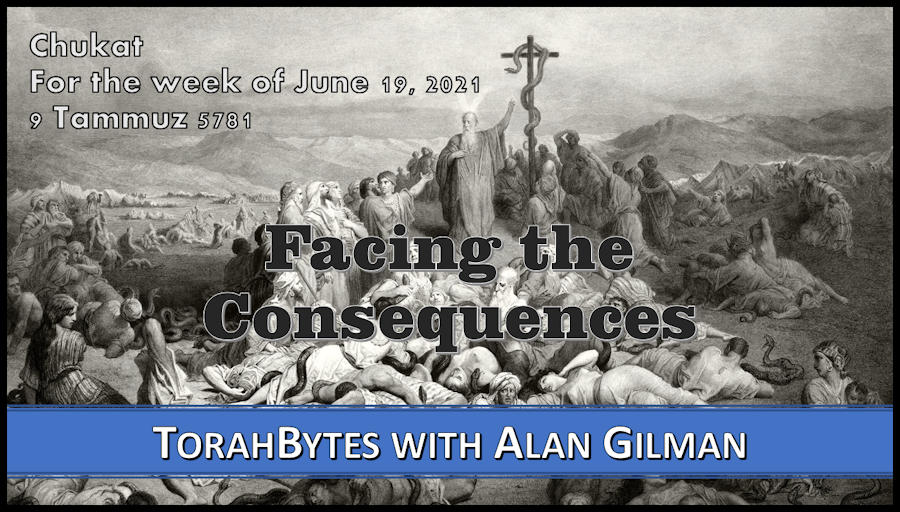
Facing the Consequences

For the week of June 19, 2021 / 9 Tammuz 5781

The Brazen Serpent by Gustave Dore

The Brazen Serpent by Gustave Dore

Chukat
Torah: B’midbar/Numbers 19:1 – 22:1
Haftarah: Shoftim/Judges 11:1-33

Download Audio [Right click link to download]

And the LORD said to Moses, “Make a fiery serpent and set it on a pole, and everyone who is bitten, when he sees it, shall live.” So Moses made a bronze serpent and set it on a pole. And if a serpent bit anyone, he would look at the bronze serpent and live. (B’midbar/Numbers 21:8-9)

I have always wondered about this story. It begins with the people of Israel yet again venting their frustration with their ongoing challenging situation. We read, “From Mount Hor they set out by the way to the Red Sea, to go around the land of Edom. And the people became impatient on the way. And the people spoke against God and against Moses, “Why have you brought us up out of Egypt to die in the wilderness? For there is no food and no water, and we loathe this worthless food” (B’midbar/Numbers 21:4-5). As I have said before, I don’t criticize them for their mishandling such situations. Nothing I have ever gone through comes close to Israel’s years in the wilderness. They shouldn’t have taken out their frustration on God and Moses, but I personally can’t fault them for doing so. I have to be careful, however, not to let my empathy for the people’s suffering get in the way of whatever lesson I need to learn from this affair.

The result of their faithless behavior was God’s sending among them “fiery serpents,” most likely very painful poisonous snakes. It didn’t take too long for the people to admit to their erroneous ways and plead with Moses to pray on their behalf for relief. God’s solution was unique in Israel’s history. He directed Moses to construct a bronze serpent on a pole. If anyone who was bitten looked at the bronze serpent, they would be healed.

That such an item would be sanctioned by God for such a purpose is very strange given the strong prohibition against idols. In fact, this item eventually did become an idol (for more on that, see the TorahBytes message, When Blessings Become Idols. As for its God-sanctioned purpose in the moment, it became a tool of faith. Certainly, the power of the healing came from God. It was the submitting to his directions in the situation that made the difference here.

But did the object itself contribute at all to the experience of healing? It might sound spiritual to say that God could have told Moses to make anything or even nothing. That might be true, but I wouldn’t assume that God’s instructions were arbitrary. It certainly doesn’t seem they are. People are bit by snakes; they have to look at a snake. Coincidence? I think not!

Since the text doesn’t clearly state the reason for the bronze serpent on a pole, we need to tread carefully. What is clear is the association between the instrument of punishment and the instrument of healing. Yet, it’s that connection which I have always found strange. How could it be that the object which was the source of pain could end up being the source of healing?

I think I’ve got it! Calling the Israelites to gaze upon the source of their pain forced them to acknowledge the consequences of their actions, and the result was healing. Not to take away anything from the supernatural dynamic of this, but isn’t this the way life works? How much personal suffering do we prolong because we refuse to accept the negative consequences of our wrongs? Conversely, how many of us have experienced the freedom that is derived from facing those consequences. While God is the agent of healing, true repentance requires we accept responsibility for our behavior.

As you may be aware, Yeshua used this story in his conversation with the Jewish leader Nicodemus to point to himself, when he said: “And as Moses lifted up the serpent in the wilderness, so must the Son of Man be lifted up, that whoever believes in him may have eternal life” (John 3:14-15). To gaze upon the crucified Messiah is to see the consequences of our sins. It is when we realize that our attitudes and behavior resulted in the horrific suffering of the Son of God, that we can be healed from the consequences of our actions.

All scriptures, English Standard Version (ESV) of the BibleFacebooktwitterredditpinterestlinkedinmail

Blind Jealousy

For the week of June 12, 2021 / 2 Tammuz 5781

Young man with blindfold over eyes

Korach
Torah: B’midbar/Numbers 16:1 – 18:32
Haftarah: 1 Samuel 20:18-42
Originally posted the week of June 24, 2017 / 30 Sivan 5777

Download Audio [Right click link to download]

They assembled themselves together against Moses and against Aaron and said to them, “You have gone too far! For all in the congregation are holy, every one of them, and the LORD is among them. Why then do you exalt yourselves above the assembly of the LORD?” (B’midbar/Numbers 16:3)

Jealousy is blinding. I don’t mean the appropriate kind of jealousy that refuses to allow others to get in the way of your marriage, for example. That’s the jealousy God has for his people. I am talking about the all-consuming emotion that takes us over when someone else has what we think we should have.

That’s what was controlling Korah and company. They couldn’t handle seeing Moses and his brother Aaron being in leadership. And it’s not as if they were at the bottom of the ladder themselves. They were Levites, the tribe of Israel that was set aside to serve in the Mishkan (English: Tabernacle). Being special was not special enough, however, as they set their eyes on the priesthood itself.

I don’t know if they thought they would have more perks or prestige by being priests. We aren’t told. But it doesn’t matter. That’s just how jealousy works. The thought they were missing out was enough to drive them. They had to have what was not allotted to them or least what they thought they were missing out on. Jealousy can’t see the true nature of whatever it is jealous of. It’s always the perceived privilege or status that is passionately desired. It’s so easy to look at the exterior of other people’s lives and think they have it better than we do. Status and prestige are not all they appear to be. With privilege, if privilege comes into play at all, comes responsibility.

When jealousy fills us, we can’t see that roles and responsibilities are allotted to people from God. That may sound overly spiritual and idealistic, especially in a world where injustice abounds. This is not the case in Korah’s story. Based on divine inspiration we know Korah is not ultimately challenging Moses and Aaron but God. But what about it when it is you and me? How do we know when our place and position are due to God’s direct involvement or the machinations of other forces?

It depends how much in control you think God is. On second thought, it doesn’t matter what you (or I) think, what’s the truth? Is God only involved with some people sometimes, or with everyone all the time? While not speaking directly to the issue of allotted roles, these words from the New Covenant book of Hebrews are applicable:

Keep your life free from love of money, and be content with what you have, for he has said, “I will never leave you nor forsake you.” So we can confidently say, “The Lord is my helper; I will not fear; what can man do to me?” (Hebrews 13:5-6)

The writer encourages his readers (and us by extension) to be materially content on the basis of the intimate presence of God. This is not a pseudo-spiritual directive to disconnect emotionally from reality. This reminds us the Messiah follower can be confident that God is personally involved in his life. We are assured therefore that whatever is happening to us is not outside of God’s direct control.

That doesn’t mean we should never pursue change. Far from it! As emissaries of the Kingdom of Heaven there are no greater change agents in the world. But when things don’t go the way we expect; when we feel passed by while others are placed in positions we think we deserve, we must avoid jealously at all costs. Instead we should continue to commit our lives to God, looking to him to work things out according to his will.

All scriptures, English Standard Version (ESV) of the BibleFacebooktwitterredditpinterestlinkedinmail