Divine Interruptions

For the week of March 12, 2016 / 2 Adar II 5776

Divine Interruptions

Pekudei
Torah: Shemot/Exodus 38:21-40:38
Haftarah 1 Melachim/1 Kings 7:40-50

Then the cloud covered the tent of meeting, and the glory of the LORD filled the tabernacle. And Moses was not able to enter the tent of meeting because the cloud settled on it, and the glory of the LORD filled the tabernacle. (Shemot/Exodus 40:34-35)

Who likes interruptions! We live in a busy world. Places to go; things to do. But interruptions are a fact of life these days especially. Phone calls, text messages, tweets, emails all vie for our attention. Already while I have been writing this message I have been interrupted by a text and a phone call. I know I could probably do a better job at resisting the buzzes and bells of these attention grabbers, but you know how it is.

Some people are better than others at not being interrupted. They are very focused individuals that are so keenly aware of their responsibilities that nothing will get in the way of their goals.

Hold on, my daughter is texting me.

Okay, I’m back. Where was I? Oh yeah, focused individuals—

Focused individuals can be so good at resisting interruption that they might actually be missing what God is trying to do in their lives. You might wonder how that could be possible. If God is God, then how can he be resisted? We’ll get to that in a minute.

In this week’s Torah portion, Moses is interrupted by God. After completing the building and setup of the Mishkan (English: Tabernacle), we read that the glory of God filled it in such a way that it prevented Moses from going into the special tent where he normally met with God. That means that this tangible manifestation of God kept Moses from doing his regular God duties.

I imagine most people reading this would consider it amazingly wonderful that God’s presence would be among people in such a spectacular, awesome way. But that’s the perspective of an objective reader. It’s another thing when you are in the middle of it. In Moses’s case, he may not have had much of a choice, but how about when God interrupts our lives in other not-so-obvious ways? When great unexpected events happen to us—the kind that have the potential to completely change the course of our lives, what then? I am not saying that every such event is a divine interruption, but I wonder how much we might be missing—or worse—resisting.

The greatest divine interruption in history was the coming of the Messiah Yeshua. The Jewish people had been prepped by God for centuries for his arrival. By the time he came, messianic expectation in Israel was at a fever pitch. As he began to teach and perform signs and wonders, crowds of people began to wonder if he might indeed be the One. The leadership was hesitant, just as established leadership tends to be. But then most of the leadership became more than hesitant. They became outright resistant; hostile, in fact. Even though they were the ones who had taught the people about the Messiah in the first place, he was interrupting their lives by not doing things exactly as they expected. They had successfully built a community of survival within a very oppressive society and were legitimately afraid that change would undermine their rule. Therefore, interruptions could not be tolerated. They may not have been conscious of how much their insistence on staying on course blinded them to God, so that most of them failed to see that the Messiah was in their midst.

This should be a great warning to us all. These leaders, for the most part, were acting out of a good motive as they sought to fulfill their God-given responsibilities. But if experts and keeners out of their earnestness could resist a divine interruption, how much more we? Do we think that we are not susceptible to being so focused on our agendas, our plans, and our ways of doing things, that we wouldn’t ever push God away when he shows up?

This is not to say that every interruption in our lives is from God and should be wholeheartedly embraced. But let’s be careful that in our desire to stay focused we don’t miss how God might be trying to get through to us.

All scriptures, English Standard Version (ESV) of the Bible

Facebooktwitterredditpinterestlinkedinmail

Toward a Biblical Understanding of Fund Raising

For the week of March 5, 2016 / 25 Adar 5776

Fundraising puzzle piece

Va-Yakhel & Shekalim
Torah: Shemot/Exodus 35:1 – 38:20; 30:11-16
Haftarah: 2 Kings 12:1-17

Download Audio [Right click link to download]

Moses said to all the congregation of the people of Israel, “This is the thing that the LORD has commanded. Take from among you a contribution to the LORD. Whoever is of a generous heart, let him bring the LORD’s contribution…” (Shemot/Exodus 35:4-5)

I was brought up with an unhealthy relationship to money. It was the subject that my parents seemed to constantly bicker about. My father taught me that “money made the world go round,” something he firmly believed. As I grew up I regularly was told that we couldn’t do this and we couldn’t do that, because of the money. Not long after my parents divorced in my mid-teens, my mother and I were on welfare. We had a nice enough place to live and we didn’t starve, but the thought of not having enough was always with us, and it got to me. Our poverty was likely a key aspect in the panic attacks that eventually led me to know Yeshua.

Coming to know God and reading the Bible radically transformed my thinking in many areas, including money. The most mind-blowing concept was that I was no longer alone with regard to material provision. According to Yeshua, I had a Heavenly Father who was committed to taking care of my needs (see Matthew 6:25-34). So instead of every future hope of mine being stamped with a big and bold red “CAN’T” on it, I had a funding resource beyond my wildest dreams. I am not saying that I expected God to give me whatever I wanted, but as I have sought him for everything from education to marriage (which would eventually include 10 kids!), houses, cars, travel, and so on, he has provided for me and my family in so many surprising ways.

I am so grateful that the first community of believers I was involved with after coming to faith highly valued the Messiah’s teaching on God’s provision. Unlike some groups, their understanding regarding the relationship between faith and finances led them to rarely, if ever, talk about money. The idea was that since God promised to provide for our needs, then it would be dishonoring to him to ask people to give. This approach was firmly rooted in people such as George Müller, who was famous for founding orphanages and schools in England in the 19th century. As far we know, Müller never made a private or public request for funds, except to God alone in prayer. His story and the example of my community at the time led me to believe that this was the only way to be a genuine person of faith. To ask anyone for money was regarded as putting my trust in people, not God, thus undermining Yeshua’s teaching on God’s generosity toward his children.

As I mentioned, I have innumerable examples of God’s provision, but my commitment to keep my needs to myself at times became more than I could handle. Years ago, we sought to establish a ministry. We were affiliated with a group of believers but were basically on our own in terms of support. When little by way of finances came in, I had a difficult time of it. I regret to say that this was one of the factors for leaving the work I was doing. Based on my conviction, I concluded that I was at fault for not trusting God.

That was about twenty-four years ago. When I considered stepping back into fulltime Bible teaching ministry in 2012, I wondered how I was going to handle the trust factor. It’s only been since then that I have been challenged to rethink how fund raising is supposed to work. It has taken a long time to accept that the George Müller method was not actually biblical after all. The Bible doesn’t teach it’s wrong to ask for money. Look at this week’s Torah portion, for example. God instructed Moses to ask for contributions for the building of the Mishkan (English: Tabernacle). While there are right and wrong ways to raise funds, being open and honest about the need to fund ministry is godly.

I have come to realize that my difficulty with asking people to fund my ministry is not derived from the Bible, but rather due to deep-seated values that I somehow inherited that makes me feel ashamed for being a “charity case.” But why should it be acceptable to trade money for temporal goods, but shameful to invite people to invest in something that will bring eternal benefits? People fund all sorts of legitimate (and not-so legitimate) activities. What’s wrong with funding the work of God’s Kingdom? We have no problem with someone hawking their wares at the side of the road. Why then are we put out when someone makes a request raise money for ministry? You can always say, “No.”

All scriptures, English Standard Version (ESV) of the Bible

Facebooktwitterredditpinterestlinkedinmail

Flip Flop

For the week of February 27, 2016 / 18 Adar 5776

Yes, no, maybe, etc. word cloud

Ki Tissa
Torah: Shemot/Exodus 30:11 – 34:35
Haftarah: 1 Melachim/1 Kings 18:1-39

Download Audio [Right click link to download]

And Elijah came near to all the people and said, “How long will you go limping between two different opinions? If the LORD is God, follow him; but if Baal, then follow him.” And the people did not answer him a word. (1 Melachim/1 Kings 18:21)

This week’s Haftarah (selection from the Prophets) was likely chosen because of the Torah’s reference to the sin of the golden calf when Israel became impatient waiting for Moses to return from meeting with God on Mt. Sinai. While he was in the presence of God receiving revelation for the nation, they were worshiping cow statues in God’s name.

The idolatrous situation in Elijah’s day was different. While there may have been elements of syncretism (the blending of true and false spiritualities) as in the earlier episode, the latter situation was one in which the people flipped flopped from faith in the Lord to Baal and back again as they desired. In this case, there was no confusion as to the identity of these two deities (or supposed deity as in the case of Baal) or the requirements each demanded. When and why one or the other would be approached would have depended upon the particular needs of the person at the given time.

Elijah challenged the people to stop flip-flopping. Note that he didn’t appeal to culture, preferences, or benefits. He didn’t even use the appeal most common in Scripture, that of the Lord’s deliverance from Egypt. Instead, he urged them to follow the one who is truly God. He left no room for syncretism. It was either one or the other, not both. The people’s reaction at the end of the story, after seeing which of the two responded in power, agrees with Elijah’s exclusive view of God. Only one divine being can be supreme, and therefore, only one God should be served. Whatever the other represented, real or not, had no claim on the people’s loyalty.

Israel had been experiencing a drought for three years ever since Elijah said it would be so. Since the Lord didn’t send the rain (or was blamed for holding it back), Baal, the storm god, was their next best choice for help. The people’s silence in the face of Elijah’s challenge exposes their uncertainty. That a god of power existed they had no doubt. But who was the true and only God? Of that they were so unsure, they didn’t know what to say. Their inability to discern spiritual truth had left them shifting back and forth between allegiances.

The difficulty in relating a story like this to our day is that we don’t tend to give our false gods personal names, such as Baal. But just because we don’t have personal names for education, money, technology, health, religion, sex, power, and fame doesn’t mean we don’t flip flop back and forth between relying on these lesser powers and the only true God. These and other areas of life are tools, not gods. But when we serve them instead of the Master of the Universe, we become enslaved to them. Then when we try to retain a right relationship to the Master of the Universe we become more and more confused, not knowing what to say when we are confronted on our duplicity.

The only way to stop flip-flopping is to stop. We need to remember that every aspect of life is under God’s rule. Whatever your need is, whatever your situation, the God of Elijah, the Father of our Messiah Yeshua is supreme. Don’t give yourself to lesser powers anymore, but rather submit to the one and only God. Don’t let impatience drive you to give yourself over to lesser powers. He will come through for you in time.

All scriptures, English Standard Version (ESV) of the Bible

Facebooktwitterredditpinterestlinkedinmail

Putting It On

For the week of February 20, 2016 / 11 Adar 5776

Formal attire

My wife, Robin, and I at the wedding of one of sons , September 2013.

Torah: Exodus 27:20 – 30:10
Haftarah: Ezekiel 43:10-27
Revised version originally posted March 7, 2009 / 11 Adar 5769

Download Audio [Right click link to download]

And you shall make holy garments for Aaron your brother, for glory and for beauty. (Shemot/Exodus 28:2)

A few years ago my wife and I were treated to a two-night getaway at a lovely manor in the country. Their high-quality restaurant had a dress code for evening meals. I find it interesting how the putting on of nice clothes makes such a difference in how we feel about ourselves and our surroundings, as well as in how others relate to us.

I had a friend who was a taxi driver. The company he worked for didn’t impose particular dress standards, but when he started wearing suits; his customers began to treat him differently, calling him “Sir,” for example.

I don’t think that the wearing of nice clothes made my wife and I or my friend different people. Wearing nice clothes or a uniform doesn’t transform a person into something he or she is not. At the same time how we present ourselves does communicate something about ourselves. It could be anything from our economic situation, the people group to which we belong, our likes and preferences, or our desires and intentions. Of course it is possible that what we wear may not be consistent with who we really are. If I wore a police uniform in public, I would be giving the false impression that I was a police officer. On the other hand, when a police officer wears a uniform, it not only communicates to others his authority, but reminds him to behave accordingly.

In the days of the Mishkan and the Temple, the priests were required to wear special clothing whenever they performed their duties. To fail to do so would have resulted in dire consequences. It is not as if they were priests on the basis of their clothing. Not wearing their priestly garments would not make them less of who they were. Still, their clothing was a necessary part of their performing their priestly duties. Priests not only played a special role in the community, they had to look the part as well. They physically and mentally could have performed their duties in regular clothing, but they could not truly represent their position if they didn’t take the time to put on their special ones.

One of the contrasts between the Old and New Covenants is a shift of focus from things external to things internal. Under both covenants what God is seeking to communicate both to and through us is very much the same, but how he does so is quite different. With the coming of the Messiah and the loss of the Levitical priesthood due to the destruction of the Temple, the external elements of worship and service to God have been internalized in those who trust and follow the Messiah. What was at one time necessary through things such as clothing and other objects is now experienced in and through the living out of our day-to-day lives.

As the priests had to purposely put on special clothing to fulfill their special role in the world, so we too must do the same, figuratively speaking. We are to purposely apply the elements of a godly lifestyle to our behavior (see Colossians 3:1-17). While it is not our deeds that make us God’s children, godly living requires decisive, purposeful activity.

At times purposely putting on godly behavior can feel as if we are play acting – more like a costume than a uniform. Being kind, generous, disciplined, merciful, and so on, may not seem natural to us. But we shouldn’t think that just because we possess the inner reality of God’s presence in our lives that godly behavior will automatically spring forth without our cooperation. Similar to dressing up to eat in a fancy restaurant, things we have never or rarely done can feel quite strange. But once we realize that we, like the priests of old, have a special place in the world, then it shouldn’t surprise us to learn that it requires our putting on special behavior.

All scriptures, English Standard Version (ESV) of the Bible

Facebooktwitterredditpinterestlinkedinmail

Sanctuary

For the week of February 13, 2016 / 4 Adar 5776

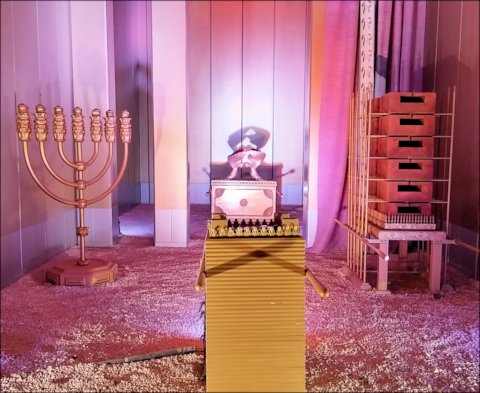
Mishkan (Tabernacle) Holy Place replica

Within the full-scale replica of the Mishkan at Hotel Eshel Hashomron, Ariel, Samaria. Photo: Alan Gilman

Terumah
Torah reading: Shemot/Exodus 25:1 – 27:19
Haftarah: 1 Melachim/Kings 5:26 – 6:13

Download Audio [Right click link to download]

And let them make me a sanctuary, that I may dwell in their midst. Exactly as I show you concerning the pattern of the tabernacle, and of all its furniture, so you shall make it. (Shemot/Exodus 35:8-9)

This week’s reading begins the instructions for the building of the Mishkan (English: Tabernacle). Mishkan means dwelling place, for this centrally located mobile complex was to signify the presence of God among the people of Israel. That it is described as a sanctuary in the selection I just read is probably not a surprise to most readers, since it is common even today to refer to a place of worship as such. But what does sanctuary mean?

I think when most people hear the word sanctuary, they immediately think of what Merriam-Webster’s dictionary lists as a common definition: “a place where someone or something is protected or given shelter.” A safe place in other words. Perhaps that is rooted in the custom of people finding protection from accusations and revenge by running to the Mishkan or later the Temple and holding the horns of the alter located there (see 1 Kings 1:50; 2:28). But shelter and protection were not central to the Mishkan’s purpose.

The Hebrew word for sanctuary here is “mikdash” which is derived from “kadash,” meaning to set apart or make holy. The Mishkan was to be a holy place, a structure designed to be set apart for God. Whatever might result from the Mishkan’s being a sanctuary, it is first and foremost God’s place. This is where God would be encountered, served, and from where his ways would be taught. It would be so, because God himself would be present. Therefore, a mikdash, a sanctuary, is where God’s presence dwells.

Where do we find sanctuary today? The Mishkan and Temple have long been destroyed. Millions of people gather at the Western Wall in Jerusalem to get as close as possible to the Temple’s location. For many this expresses a desire to be near to God’s presence. Synagogues and churches refer to their main meeting and prayer halls as sanctuaries, for it is in these locals that the community gathers to meet God in a special way, similar to the Mishkan and Temple. But he is in none of these places, at least not in the manifest way he was in ancient times.

That doesn’t mean that true sanctuary no longer exists. Far from it! Because of the coming of the Messiah, that which at one time dwelt within the confines of the Mishkan or the Temple is now present within his people both individually (see 1 Corinthians 3:17) and corporately (see 1 Corinthians 3:17).

If you truly know God through Yeshua the Messiah, you are God’s sanctuary. He who dwelt in the Mishkan of old now dwells in you. And if you are God’s sanctuary, his mikdash, then you are his holy place, set apart by him and for him. It is in and through you and others like you that he desires to manifest his presence and make himself known by his word and his power. The so-called sanctuaries of our houses of worship can be nothing of the kind unless filled with God’s faithful people. But when they are, they too become God’s true sanctuary.

It is time for Yeshua’s followers to realize our special function in the world. We don’t simply represent a far-off, detached Supreme Being that people need to know about. He has taken up residence in us, so that when people encounter us they should be encountering their Creator, Lord, Judge, and would-be Savior. We are the bridge through which God seeks to access a lost and confused world. We therefore must be diligent to prevent any barriers to form preventing people from seeing him in us. But please don’t ask God to take you out of the way, for it is you he has chosen through whom to make himself known.

All scriptures, English Standard Version (ESV) of the Bible

Facebooktwitterredditpinterestlinkedinmail

Practical Torah

For the week of February 6, 2016 / 27 Shevat 5776

Practical Torah

Mishpatim
Torah: Shemot/Exodus 21:1-24:18
Haftarah: Jeremiah 34:8-22; 33:25-26

Download Audio [Right click link to download]

Now these are the rules that you shall set before them (Shemot/Exodus 21:1)

Last week we looked at how the Ten Words (commonly known as the Ten Commandments) function as representative of the covenant God established with the people of Israel through Moses at Mount Sinai. Accepting them as eternal principles simply because they are the Ten Commandments or rejecting them as Old Testament relics fails to regard their covenantal function. With the coming of Yeshua and the inauguration of the New Covenant as promised by the prophet Jeremiah (see Jeremiah 31:31-33; compare Luke 22:20), the constitution of God’s people underwent a major transformation. That which was given on tablets of stone has been internalized as Jeremiah said (see 2 Corinthians 3:3). The life that God had called Israel to live was no longer something outside and out of reach, so to speak, but instead to be lived from the inside out. The alienation from God which had prevented Israel from living up to the Sinai covenantal demands was resolved once and for all by the forgiveness of sin brought about through Yeshua’s sacrificial death.

The main contrast between the Sinai and New Covenants, therefore, is found not primarily in their practical details, but in the constitutional arrangements within which the details are given. The older covenant provides for the organization of a national entity; the newer one enables for the inclusion of all nations without requiring specific membership in Israel. The great change in the sacrificial system from ongoing and temporal to final and permanent makes the older priestly function obsolete and thus allows believers to approach God directly.

But just because the covenantal foundations have changed, that doesn’t mean that every God-given directive through Moses is no longer relevant. For it is in the Torah thatwe encounter almost every aspect of life from God’s perspective. Discerning which elements of God’s teaching (for that’s what “torah” means) were for ancient Israel alone and which ones are for all people for all times can be a challenge, but a worthwhile and enriching one.

Through Torah we are reminded that relationship with God is not something detached from life’s practicalities. While abstract notions of love and forgiveness are essential, it is through the directives of Torah that the core of our faith is expressed in very practical ways. When reading the first section of this week’s Torah portion you might wonder if that is really true, however. The subject of slaves in the Bible is often used to demonstrate how backwards it is. But what we actually have here is God’s speaking into a world where slavery was taken for granted. The boundaries and regulations God established through Moses emphasizes the value of all human beings. This would have been radical for those days and sets the stage for its eventual abolishment. How’s that for being practical?

Our portion continues by addressing the subject of personal liability. We are privileged to be given God’s mind regarding common issues like these that people have faced throughout history. We neglect God’s word on these matters to our peril.

In another section in this week’s reading we see the consequences for certain types of social behavior, including premarital sex, bestiality, sorcery, as well as dealing with the vulnerable members of society: foreigners, widows, and orphans. As with the slavery section, modern readers might too quickly react to the prescribed consequences for certain behaviors rather than glean from God’s perspective. The determining of consequences is subject to the jurisdiction of civil leaders, which while regulated under Sinai for ancient Israel, is not expanded to the nations under the New Covenant. What we can derive from this is the destructive nature of the things addressed, so that they can be avoided among believers and discouraged within the cultures in which we find ourselves.

This is what Yeshua meant when he told his followers that they are “salt and light” (see Matthew 5:13-16). As the great Master Rabbi he expounded the teachings of Moses, so that they (and us!) can learn the practical details of Torah within a New Covenant framework.

All scriptures, English Standard Version (ESV) of the Bible

Facebooktwitterredditpinterestlinkedinmail

The Ten Words

For the week of January 30, 2016 / 20 Shevat 5776

TheTenWords01_480

Yitro
Torah: Shemot/Exodus 18:1 – 20:23
Haftarah: Isaiah 6:1-7:6, 9:5

Download Audio [Right click link to download]

And God spoke all these words, saying, “I am the LORD your God, who brought you out of the land of Egypt, out of the house of slavery. You shall have no other gods before me.” (Shemot/Exodus 20:1-3)

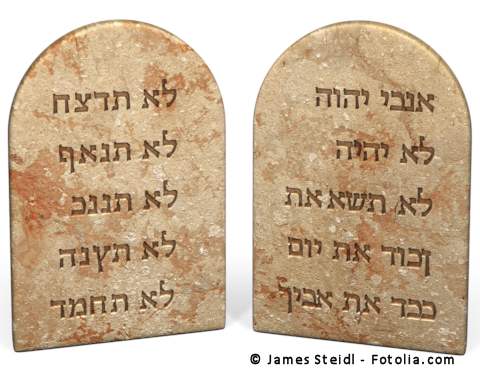
The Ten Commandments function in a most special way within holy scripture. You may not be aware that they are never actually called the “ten commandments,” but rather, eseret ha-devarim, “the Ten Words” (see Shemot/Exodus 34:28). Obviously the Hebrew is indicating that this is much more than a list of ten individual words. Rather they are ten unique divine utterances; unique in several ways.

First, the Ten Words were the only part of God’s revelation to Moses that was given in the direct hearing of the people (see Shemot/Exodus 20:18-21). It isn’t clear if they heard the actual words, but whatever they heard, they were so terrified, they never want to experience it again.

Second, of all that Moses received from God, only these Ten Words were written by God’s own finger. In fact, he did so twice, due to Moses destroying the first set in reaction to Israel’s rebellious activities while he was with God on the mountain (see Shemot/Exodus 31:18; 34:1).

The third and perhaps most important way the Ten Words are unique is that they, in particular, are called “the covenant” (see Shemot/Exodus 34:28). This would be why they were among the items that were placed inside the “aron ha-berit,” the Ark of the Covenant.

There was of course more to the covenant given at Mount Sinai than just the Ten Words. The Ten served to point the people to the details of the entire covenant. They weren’t necessarily more important than any other of God’s directives, but what they do is capture the essence of the whole covenant, while the rest of Torah elaborates on them. The Ten, then, especially as a collection, have an essential symbolic function in that they represent the whole Sinai covenant.

It is not biblically sound, therefore, to isolate or detach the Ten Words from the rest of Torah as if God gave these directives as universal principles, while everything else he revealed through Moses was for Israel alone. This is not to say that the Ten Words or anything else in Torah aren’t necessarily universal. It’s that it is not right to automatically consider them as universal just because they are the Ten Words.

Biblically speaking, the Ten Words first and foremost function as covenant, not moral principles. They (as much of the rest of Torah) are full of morality, but primarily they establish the basis and parameters of God’s relationship with ancient Israel. That is why the Ten Words begin with “I am the LORD your God, who brought you out of the land of Egypt, out of the house of slavery” (Shemot/Exodus 20:2). Israel was to obey God’s commands on the basis of their having been rescued from Egypt, something which no other nation can claim. Note that Israel’s salvation and relationship to God were established by God first before he gave them directions to live by. Biblical morality was never intended to be a pathway to God, but rather a response of God’s people to his love and faithfulness.

Living God’s way under the New Covenant is similar in that it too is a response to God’s salvation. This time not only as the nation of Israel who were in physical bondage to Egypt, but people of all nations who have been released from the greater bondage to sin and death through faith in the Messiah.

But as those who have a relationship with God through Yeshua, how do we live? While many have adopted the Ten Words as their moral code, others have rejected most, if not all, the commands given through Moses as being relevant today. Some claim that Yeshua replaced an older notion of hundreds of commands with only two (love God and love your neighbor) as if God is now lenient instead of strict. But that’s not what is going on here at all. Yeshua’s answer to the question concerning the greatest commandment (see Matthew 22:36-40) provides perspective and priority in relating to God. These two commands therefore serve as a summary of everything God calls us to.

But what does he call us to? Under the New Covenant, Torah, which was at one time written on tablets of stone, is now engraved upon our hearts (see Jeremiah 31:31-34; 2 Corinthians 3:3). That which was external has been internalized. This transformational change brought about by Yeshua’s death and resurrection allows us to live out the essential elements of God’s revelation through Moses including the Ten Words, but within a new covenantal arrangement. We will look at how this works out practically next week.

All scriptures, English Standard Version (ESV) of the Bible

Facebooktwitterredditpinterestlinkedinmail

Go Forward

For the week of January 23, 2016 / 13 Shevat 5776

GoForward01_600
Be-Shallah
Torah: Shemot/Exodus 13:17 – 17:16
Haftarah: Shoftim/Judges 4:4 – 5:31

Download Audio [Right click link to download]

The LORD said to Moses, “Why do you cry to me? Tell the people of Israel to go forward.” (Shemot/Exodus 14:15)

This week’s message is not for everyone. I guess that’s always true, but there’s something about this one in particular that probably should be ignored altogether if it doesn’t apply to you. But if it does, you don’t want to miss it! So, here we go…

The people of Israel were between a rock and a hard place, metaphorically speaking. They were actually between an impassible body of water and the Egyptian army keen on dragging them back to Egypt. An interesting interchange ensues between Moses and God. Well, actually, it’s not an interchange. The people freak out, thinking that they are about to be slaughtered, Moses reassures them, but then God tells Moses what to do, contradicting him in the process. Let’s look at this more closely.

Moses said to the people: “Fear not, stand firm, and see the salvation of the LORD, which he will work for you today. For the Egyptians whom you see today, you shall never see again. The LORD will fight for you, and you have only to be silent” (Shemot/Exodus 14:13-14). Based on everything Moses knew about God up to that moment – his character, his power, and his methodology – this sounds so right. Moses knew how fundamentally incorrect the people’s freak-out was. God didn’t bring them to this point only to abandon them now. Moses knew that he was leading them to Sinai and on to the Promised Land. So this couldn’t be the end. How God would rescue them he didn’t know, but after all that had happened with the ten plagues and a reasonable analysis of the situation, Moses assumed that all Israel had to do was to do nothing, except stand. God would take care of the situation all by himself.

But with all due respect to Moses, he was wrong. They were not just to stand there; they were to “go forward.” I know Moses was also told: “Lift up your staff, and stretch out your hand over the sea and divide it, that the people of Israel may go through the sea on dry ground” (Shemot/Exodus 14:16), but the people were not to wait for the sea to part first, but rather begin to march toward the sea.

God was calling the people to readjust their orientation to the situation. He had called them to journey in a certain direction, which required getting to the other side of the water. But instead they were frozen by their fears. They needed to refocus and get with God’s program again.

Note that God was not calling them into the water before it parted. He might call people to do that from time to time, but not in this case. They simply had to move in its direction. He also didn’t order them to turn around and confront the enemy nipping at their heels. The day would come when Israel would engage in battle, but not now. In this situation they had to go forward.

I remember a situation I was in where I was called to go forward. It was nothing as drastic as what the Israelites were facing here, but for me at the time the dynamic was similar. I was at a large leaders’ conference, a pretty intense time of seeking God for wisdom and blessing. I was privileged to be part of the core group tasked with discerning the direction for the various meetings. I was new to such things and probably a little too excited about it all. In one of the core group meetings, I felt a real burden over something, but once I finally had a chance to speak out, I got the impression (right or wrong) that I was really out of line. I felt absolutely terrible and embarrassed. I went to my room, not wanting to show my face in public again (I am being only a little overdramatic!). As I called out to the Lord in my fear and confusion, I had the clear sense that I needed to go forward. That meant joining the others to face whatever might happen, whatever others might think of me, whatever reprimand I might receive, whatever. I had no guaranty of how God would deal with the scary elements ahead of me. I simply had to face them. And as I did, nothing I feared came to pass. My sea had parted.

Some of you reading this need to go forward. You need to walk right towards the very thing that you think will be your complete undoing. But as you do, God will enable you to walk right through it as if it is not really there, just like the Israelites walked through on dry ground. Perhaps he will even obliterate the threat at your back at the same time, just like the Egyptians who drowned when the waters receded.

But as I mentioned at the start, this is only for those for whom it is for. God may have a different tactic for you to follow. Maybe you are to stand, to fight, or something else. Only don’t be surprised if God is telling you to go forward.

All scriptures, English Standard Version (ESV) of the Bible

Facebooktwitterredditpinterestlinkedinmail

Blessed Rejection

For the week of January 16, 2016 / 6 Shevat 5776

Isolated man pushing copy space

Bo
Torah: Shemot/Exodus 10:1 – 13:16
Haftarah: Jeremiah 46:13-28

Download Audio [Right click link to download]

The Egyptians were urgent with the people to send them out of the land in haste. For they said, “We shall all be dead.” (Shemot/Exodus 12:33)

Last week we looked at how God used drastic measures to secure his people’s freedom in Egypt (Love in Action). Because of his love for his people he did what was necessary to break the power of oppression. When the story of the exodus is recounted, we normally hear about God’s sending of Moses, Pharaoh’s stubborn refusal to let the people go, and the ten plagues. We remember how Pharaoh finally gives in to God’s demands, but later changes his mind again. However, when his army catches up to the Israelites at the Red Sea, God causes it to part, allowing the people to cross, then drowns the Egyptians. Once on the other side, the people of Israel are finally free to begin the next chapter in their history.

There is an essential aspect of the process of Israel’s deliverance that is often overlooked. It’s a part played by the Egyptian people in reaction to the tenth plague, the killing of the firstborn. We don’t read much up to that point about the common Egyptian. The focus is on God, Moses, his brother Aaron, and Pharaoh. We also read a bit about Egyptian and Jewish leadership. But something crucial happens with the Egyptian people themselves after the tenth plague that may have made all the difference in Israel’s departure. The final plague freaked them out. I don’t blame them. After witnessing the death of the firstborn, if Israel didn’t leave, what could be next other than complete national extermination!

We might wonder why it took the common folks until now to urge the Israelites to leave. Hadn’t they already greatly suffered under the other plagues? Yet it’s reasonable to assume that to have said or done anything with regard to Israel’s liberation would have been illegal until Pharaoh gave his permission. Once he did, and death had visited every Egyptian home, the people pushed them out of the land in haste. Every year we eat matza (English: unleavened bread) to commemorate this very aspect of the story (Shemot/Exodus 12:34,39).

But why was the Egyptians’ urging of the people essential? Didn’t Pharaoh possess supreme power over Egypt? Once the Israelites were told they could go, that should have been it, right? While I am aware we can’t know what would have happened, we do know that after they left, Pharaoh changed his mind again, sending his army to bring them back. Is it not possible that if the Israelites would have hesitated, they may not have been able to leave after all? Also, it’s no small thing for two million people to get up and go after being so entrenched in a society. Individual Egyptians may have wanted to retain their slaves. And the Israelites, once certain that their freedom was secured, may not have felt the need to rush. It may not have occurred to them that Pharaoh would have reneged again on his word and prevented them from leaving. In addition, life in Egypt was not bad in every way. Later, during their travels in the wilderness, they pined after Egypt, saying “We remember the fish we ate in Egypt that cost nothing, the cucumbers, the melons, the leeks, the onions, and the garlic” (Bemidbar/Numbers 11:5). Egypt was difficult, but it was not as if the wilderness was easy. Both experiences had their positives and negatives. People will put up with a lot if their basic needs are met, even giving up personal freedom and comfort for a sense of security. So without the Egyptians urging them to leave quickly, the Israelites may have stayed.

The theme of liberty that emerges from the story of the exodus is easily romanticized: visions of people singing and dancing with big smiles on their faces as they journey into the horizon. But the exodus is no fairy tale. True freedom is an adventure into the unknown, often fraught with great danger. Freedom in God is a journey of trusting the Unseen One, where we must give up relying on those things we have grown accustomed to, including ourselves and others. That is why God knows that without a push we often prefer whatever oppression we may be in bondage to. That push may arise from within us, as the struggles of life take us to the end of ourselves, but it may also come from elsewhere as it did for the Israelites in Egypt.

When the push comes from others, it can be painful and confusing. It can take years to realize the blessing of rejection. Doors slammed in our faces, friends turning us away, opportunities that never materialized. It would be easy if we could simply get directions from God and follow them. But God knows that we are easily fooled by the false security of our oppressive situations and our natural fear of the great unknown. So he gives us a push, because he loves us too much to leave us where we are.

All scriptures, English Standard Version (ESV) of the Bible

Facebooktwitterredditpinterestlinkedinmail

Love in Action

For the week of January 9, 2016 / 28 Tevet 5776

LoveInAction01_480

Va-Era
Torah: Shemot/Exodus 6:2 – 9:35
Haftarah: Ezekiel 28:25 – 29:21

Download Audio [Right click link to download]

Say therefore to the people of Israel, “I am the LORD, and I will bring you out from under the burdens of the Egyptians, and I will deliver you from slavery to them, and I will redeem you with an outstretched arm and with great acts of judgment.” (Shemot/Exodus 6:6)

Love is core to Holy Scripture. The Torah commands the people of Israel to love God with everything they’ve got (see Devarim/Deuteronomy 6:5) and others like oneself (see Vayikra/Leviticus 19:18). Messiah was clear that these particular commandments are the greatest of them all (see Matthew 22:36-40). Love is so key that God himself is defined by it (see 1 John 4:8).

But none of this means anything unless we know what love actually is. Most commonly the term love is used as code for having romantic feelings. “I love you” means “I want you.” It’s not exclusively used that way, of course. Parents, children, and siblings may love one another, but it would be an interesting exercise to see if people could tell you what love really means to them in those contexts.

Irrespective of what people mean by it, the biblical call to love is a call to give of oneself to another. To love within a marriage, or any other sort of relationship, should be about giving not getting. What is given, if it is true sincere love, is to be based on what is best for the other person. Once we understand that, then it’s easier to understand the concept of tough love, doing what is necessary for another, not perhaps what they would prefer. Disciplining a child or refusing to fuel a spouse’s addiction are examples of that. Similarly, in our relationship with God, we shouldn’t misinterpret hardships as something other than his love, for it is through difficulties we become better people (see Hebrews 12:7-11).

Sometimes true love within a relationship is expressed through actions outside that relationship. Loving the poor and the oppressed can and should include direct relief to such persons, but may also require confronting the societal structures causing the oppression. One of the greatest examples of God’s love, therefore, was the plagues of Egypt. The story of Israel’s rescue would have been a much nicer one, had God’s love been expressed solely through Moses’s word to Pharaoh to let the people go. However, Pharaoh’s stubborn refusal called for harsher action.

To grasp the fullness of the meaning of love, whether it be divine or human, we need to come to grips with the need for the kind of extreme measures that God himself utilized in order to alleviate his people’s suffering. Bullies – whether they be a ten-year-old child in the school yard, or oppressive regimes like ancient Egypt – cannot be effectively dealt with by niceness. After being given a reasonable amount of time to cease their destructive behavior, harsh action may be necessary. It is one thing to endure injustice ourselves for God’s sake, but to expect others, be it our own children or people groups, to suffer when we have the means to put an end to it, is to hate, not love, them.

How might you put love in action today?

All scriptures, English Standard Version (ESV) of the Bible

Facebooktwitterredditpinterestlinkedinmail